October 2026 Astronomy Events: A Night-by-Night Sky Guide
Ten nights define the month, from Saturn's brightest evening to a Moon-and-Pleiades pairing low in the northeast — here's when to step outside and what each one needs.

- Published
- ◷
- 6 min read
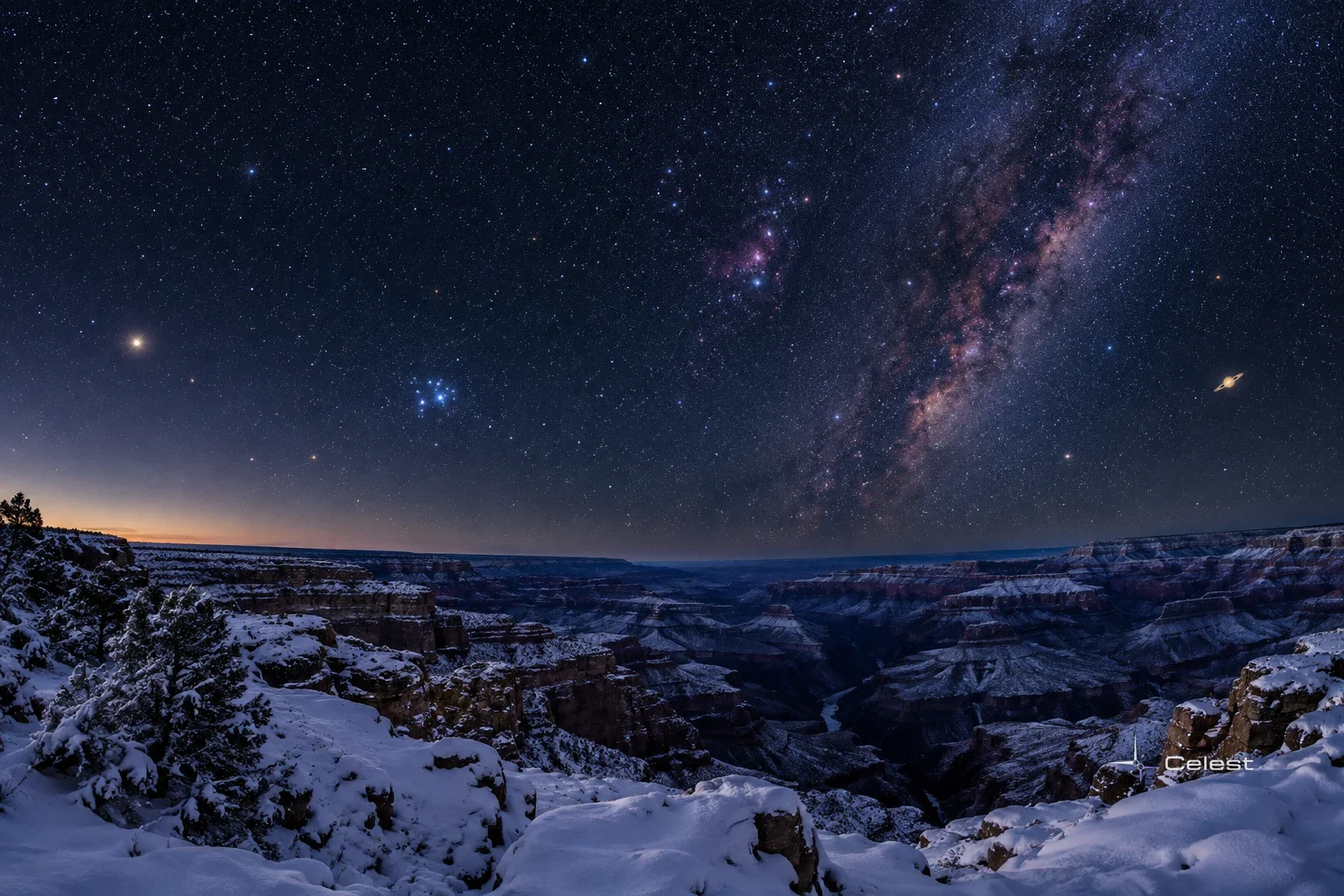
October 2026 opens with the month's single best planet night, then eases into a stretch where moonlight sets the pace. Saturn at opposition on October 4 needs nothing but a clear sky, and within days comes the month's darkest stretch. Check Celest's astronomy calendar to convert every UTC time below to your own clock.
None of this needs a telescope. Saturn's opposition and the Moon's phases are naked-eye events that suit a beginner with no gear at all, while the Draconids and Orionids reward patience and a dark sky. The Moon guide explains why the New Moon window on October 10 is this month's darkest sky.
October 2026 at a glance
Ten events shape October 2026, and Celest's visible planets guide can help you track Saturn beyond opposition night too.
- October 3, 2026 · Last Quarter Moon — half-lit Moon before sunrise, darker evenings begin.
- October 4, 2026 · Saturn at opposition — brightest and up all night (best night).
- October 6, 2026 · Moon occults Jupiter — the Moon passes directly in front of Jupiter, low in the east.
- October 8, 2026 · Draconids peak — an unpredictable evening shower under a nearly dark sky (best night).
- October 10, 2026 · New Moon — the month's darkest night, best for faint objects (best night).
- October 12, 2026 · Mercury at greatest evening elongation — the elusive planet's widest reach from the Sun.
- October 18, 2026 · First Quarter Moon — sharp crater shadows along the terminator.
- October 21, 2026 · Orionids peak — Halley's Comet debris streaking through Orion.
- October 26, 2026 · Full Moon — bright disc, washed-out faint stars.
- October 28, 2026 · Moon meets the Pleiades — a close pass low in the northeast.
Oct 1–4: Saturn's best night arrives
Oct 3: Last Quarter Moon
October 3, 2026's Last Quarter Moon is half illuminated and best seen before sunrise. With the Moon out of the evening sky, the nights leading into Saturn's opposition get noticeably darker — good timing for a first look at fainter stars.
Oct 4: Saturn at opposition
Saturn at opposition on October 4, 2026 puts the ringed planet directly opposite the Sun in Earth's sky, meaning it rises at sunset, stays up most of the night and reaches its highest point around midnight local time. This is the month's best Saturn night, rated Excellent.
At magnitude 0.2, Saturn is bright enough to find with the naked eye and rewarding through even a small telescope. Its rings and moons show real detail on a night like this one, without needing to wait for a dark sky first.
Oct 5–11: Draconids and the darkest sky
Oct 6: Moon occults Jupiter
On October 6, 2026, the Moon occults Jupiter — passing directly in front of the planet as seen from some locations. The pair sits low, only 6° above the eastern horizon, separated by just 0.11° at closest approach.
Whether the occultation itself is visible, rather than just a close pairing, depends on exactly where you're standing. Treat this one as a low-horizon challenge rather than a sure thing.
Oct 8: Draconids peak
The Draconids peak on October 8, 2026, with the shower's peak centered on 01:00 UTC that night. It's an unusual meteor shower best watched in the evening rather than after midnight, with its radiant — the point the meteors appear to stream from — sitting 61° up toward the northwest.
The shower favors the Northern Hemisphere and stays active from October 6 through October 10. It's rated Excellent this year and is known for variable output that can occasionally include brief outbursts. Check Celest's meteor shower guide for help finding the radiant before you head outside.
Oct 10: New Moon
New Moon arrives on October 10, 2026, handing the month its darkest sky. With no moonlight to wash things out, this is the best window for faint galaxies, nebulae and meteors alike, and it lasts all night.
Oct 12–18: Mercury's tricky window
Oct 12: Mercury at greatest evening elongation
Mercury reaches greatest evening elongation on October 12, 2026, standing 25.2° from the Sun at magnitude −0.1 — its widest separation and one of its better evening windows. The catch: this one is rated Difficult, so a low, unobstructed western horizon right after sunset matters more than usual.
Oct 18: First Quarter Moon
First Quarter Moon falls on October 18, 2026, half illuminated and best viewed in the evening. Long shadows along the terminator — the line between lunar day and night — throw craters and mountain ranges into sharp relief.
Oct 19–26: Orionids peak in moonlight
Oct 21: Orionids peak
The Orionids peak on October 21, 2026, made of debris shed long ago by Halley's Comet. The shower's radiant climbs 66° up toward the south, best watched after midnight, and it's visible from both hemispheres.
This year it's rated only Fair, largely because a Moon just past First Quarter brightens the sky and hides the fainter meteors. The shower stays active into November, so a later, darker night is worth trying too.
Oct 26: Full Moon
Full Moon lands on October 26, 2026, illuminating the entire lunar disc and making surface rays easy to trace. It's a naked-eye spectacle on its own, but the bright sky it creates washes out faint stars for several nights on either side.
Oct 27–31: Moon meets the Pleiades
Oct 28: Moon meets the Pleiades
On October 28, 2026, the Moon passes beside the Pleiades star cluster, closing to just 0.13° separation. The pairing sits low, only 2° above the northeastern horizon, so a clear, unobstructed view in that direction matters.
Binoculars sharpen the view considerably, turning a naked-eye pairing into a small field packed with stars.
Moonlight, dark windows and a plan for the month
The Moon's phases set the rhythm of October 2026: darker evenings begin after the October 3 Last Quarter, bottom out at the October 10 New Moon, sharpen for evening viewing by October 18, and brighten fully by the October 26 Full Moon.
That puts the strongest dark window roughly between October 8 and October 14, right where the Draconids and New Moon fall, while the Orionids on October 21 and the Pleiades pairing on October 28 both compete with a brighter sky.
Check Celest's observing conditions for clouds before committing to any one night, and use the light-pollution map to find a darker spot nearby.
A few nights are worth marking ahead of time:
- Oct 4 around midnight: Watch Saturn at opposition — no equipment needed, magnitude 0.2, up most of the night.
- Oct 8 in the evening: Face northwest for the Draconids, under a nearly New Moon sky.
- Oct 10: Save this date for the faintest targets — the month's darkest sky.
- Oct 12 right after sunset: Give Mercury a clear, low western horizon; it's a difficult catch.
- Oct 28: Bring binoculars and look low in the northeast for the Moon and Pleiades together.
None of these nights demands a trip anywhere special, but the ones low on the horizon — Jupiter on the 6th, the Pleiades on the 28th — reward whoever finds the clearest, flattest view of that part of the sky.
Sources
The facts in this article are based on the sources below. How we work: editorial policy.
Leave a comment
Comments appear after moderation.