Orionid Meteor Shower 2026: Peak Night and How to Watch
A beginner's plan for the year's Halley's Comet shower: no telescope needed, just a dark patch of sky and patience after midnight.

- Published
- ◷
- 4 min read
In the Celest calendar: Orionids Meteor Shower →
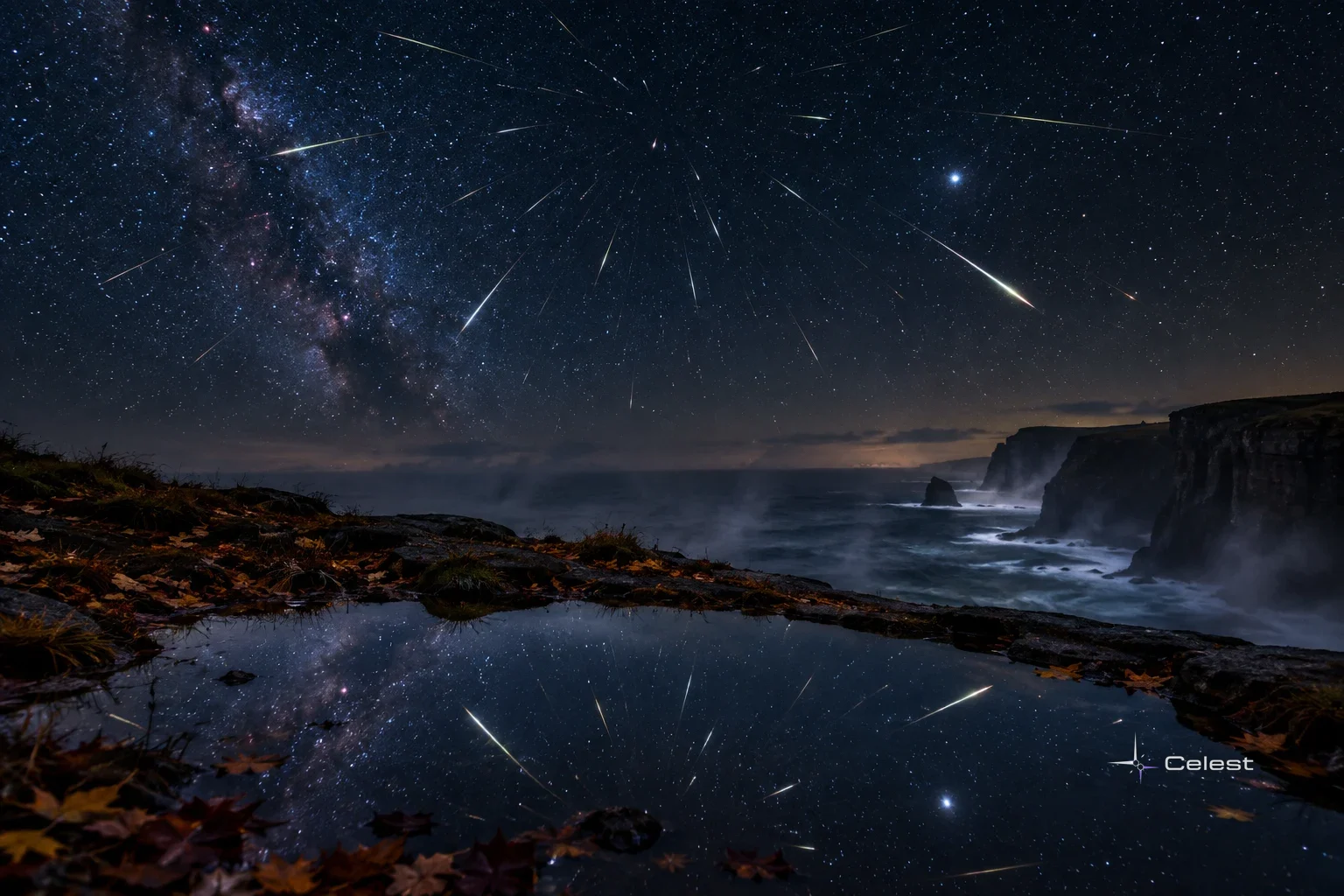
The Orionid meteor shower peaks on the night of October 21, 2026, according to Celest's astronomy calendar, with the best viewing after midnight from both the Northern and Southern Hemisphere. Under a dark sky you might catch a swift meteor every couple of minutes — a steady trickle, not a storm, but worth losing some sleep over.
Moonlight is the wildcard this year. Check the Moon guide before you commit to an all-night session, since a bright Moon near peak night can cut what you actually see by half or more.
The quick plan
Here's what to know before you set an alarm:
- Peak: October 21, 2026, per Celest's calendar — a few outlets list dates a day or two earlier or later, but the calendar date is the one to plan around.
- Best time: after midnight, building toward its best in the hours before dawn.
- Where to look: no need to stare at Orion itself — meteors radiate from near its raised club, north of the red star Betelgeuse. From northern mid-latitudes the radiant climbs to about 66° up toward the south by peak night; south of the equator, face north instead.
- Moon: variable this year — confirm your local moonrise and moonset before committing to a long session.
- What to expect: realistically a few to two dozen meteors an hour under dark skies, far fewer under streetlights.
- Equipment: none needed — just your eyes, patience, and something to recline on.
What you'll actually see
The often-quoted 15 to 25 meteors an hour describes ideal conditions: a rural sky, no moon, and eyes that have had time to adjust. Shower strength is also measured as a zenith hourly rate, or ZHR — a theoretical peak of 20 for the Orionids if the radiant sat directly overhead in a perfectly dark sky, which it rarely does.
From a suburban yard, or under a bright Moon, expect closer to a fifth or a half of that. Orionids also move fast, around 41 miles (66 km) a second, among the quickest meteors of the year, because Earth meets the debris stream almost head-on.
Roughly half leave a short glowing trail, called a train, that lingers a few seconds after the meteor itself is gone. Most look white or pale yellow; a smaller share flashes green or orange. Occasionally one flares into a fireball — roughly one in every thirty does — though most nights pass without one.
In rare years the shower has surged well past its usual rate, including an outburst in 2006 when counts topped five times normal.
How to watch
Getting the most out of the night takes no gear, just a plan.
- Pick a dark site. Check the light pollution map and drive away from city glow — even thirty minutes out can roughly double what you see.
- Arrive before midnight. The radiant climbs higher as the night goes on, so being settled early means you're ready as rates pick up.
- Let your eyes adjust. Give them twenty to thirty minutes in the dark, and skip the phone screen — one glance resets the adjustment.
- Face away from Orion. Meteors near the radiant look short; ones farther off streak longer, so aim roughly halfway up the sky, away from the constellation.
- Settle in and wait. Lie back or recline, and stay out at least an hour — meteors arrive in clusters with quiet gaps between.
If the sky and Moon don't cooperate
Clouds or a bright Moon on October 21 don't end the opportunity. The Orionids stay active from late September through late November, so a clear, moonless night a few days before or after the peak still turns up meteors — just fewer of them.
If the Moon is the problem, wait until it sets, or position yourself so a hill or building blocks it from view. Either trick keeps the glare out of your eyes without costing you the rest of the sky.
Why it happens
These meteors are debris from Halley's Comet, as the comet guide explains — dust shed as the comet swings close to the Sun and scattered along its orbital path. Earth crosses that trail every late October, meeting the particles almost head-on, which is why Orionids move so fast and burn up in a flash rather than a slow streak.
Halley itself last passed through the inner solar system in 1986 and won't return until 2061, presently too faint to see. The meteors overhead are the closest most people will get to it for decades — and next May's Eta Aquariids come from the same comet's outbound leg, the same debris met from a different angle.
Sources
The facts in this article are based on the sources below. How we work: editorial policy.
- Orionid meteor shower 2026: All you need to know — earthsky.org
- Orionid Meteor Shower 2026: Peak Date — farmersalmanac.com
- Orionid Meteor Shower: Everything You Need To Know | High Point Scientific — highpointscientific.com
- Orionid meteor shower 2025 — When, where and how to see it | Space — space.com
- Meteor shower guide 2026: Up next … the Draconids — earthsky.org
Leave a comment
Comments appear after moderation.