What Are Fireball Meteors?
Not a falling star, not a UFO — just a small piece of space debris burning brighter than almost anything else in the night sky. Here's the mechanics behind the flash.

- Published
- ◷
- 5 min read
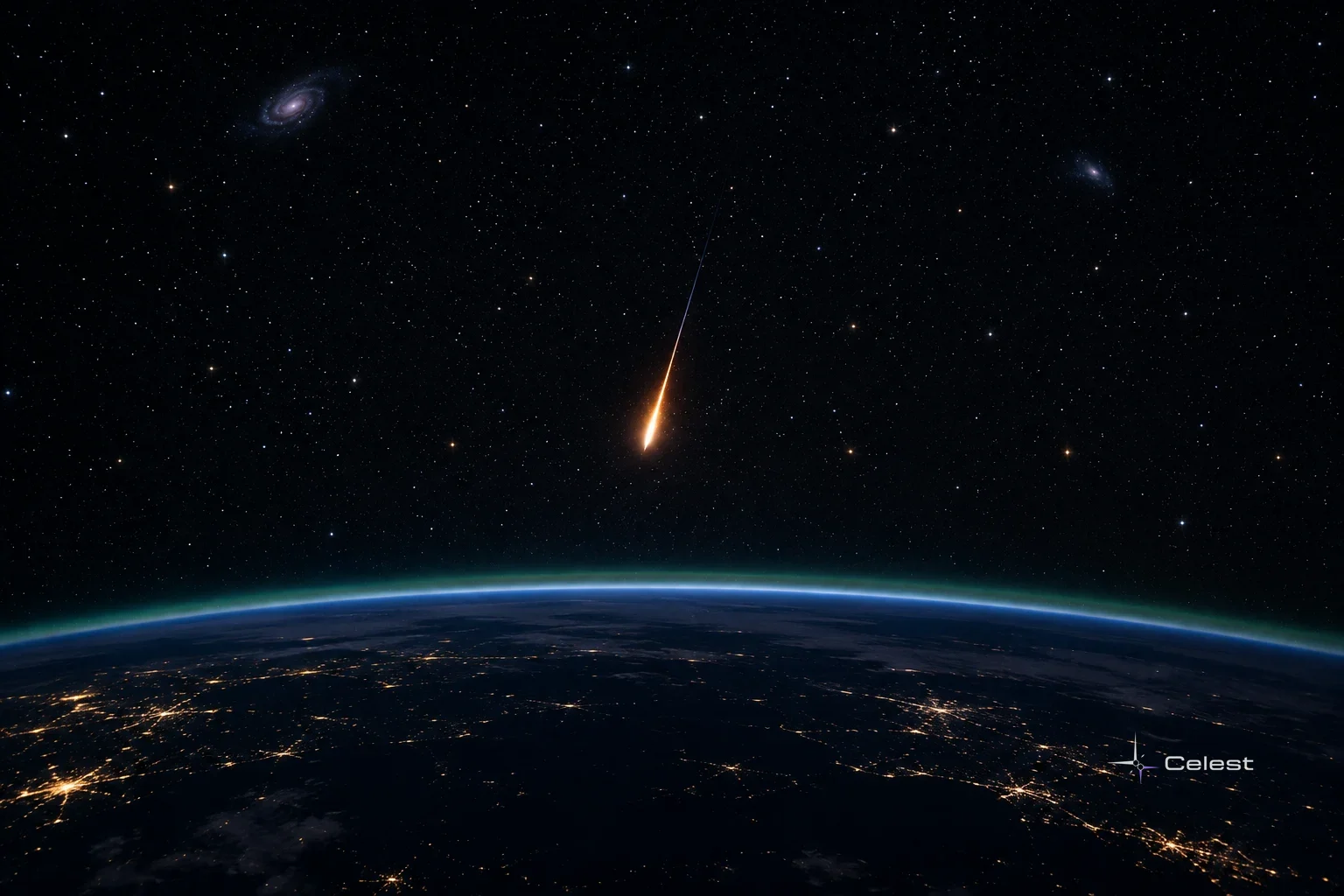
A fireball meteor is just an unusually bright meteor — not a different kind of object, only a brighter one. A fireball is simply a meteor bright enough to outshine every planet in the sky, produced when a small piece of rock or ice slams into the atmosphere and heats until it glows.
The International Astronomical Union sets that brightness threshold at apparent magnitude −4 or better; the International Meteor Organization uses a stricter mark, −3 as seen from directly overhead. Most burn out completely long before anything reaches the ground.
How it works
The sequence behind a fireball is short, violent and over in a couple of seconds.
- Entry — a meteoroid, sometimes larger than a metre (about three feet) across, hits the top of the atmosphere at 11 to 72 kilometres per second (25,000 to 160,000 miles per hour).
- Heating — the compressed air ahead of the object heats it to roughly 2000 kelvins (1727°C, or 3140°F).
- Glow — the heated meteoroid and the air around it ionize and vaporize, creating the visible streak, somewhere between about 75 and 120 kilometres (47 to 75 miles) up.
- Breakup — the object sheds material as it travels, and larger ones can fragment or explode outright.
- Dark flight — once it slows to around 2 to 4 kilometres per second (roughly 4,500 to 8,900 miles per hour), it stops glowing and falls the rest of the way in darkness, cooling as it goes.
That heating comes mainly from ram pressure — the compression of air ahead of the object — rather than ordinary friction, especially for anything bigger than about 10 centimetres (4 inches).
Put together, that chain is why a fireball looks and behaves so differently from an ordinary meteor: it's the same physics, just scaled up by a bigger piece of debris moving fast enough to survive longer before it burns away. Check the night sky guide to see what else is visible while you wait for one.
Not a falling star
A fireball is not a star falling out of the sky, and it isn't usually a large object either. Most of the meteoroids that produce ordinary meteors are about the size of a grain of sand, a millimetre or less across.
A fireball is rarer: roughly one meteor in a thousand is bright enough to count as one. Even a fireball-producing meteoroid is still typically a fragment of rock or metal, not a star, not a planet, and nothing close to stellar scale.
Bright moonlight can wash out fainter meteors, but a genuine fireball is bright enough to cut through it. Checking the Moon guide for the current phase mostly matters for the fainter, everyday meteors, not for a fireball itself.
Fireball vs. bolide vs. meteorite
These terms describe the same basic event at different stages of brightness and survival, not separate phenomena.
- Fireball: any meteor at magnitude −4 or brighter (IAU) — the base brightness class.
- Bolide: often used for an exceptionally bright fireball, especially one that explodes with a sonic boom; some classifications set the line at −14, with −17 or brighter called a superbolide. The IAU has no official bolide definition and mostly treats it as a synonym for fireball.
- Meteorite: a fragment that survives all the way to the ground. Usually only fireballs at magnitude −8 or brighter are bright enough to leave meteorites behind.
- Earth-grazer: a very bright meteor that enters the atmosphere and leaves again rather than burning up or falling; as of 2026, seven have been scientifically documented.
Composition adds another layer. Most meteoroids are chondrites — primitive rock unchanged since the solar system formed — split into ordinary and carbonaceous types from asteroids, plus two cometary types from denser and less dense comets. Achondrites, rarer, come from asteroids that melted and separated internally.
Colour depends on that composition and on speed: a green fireball briefly lit up an erupting volcano in the Philippines in May 2026 and was confirmed by local volcanologists to have disintegrated in the air, while a golden fireball was reported by a witness in spring 2025.
The 2013 Chelyabinsk bolide over Russia shattered windows and injured more than a thousand people, a reminder that the exploding, damage-causing end of the scale is real, even if rare.
When fireballs are more likely
Thousands of fireballs occur every day worldwide, but most go unnoticed because they happen over open ocean or during daylight; only an estimated two to twelve a day are realistically seen by anyone.
Two patterns raise the odds. Fireball sightings climb by roughly 10 to 30 percent during the weeks around the March equinox, with February through April marked as the northern hemisphere's peak fireball season.
Meteor showers also help: the Perseids in mid-August and the Leonids in mid-November are two of the most reliable, since Earth is crossing denser streams of comet debris. The meteor shower guide and the astronomy calendar are the places to check which stream is active in a given month.
A reported surge in fireball sightings across 2026 is worth noting with caution.
The American Meteor Society logged 4,462 fireball reports in April 2026, up from 2,567 in January 2026 and 2,280 in April 2025 — but the society itself said it can't yet tell whether that reflects a real change in near-Earth debris or simply more people reporting what they see.
If someone mentions a fireball from last night, treat it as a retrospective report, not a forecast; nothing about fireballs can be reliably predicted in advance.
Sources
The facts in this article are based on the sources below. How we work: editorial policy.
- Meteor - Wikipedia — wikipedia.org
- Fireball | Astronomy and Astrophysics | Research Starters | EBSCOhost — ebsco.com
- Experts baffled by surge of fireball meteors this year — journalrecord.com
- Great Basin Observatory Fireball | Great Basin National Park Foundation — greatbasinfoundation.org
- Earth-grazing fireball - Wikipedia — wikipedia.org
Leave a comment
Comments appear after moderation.