Comet vs Asteroid: What's Actually Different
The two get mixed up constantly, but one is a leftover of rock, the other a leftover of ice — and a handful of objects now blur that line entirely.

- Published
- ◷
- 4 min read
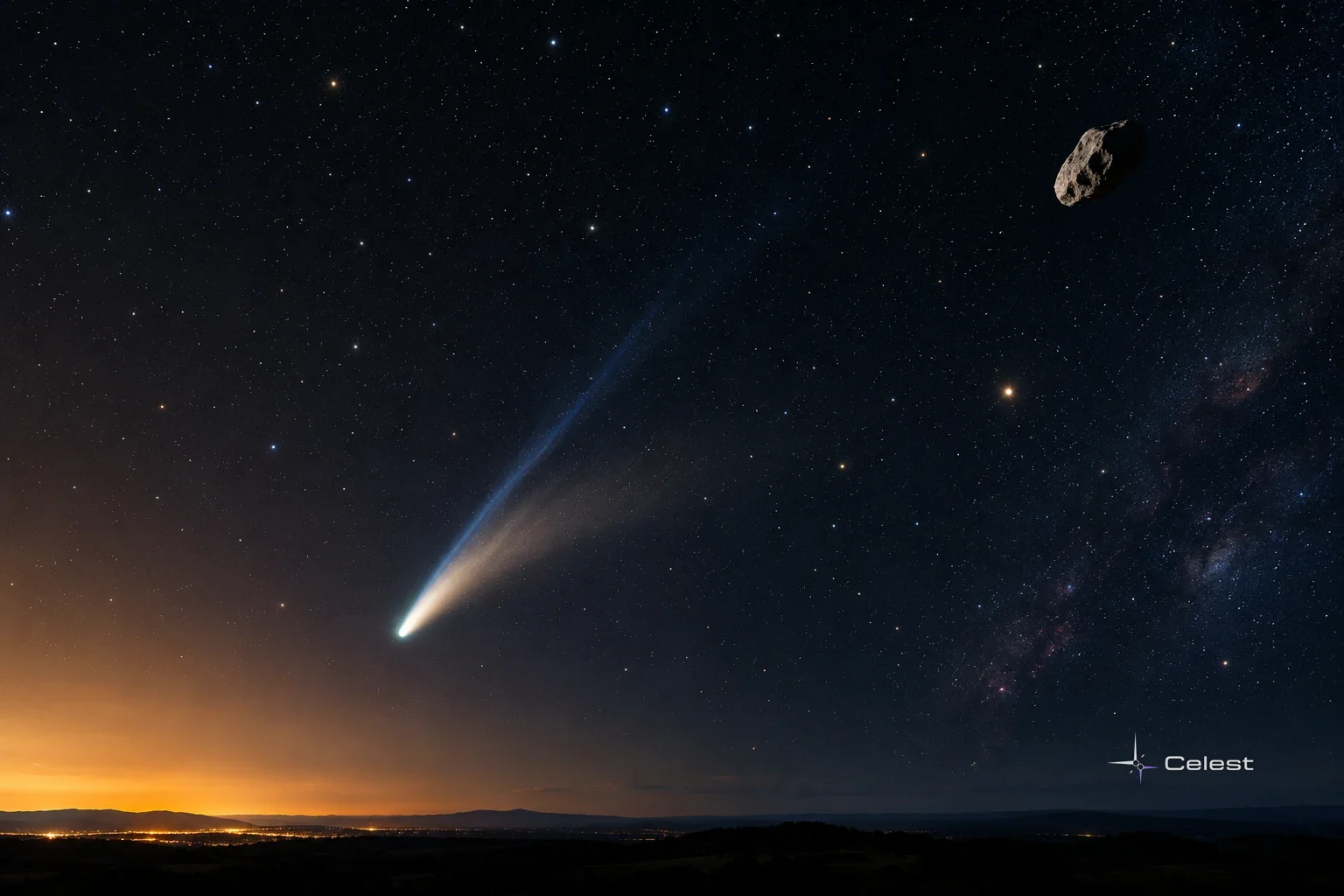
Ask what separates a comet from an asteroid, and the answer comes down to what each one is made of. An asteroid is a lump of rock and metal; a comet is a mix of ice, dust, rock and organic material that behaves very differently once it nears the Sun.
That difference traces straight back to where each object formed billions of years ago.
You can look up which comets are currently active in Celest's comet guide, and see where asteroids sit relative to the planets in the night sky guide. Both groups share the same solar system, but they took very different paths to get here.
How it works
The split started about 4.6 billion years ago, when the solar system was still a disk of gas and dust settling around the young Sun. Distance from the Sun decided almost everything that followed.
- Formation region: close to the Sun, it was too warm for ice to stay solid, so material there condensed into rock and metal — the seeds of asteroids.
- Frozen leftovers: farther out, beyond Neptune, ice survived. Objects that formed there — in the Kuiper Belt, the scattered disc or the Oort Cloud — kept their ices and became comets.
- Composition locked in: an asteroid ends up built from silicate rock and metal; a comet ends up built from ice and dust, plus rock and hydrocarbon-rich material.
- A nudge inward: gravity from a passing star or planet can perturb a distant icy body onto a long orbit that dips into the inner solar system.
- Heat does the rest: as that body nears the Sun, its ice sublimates — turns directly from solid to gas — releasing gas and dust that form a coma, a tail, or both.
An asteroid making the same close pass to the Sun doesn't do this. It has little or no ice left to release, so it stays a bare rock with no coma and no tail. What you actually notice from the ground isn't some fixed label — it's whether the object is currently shedding gas and dust.
Not every "shooting star" is the same thing
Comets and asteroids often get lumped in with meteors and meteorites, but those are different objects at different stages.
- Meteoroid: a pebble-size piece of rock or debris drifting in space, smaller than either an asteroid or a comet.
- Meteor: what you see when a meteoroid burns up entering Earth's atmosphere — the streak of light people call a shooting star.
- Meteor shower: check Celest's meteor shower guide for when Earth passes through a denser trail of debris and meteors appear in numbers.
- Meteorite: a meteoroid that survives the trip and lands on the ground.
None of those terms describe a comet or an asteroid itself — they describe smaller fragments and what happens when Earth runs into them. Thousands of asteroids and dozens of comets are still discovered every year, and astronomers pay particular attention to near-Earth objects, whose orbits bring them through the inner solar system, in case any pose a future impact risk.
Same solar system, blurred edges
On paper, the two categories look tidy: asteroids are rocky and mostly stay inside Jupiter's orbit; comets are icy and swing in from far beyond Neptune.
One popular comparison puts asteroid orbital periods at roughly 1 to 100 years against comet periods anywhere from 75 to over 100,000 years, and asteroid sizes from 1 kilometer up past 100 kilometers against comet nuclei typically 1 to 10 kilometers.
Those figures come from a single source and are worth treating as a rough contrast rather than a precise rule.
Real objects don't always sort neatly into either bin. A 2017 review described "continuum objects" that show properties of both: some asteroids that look rocky but move on comet-like orbits are probably dormant or extinct comets, while others that look like comets but move on asteroid-like orbits are called active asteroids.
The clearest example is 288P, a body in the main asteroid belt between Mars and Jupiter.
Discovered in 2006, it showed unexpected comet-like activity in 2011 images, and Hubble observations from September 2016 — reported by the University of Arizona in 2017 — revealed it's actually two nearly equal-mass bodies orbiting each other about 100 kilometers (62 miles) apart, with water-ice sublimation as the likely driver.
Researchers concluded the pair has probably existed as a binary for only about 5,000 years, most likely split apart by fast rotation and pushed farther apart since by that same sublimating ice.
That same research points to another twist: current evidence suggests water reached early Earth mainly through icy asteroids, not comets, despite comets long getting the credit.
Comets and asteroids remain useful shorthand — one tells you roughly what an object is made of and where it formed. Just don't expect every object out there to respect the boundary.
See it for yourself
There's no specific comet or asteroid flagged here as visible right now — that changes often enough that it's worth checking rather than assuming from an explainer. Celest's calendar lists which comets and related events are currently active, and it's a better starting point than any fixed date.
Sources
The facts in this article are based on the sources below. How we work: editorial policy.
- Asteroid–comet continuum objects in the solar system - PMC — nih.gov
- Difference between Asteroid and Comet — byjus.com
- Asteroids, Comets, Meteors, and Meteorites | NISE Network — nisenet.org
- Asteroid-Comet Is New Type of Object | Lunar and Planetary Laboratory & Department of Planetary Sciences — arizona.edu
Leave a comment
Comments appear after moderation.