16 Psyche: The Metal-Rich Asteroid NASA Is Visiting
A dense, iron-flecked world between Mars and Jupiter is about to get its first close look — and the old 'pure metal' story about it is already being rewritten.

- Published
- ◷
- 6 min read
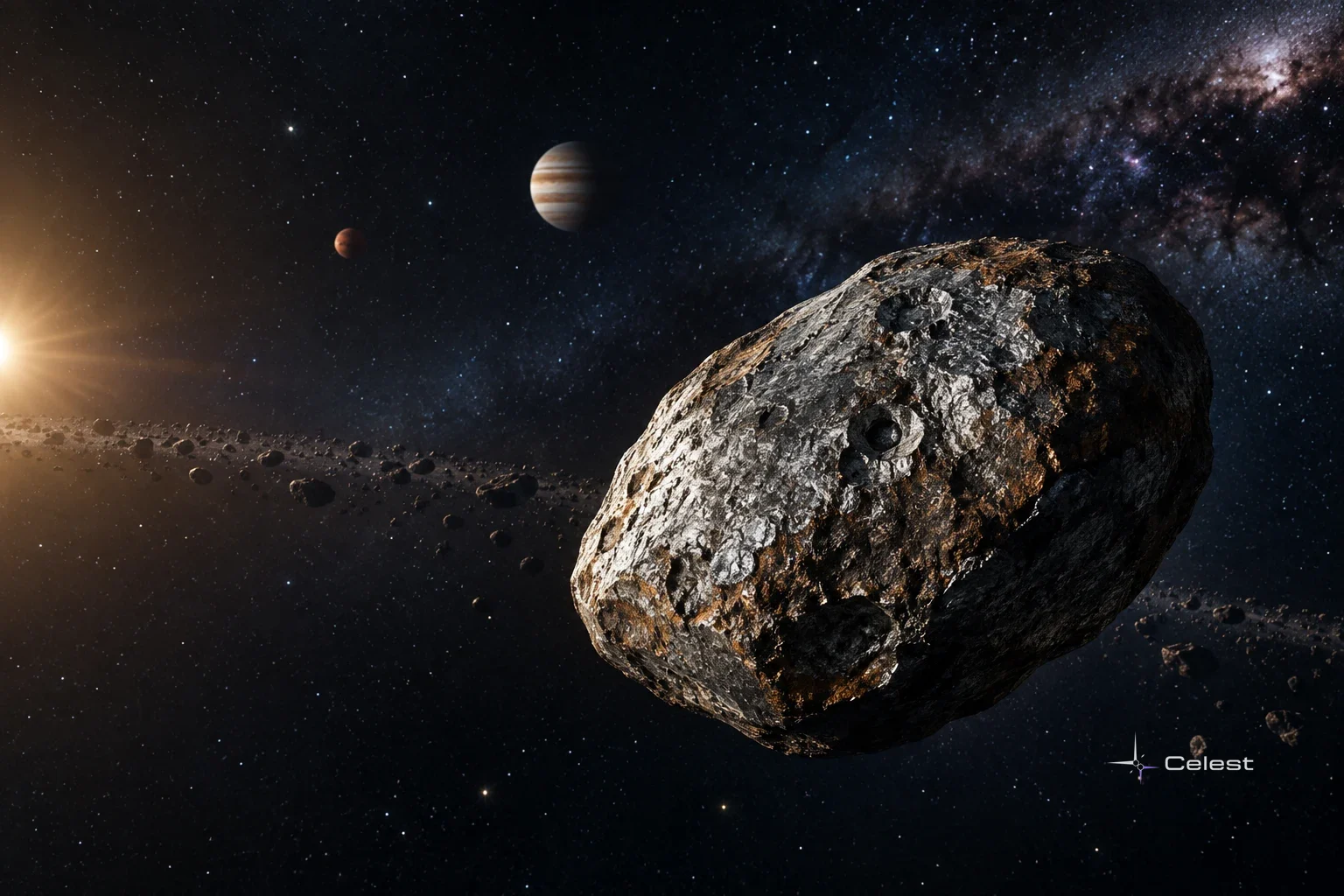
16 Psyche is a metal-rich asteroid about 222 kilometers (138 miles) across, orbiting the Sun in the main asteroid belt between Mars and Jupiter, roughly 2.9 AU from the Sun on average. It is the largest and most massive of a rare group called M-type asteroids, bodies whose spectra point to iron and nickel rather than ordinary rock.
No one has ever seen a world made mostly of metal instead of rock, ice or gas. That is the one fact that makes Psyche worth knowing: it is the first object of its kind to have a spacecraft sent to visit it.
You can check the night sky guide for what else is up on any given evening while a robotic mission crosses millions of kilometers to reach it.
16 Psyche at a glance
The numbers below come from telescopic surveys and orbital tracking, not from the spacecraft itself, which has not arrived yet.
- Type: M-type, metal-rich main-belt asteroid
- Where: main asteroid belt between Mars and Jupiter, about 2.9 AU from the Sun; currently crossing the constellation Leo
- Distance: minimum orbit intersection distance from Earth is 1.53 AU; on 20 September 2026 it sat about 3.88 AU away, roughly 580.65 million km
- Size: mean diameter 222 ± 3 km, with a lumpy triaxial shape near 278 × 232 × 164 km
- Brightness: apparent magnitude ranges from 9.5 to 12.5; about magnitude 12.1 in September 2026
- Best seen: telescope only — it never reaches naked-eye brightness
For its position among the stars right now, the constellation guide explains how Leo is laid out and where to look within it.
A world that is metal-rich but not pure metal
Psyche is dense. Its mean density works out to 3.977 ± 0.253 g/cm3, and one mission-review estimate puts it closer to 4.1 g/cm3 — among the highest densities measured for any asteroid. That density alone tells you it is packed with heavier material than typical rocky bodies.
For decades the working picture was simple: about 90% iron-nickel metal, 10% rock. That figure has not held up. Newer data lowered the metal share to perhaps 60% at most, and a 2026 review goes further, modeling tens of percent or more of silicate material mixed through the body.
The honest summary is that Psyche is metal-rich in its bulk properties, not a solid lump of iron. It behaves like a world where metal and rock were never fully separated, or were partly mixed back together after Psyche formed.
Was it a planet's core?
One long-standing idea is that Psyche is the exposed core of a small protoplanet — a body that once had a rocky outer layer, lost it in ancient collisions, and left the dense metal interior bare.
It is an appealing story because it would let scientists study planetary core material without drilling anywhere near Earth's own core, which sits thousands of kilometers down under pressures no probe could survive.
Observations reported in 2020 cast doubt on that tidy explanation. If Psyche were a clean exposed core, its composition and shape should look more uniform than what telescopes actually show.
The spacecraft's first listed science objective is to settle the question directly: is Psyche a core, or is it made of unmelted, primordial material that never separated into layers at all?
The spacecraft on its way
NASA's Psyche mission, led by principal investigator Lindy Elkins-Tanton, was chosen as a Discovery-program finalist in 2015 and approved for flight in 2017. The spacecraft launched on 13 October 2023 from Kennedy Space Center aboard a SpaceX Falcon Heavy rocket.
Instead of chemical engines, it uses xenon-fueled ion thrusters for a slow, efficient cruise. It carries a pair of multispectral imagers, a gamma-ray and neutron spectrometer, a two-sensor magnetometer, and a gravity-science setup that uses its own radio link to measure the asteroid's mass distribution.
As of the most recent review, the craft had completed about a third of its journey and was heading toward a Mars gravity assist in May 2026.
Orbit capture around Psyche is planned for mid-2029, followed by 27 months of progressively closer orbits, with science operations targeted to begin around August 2029 and the prime mission wrapping up by November 2031.
An earlier plan, published in 2021, had called for a 2022 launch and a 2026 arrival — that timeline was superseded once the mission slipped and was replanned.
The naming and the symbol
Annibale de Gasparis discovered Psyche on 17 March 1852 from the Astronomical Observatory of Capodimonte in Naples, Italy. It was named after Psyche, the Greek goddess associated with the soul — a fitting counterpart to an asteroid belt already thick with mythological names.
The number 16 in front of its name is not a size or brightness ranking. It simply records that Psyche was the sixteenth minor planet ever discovered, back when astronomers were still numbering these objects in the order they turned up.
How to see it
At magnitude 9.5 to 12.5, Psyche never gets bright enough for the naked eye, and it sits beyond what ordinary binoculars can reliably pull out of a dark sky. Seeing it means pointing a telescope, or a camera-equipped smart telescope, at a very specific patch of stars and confirming you have the right faint dot.
In August 2024, one amateur observer using a Seestar S50 smart telescope located Psyche in Capricornus, near the star Theta Capricorni, at around magnitude 10 — though pointing was tricky because star-chart positions had already drifted from the asteroid's actual spot.
In September 2026, Psyche sits in Leo near right ascension 09h 41m, declination +13°, glowing at roughly magnitude 12.1 and drifting about a degree and a half eastward in right ascension every day. That drift means a finder chart from one week is already stale the next.
Before heading out, the live sky map helps confirm Leo's position for your location and time, and the observing conditions guide flags cloud cover and moonlight that would wash out a target this faint. A genuinely dark site, found through the light-pollution map, makes the difference between catching that dim point and missing it entirely.
The question the mission was built to answer
Psyche will not look dramatic through any eyepiece between now and 2029 — it is, and will stay, a faint point of light drifting through the background stars. The real transformation happens once a spacecraft finally orbits it and starts mapping instead of guessing.
Whether that mapping reveals an exposed planetary core, a jumble of unmelted primordial material, or something in between is still an open question. For now, Psyche keeps its answer to itself, quietly circling the Sun once every five years while the instruments built to read it close the distance.
Sources
The facts in this article are based on the sources below. How we work: editorial policy.
- The NASA Psyche Mission: The First up-Close Exploration of a Metal-Rich World — springer.com
- 16 Psyche — wikipedia.org
- Asteroid 16 Psyche: Complete Information & Live Data | TheSkyLive — theskylive.com
- How to study the Earth's core from... SPACE! Meet asteroid 16 Psyche! — wonderdome.co.uk
Leave a comment
Comments appear after moderation.