The Solar System's Planets in Order
A beginner-friendly walk through Mercury to Neptune, the science behind their arrangement, and the single reclassification that trimmed the list from nine to eight.

- Published
- ◷
- 4 min read
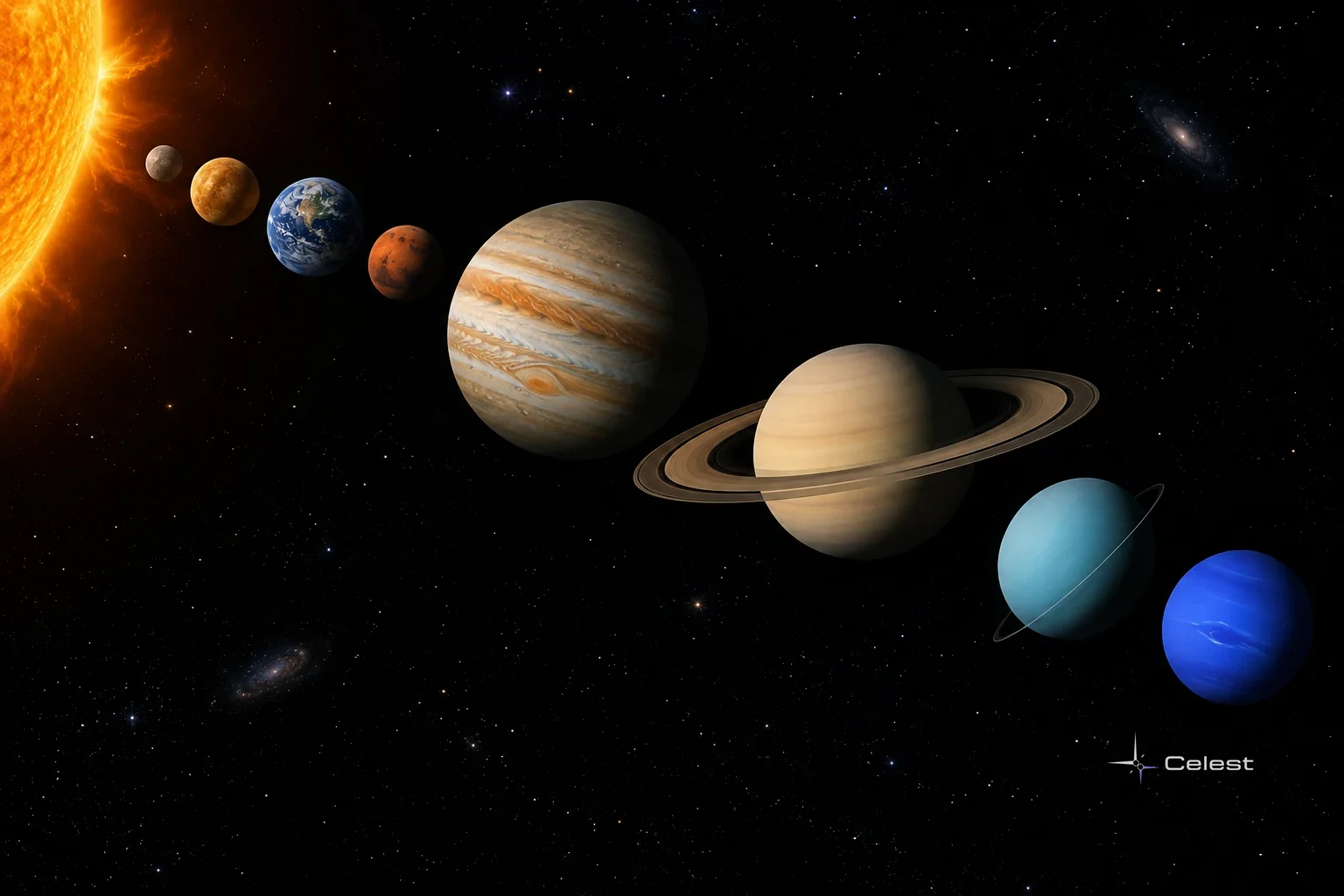
Counting outward from the Sun, the eight planets of the solar system run Mercury, Venus, Earth, Mars, Jupiter, Saturn, Uranus and Neptune. That order is simply distance from the Sun, not size, brightness, or how interesting each world happens to be. Several of them are bright enough to spot yourself among the visible planets on any clear night.
How It Works: Why This Order Exists
That sequence isn't random. It comes from how the solar system took shape roughly 4.6 billion years ago, and Celest's astronomy guides cover the physics behind it in more depth than a quick answer allows.
According to Caltech, a slowly rotating cloud of gas and dust called the solar nebula collapsed under its own gravity, and everything that followed inherited that cloud's shape, spin and leftover material.
The process ran through a handful of distinct stages:
- Collapse — gravity pulls the nebula's gas and dust inward until the center grows dense and hot enough to ignite as the Sun.
- Flattening — the remaining material spreads into a spinning, flattened protoplanetary disk circling the newborn Sun.
- Accretion — dust grains stick together into pebbles, then boulders, then planetesimals, the raw building blocks of planets.
- Growth — planetesimals collide and merge over millions of years, building up into full-sized planets.
- Heat sorting — near the Sun, heat drove off light gases, leaving small rocky worlds; farther out, cold let gas and ice accumulate into giants.
That last stage explains the split you see today. The Sun holds 99.8% of the solar system's mass, and its gravity keeps every planet moving in the same direction, in roughly the same flat plane called the ecliptic.
The Nine-Planet Misconception
Many adults learned nine planets in school, with Pluto counted as the ninth and farthest. That count is out of date.
In 2006 the International Astronomical Union reclassified Pluto as a dwarf planet, which dropped the official tally to eight. The change came from a new three-part definition: a planet must orbit the Sun directly, be rounded by its own gravity, and have cleared its orbital neighborhood of other debris.
Pluto fails that third test. It shares its orbit with other icy bodies in the Kuiper Belt and never swept them aside, so it doesn't qualify.
A simple memory aid still works for the eight that remain: 'My Very Educated Mother Just Served Us Noodles,' one word per planet from Mercury to Neptune. Some versions swap 'Educated' for 'Eager,' but either way the initials line up the same.
Rocky Worlds vs. Gas and Ice Giants
The four planets closest to the Sun — Mercury, Venus, Earth and Mars — are the terrestrial planets: small, dense, built from rock and metal, and solid enough to stand on.
Beyond the asteroid belt, a band of rocky debris between Mars and Jupiter, sit the four outer giants. Jupiter and Saturn are gas giants made mostly of hydrogen and helium with no solid surface to land on. Uranus and Neptune are ice giants, carrying a much larger share of heavier compounds like water, ammonia and methane under their outer atmospheres.
The contrast between the two families shows up in extremes. Venus is the hottest planet, with surface temperatures near 864°F (462°C) thanks to a thick, heat-trapping atmosphere.
Mercury tells a different story. It swings from roughly 840°F (450°C) in daylight to about −290°F (−180°C) at night, because it has almost no atmosphere to hold heat in.
Neptune sits at the other end of the scale. It can drop to −360°F (−218°C) and drives winds over 1,200 mph (2,000 km/h), the fastest recorded anywhere in the solar system.
Jupiter and Saturn set their own records. Jupiter is the largest and most massive planet, spins faster than any other, and hosts the Great Red Spot, a storm about three times Earth's size — while Saturn currently holds the record for moons, with more than 140 confirmed.
See It for Yourself
Planets don't twinkle the way stars do — their steadier glow comes from reflected sunlight rather than starlight passing through miles of turbulent air. That steadiness is often the easiest way to pick one out with the naked eye.
Look for these two first:
- Venus is the brightest planet in the sky, showing up as a dazzling morning star or evening star near sunrise or sunset; check current sky conditions before heading out, since even light haze can wash it out low on the horizon.
- Jupiter ranks as the fourth-brightest object visible from Earth, after the Sun, Moon and Venus, and a steady pair of binoculars can reveal its four largest moons as tiny points strung beside it.
Start with Celest's night sky guide to see which of these worlds happens to be above the horizon tonight — the lineup changes every few weeks.
Sources
The facts in this article are based on the sources below. How we work: editorial policy.
Leave a comment
Comments appear after moderation.