When the Moon Occults Jupiter on October 6, 2026
A narrow path across eastern North America gets a rare sight before sunrise: the Moon sliding directly in front of Jupiter and its four largest moons.

- Published
- ◷
- 4 min read
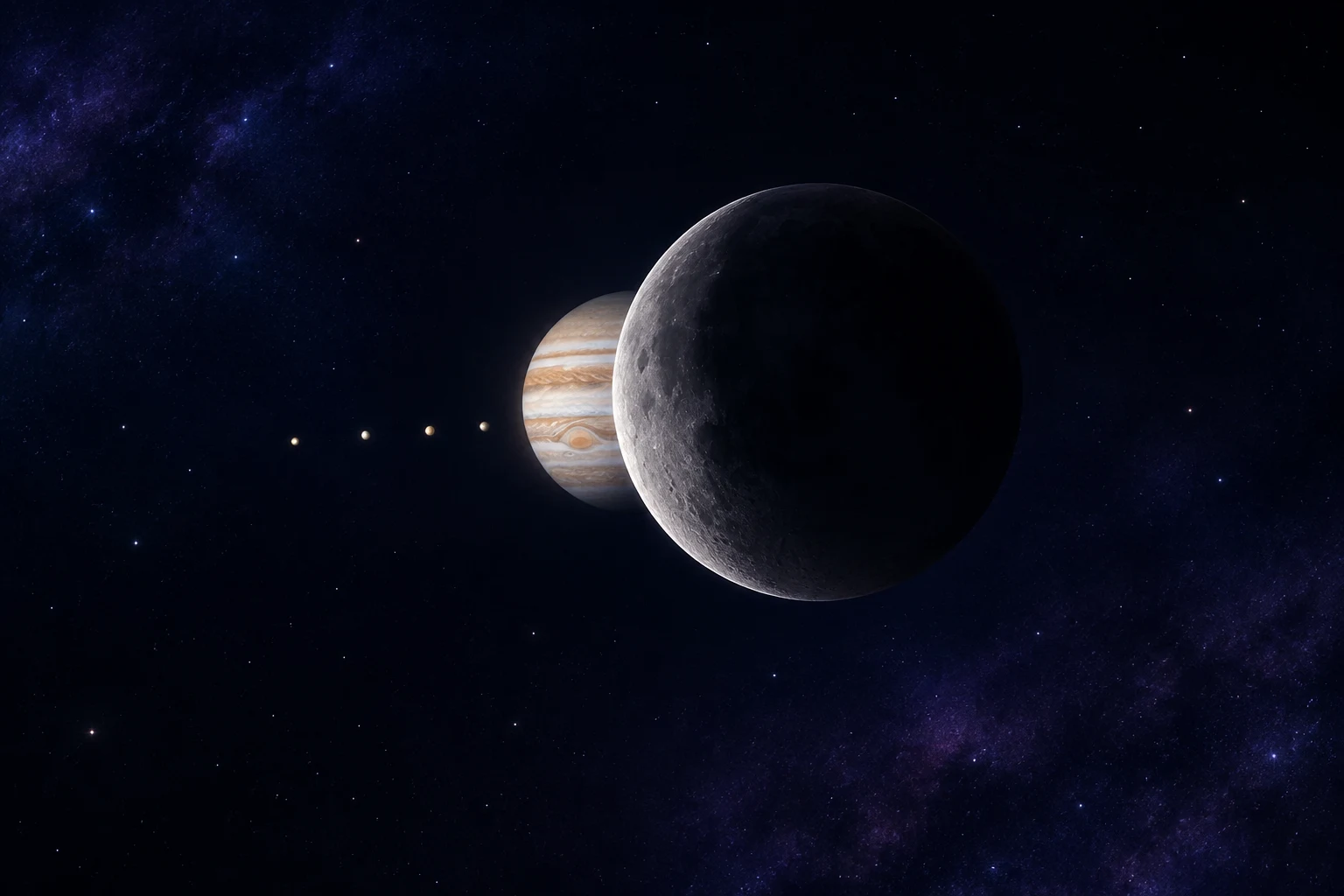
Before dawn on October 6, 2026, the Moon passes directly in front of Jupiter, and only observers along a narrow path through eastern North America see it actually happen. Everyone else, including western North America, Europe and most of Asia, sees the two objects pass unusually close together instead — a striking pairing, but not a true occultation.
Check the astronomy calendar for the exact date, and the visible planets page to see where Jupiter sits in your local sky beforehand. The event unfolds during a thin, waning crescent Moon, which changes how the reappearance looks later on.
The quick plan
The timing shifts by location, so treat these as a starting point and refine them for your city.
- Peak: the reference moment is 08:46 UTC on October 6, roughly 4:46 a.m. EDT, but real ingress times vary city by city.
- Best time: around 2:15 a.m. in Atlanta, 2:26 a.m. in Boston, 3:19 a.m. in Kansas City, about 3:21–3:22 a.m. in Chicago, 4:26 a.m. EDT in Albany, NY, and 5:34 a.m. ADT in Halifax.
- Where to look: low in the east, anywhere from a few degrees to roughly a quarter of the way up the sky, depending on your city and the exact minute.
- Moon: a slim waning crescent, dim enough that Jupiter can outshine it.
- What to expect: Jupiter, about 32 arcseconds across and shining at magnitude -1.8, disappears gradually behind the Moon's bright edge and returns about an hour later on the dark limb, taking its four Galilean moons with it.
- Equipment: naked eye works, but 7x50 or larger binoculars, or a telescope on a steady tripod, show the vanishing and reappearing moments far more clearly.
What you'll actually see
This isn't the sudden blink of a star disappearing. The Moon covers Jupiter's small disk gradually, taking just over a minute to fully swallow it, so the loss of light happens in stages rather than an instant snap.
Because the Moon is waning, its dark, unlit edge trails behind, and that's the edge Jupiter and its moons emerge from about an hour later — a quieter, less obvious return than the bright-limb disappearance.
Outside the narrow path, the show changes but doesn't disappear entirely. Observers across most of the world simply watch the Moon and Jupiter sit unusually close together, a conjunction rather than a cover-up.
Along the western United States, Jupiter and its moons rise first, followed shortly by a faint waning crescent Moon trailing behind it in the eastern sky. According to Sky Caramba, the most central version of this alignment occurs near 10:16 UT, though local circumstances shift the picture everywhere else.
In Europe, the pairing happens in daylight, with the Moon-Jupiter gap shrinking to around 15 arcminutes in a sky too bright to see it.
How to watch
A few deliberate steps make the difference between catching the moment and missing it entirely.
- Pick a site with an open eastern horizon. Check observing conditions the night before for cloud cover, since low-altitude events vanish behind trees, hills or haze fast.
- Arrive at least 20 minutes before your local ingress time. The pair sits low at first, so extra time buys you a better angle as it climbs.
- Let your eyes adjust to the dark for about 20 minutes before you start scanning; this matters more with a dim crescent Moon than a full one.
- Face east and find the crescent Moon first, then look for Jupiter's steady, bright point sitting right beside it.
- Track the pair through binoculars or a telescope for roughly an hour, watching Jupiter fade against the bright limb and later return on the dark side.
- If recording, acquire the Moon about 10 minutes early, set focus so both objects are sharp, and start video about a minute before ingress; Stellarium or IOTA give the most precise local times.
If you miss it, and why it happens
Clouds, a late start or a location outside the path all lead to the same fallback: look west instead. Observers there still catch Jupiter and its four moons rising ahead of a dim crescent Moon, which is worth a look on its own through binoculars.
This wasn't the year's first Jupiter occultation — one occurred on September 8, 2026, though daylight hid it for most viewers. Sky Caramba lists the next chances on November 2 and November 30, 2026, followed by three more through April 2027, so a missed morning here isn't the last shot.
Check the night sky guide for what's up from your location on any of those dates.
The cause is straightforward geometry. The Moon orbits close enough to Earth that it regularly sweeps across a path roughly half a degree wide, crossing paths with planets and bright stars along the way.
Jupiter, despite being enormous, sits so far away that it appears small enough for the Moon to block completely — which is exactly what happens for that lucky sliver of eastern North America before sunrise on October 6.
Sources
The facts in this article are based on the sources below. How we work: editorial policy.
- Lunar Occultation of Jupiter: October 6, 2026 Viewing Guide — highpointscientific.com
- Penultimate Lunar Occultations Inbound for Jupiter, Venus and More in September - Universe Today — universetoday.com
- Sky Caramba — skycaramba.com
- Observations - astroshop.eu Blog — astroshop.eu
- 2026, September 8: Jupiter-Moon Conjunction Before Sunrise Previews October Occultation - When the Curves Line Up — whenthecurveslineup.com
Leave a comment
Comments appear after moderation.