Aldebaran: The Red Giant in Front of the Hyades
The bright eye of Taurus seems to belong to the surrounding V-shaped cluster. Its nearer position reveals the depth hidden in that sky drawing, while measured stellar changes pose another problem of interpretation.

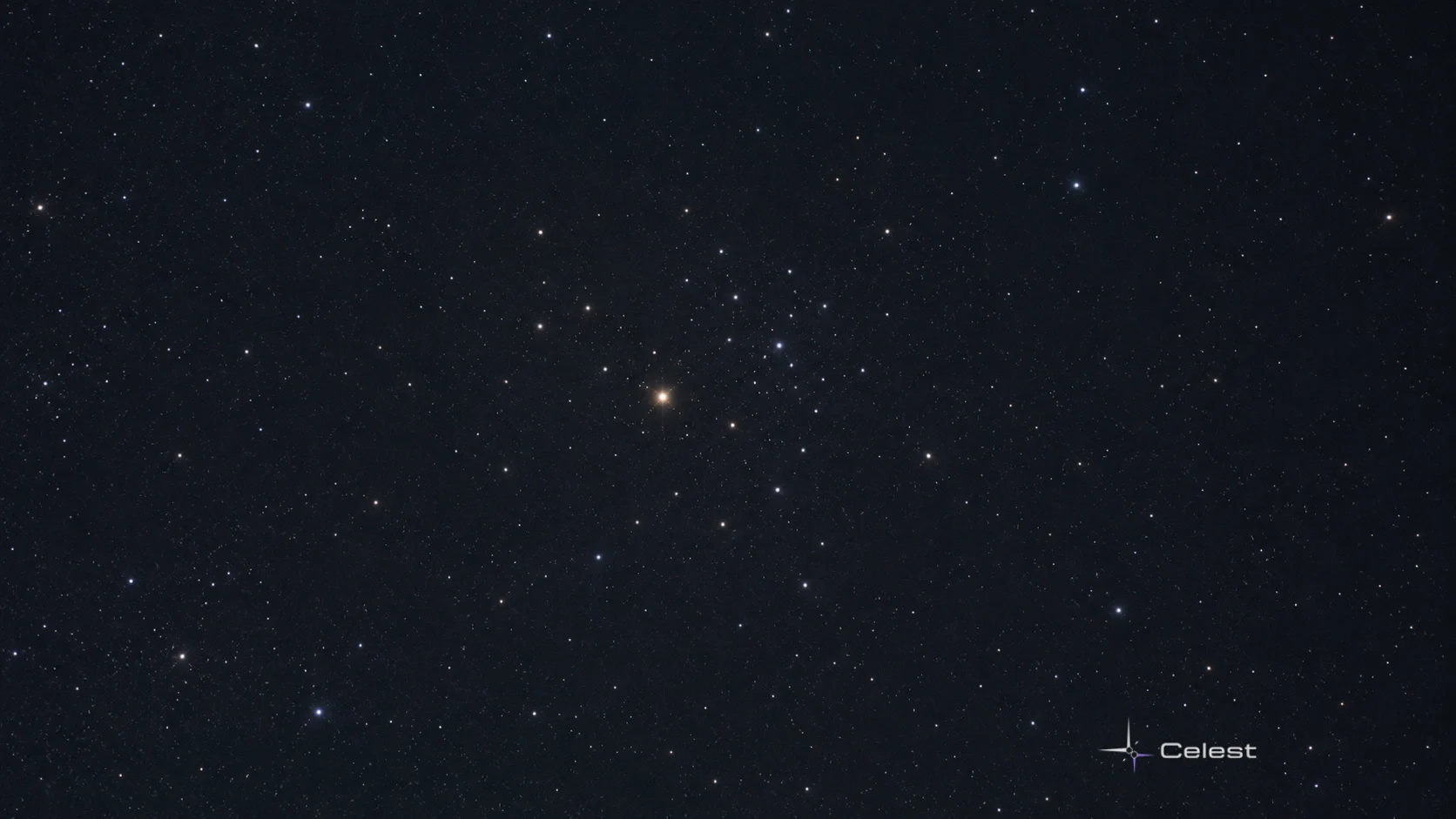
Aldebaran is the orange-red giant marking the eye of Taurus, the Bull. It seems to sit among the Hyades, but it is a much nearer foreground star rather than a member of that cluster. Compare the surrounding V-shaped pattern in the constellation guide.
This makes Aldebaran a useful landmark with a misleading apparent relationship. Start with Orion’s belt and check the route toward Taurus in the live sky map. Finding a cluster and understanding which stars belong to it are separate steps.
Aldebaran at a Glance
The star’s physical identity differs from its place in a familiar sky drawing.
- Other name: Alpha Tauri, or α Tauri.
- Star type: a warm-coloured K-type red giant.
- Sky position: the eye of Taurus, near the Hyades’ V.
- Distance: approximately 65 light-years, compared with roughly 150 for the Hyades.
- Apparent brightness: about magnitude 0.86 in the catalogue; larger numbers mean fainter objects.
- Useful evening season: northern winter or southern summer.
The Bright Eye Does Not Belong to the Cluster
The Hyades are a physical group of stars. Their broad V forms part of the Bull’s face, and Aldebaran helps make that face recognisable. The visual drawing combines objects that occupy very different positions along our line of sight.
NASA’s rounded distances place Aldebaran at about 65 light-years and the cluster at about 150. A light-year is the distance light travels in one year. The foreground star is therefore much closer, even though a photograph can place it beside the cluster’s members.
The comparison does not establish an exact distance between Aldebaran and any individual Hyades star. It explains why the brightest point in the pattern can be unrelated to the physical group behind it. A convenient landmark need not share that group’s origin.
A Giant With Measurable Oscillations
Aldebaran is a red giant, an evolved star whose outer layers have expanded. Its classification describes the star itself, rather than the age or evolutionary stage of the Hyades. Assigning the cluster’s history to Aldebaran would confuse an alignment with membership.
Its light carries information beyond the warm colour. A 2018 analysis found evidence of acoustic oscillations in the star, pressure waves that affect its observed behaviour. The study combined archival spectra with additional ground-based observations and space-based brightness measurements.
Those oscillations gave a mass estimate of 1.16 solar masses, with 0.07 solar masses of uncertainty. The result is a study-based estimate, not a measurement inferred simply from how large or bright the star looks. Stellar vibrations can help constrain an interior that cannot be photographed directly.
The term acoustic does not mean that an observer hears sounds travelling from Aldebaran across space. It describes the physical type of wave inside the star. The useful evidence reaches instruments through changes in the star’s light.
Why Its Reported Planet Remains Uncertain
Astronomers also examined a long-period change in radial velocity, the star’s motion toward or away from us inferred from its spectrum. A planet can produce such a pattern by causing a star to move around their common centre of mass. Stellar changes can also complicate that interpretation.
The 2018 study adopted the planet explanation. A 2019 analysis added 165 measurements to 373 previously published ones and found problems with a simple orbit: the signal’s strength changed, its phase shifted and substantial unexplained variation remained.
That additional evidence weakened the proposed planet rather than giving a new secure orbit. Oscillatory convection was suggested as an alternative, but the analysis did not prove one unique physical cause. A 2025 study still discussed Aldebaran as an example of this difficult distinction.
The catalogue therefore lists the reported planet as unconfirmed. The interesting result is not an established temperate world around the star; it is how a convincing-looking signal must survive longer observations and competing stellar explanations.
How to Find the Eye of Taurus
Northern winter evenings are a useful starting season. Find the three belt stars of Orion, then look toward the Hyades and Pleiades westward of that constellation, checking the exact orientation on your chart. The broad V and its conspicuous warm star help identify Taurus.
The Pleiades are a separate, more compact-looking cluster. Comparing the two groups through binoculars helps you notice their different apparent spread. You can recognise the main patterns with your eyes as well; check observing conditions when choosing a night for the weaker surrounding stars.
Taurus lies along the ecliptic, the Sun’s apparent yearly path against the distant stars. Planets can pass through the same region. If an exceptionally bright point appears near the pattern, use the current map to distinguish a moving solar-system object from the familiar stellar landmark.
A Clear Pattern Can Hide Two Different Questions
Aldebaran shows why appearance and cause need separate checks. Looking beside the Hyades does not make it a cluster member, and displaying a planet-like period does not by itself establish a planet.
You can use the simple drawing to find your way around Taurus while keeping its depth in mind. Measurements add that missing third dimension and test which physical explanation actually fits the light.
Leave a comment
Comments appear after moderation.