Auriga’s Star Clusters: M36, M37 and M38
Three open clusters brighten the winter sky around Auriga. Their different appearances and stellar populations make them useful places to notice how stars change over time.

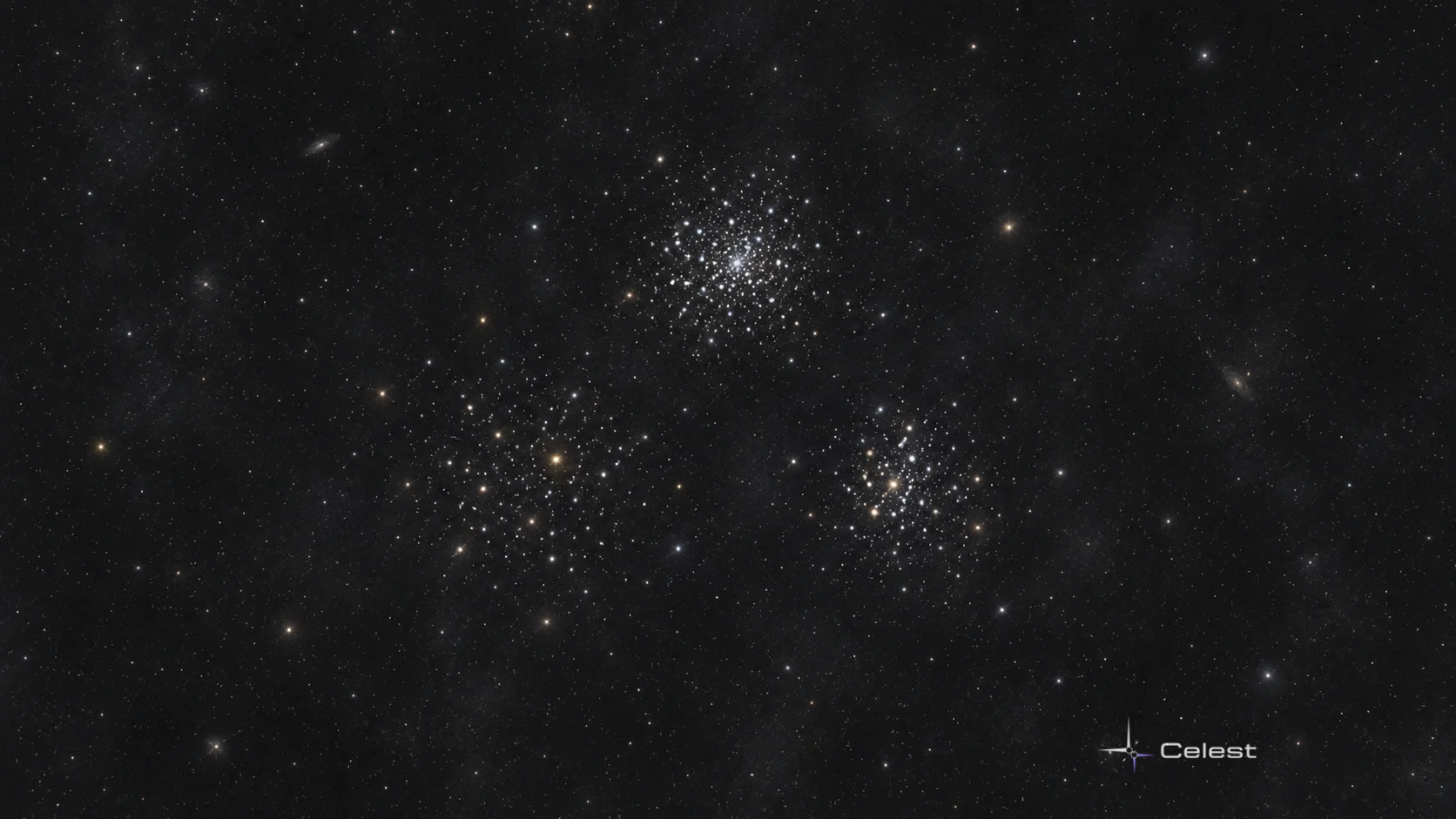
Auriga’s star clusters M36, M37 and M38 are three separate open clusters in the northern winter sky.
Binoculars or a small telescope reveal different concentrations of stars within the same constellation. Their appeal goes beyond a pleasant view: their stellar populations show different stages of evolution.
Auriga lies along the Milky Way, in a direction away from the Galaxy’s centre. The region contains many clusters and nebulae, so a broad sweep can reveal more than one small concentration.
Keeping track of which cluster you are examining turns that busy field into a useful comparison.
Auriga’s Clusters at a Glance
- M36: also NGC 1960, a young open cluster with conspicuous bright members.
- M37: also NGC 2099, a rich cluster with many faint stars and evolved stellar members.
- M38: also NGC 1912, a looser group whose stellar chains can suggest an X.
- Sky region: the winter Milky Way around Auriga.
- Distance scale: roughly 4,000 light-years in a 2007 observing guide, not a precise common distance.
- Useful equipment: binoculars or a small telescope, beginning at low power.
You can place Auriga among nearby constellations before exploring its smaller features. A light-year is the distance light travels in one year. The similar broad distance estimates do not establish that the three clusters formed together or sit immediately beside each other in space.
Why Can Coeval Stars Look Different?
Stars within an open cluster form at roughly the same time and location, but they do not all follow the same timetable. Different masses lead to different lifetimes. A more massive star can already have changed substantially while a smaller neighbour continues a much longer-lived phase.
The star guide explains that range of lives. A cluster’s mixed appearance therefore need not mean that each colour marks a different birthday. Instead, astronomers can compare stars that began under related conditions and ask how their properties influence what happens next.
Across M36, M37 and M38, there is another distinction: each cluster has its own population and history. The three catalogue entries provide separate examples rather than consecutive frames of one group evolving before your eyes.
What Distinguishes the Three Clusters?
M36: A Young Population
M36 has a relatively compact, bright-star pattern. A 2007 observing description estimated its age at about 30 million years and noted the absence of red giants. Treat that figure as an approximate historical estimate, not an exact birth date.
It provides a useful young comparison for the older, more evolved populations nearby on the sky. You can examine the spacing of its brighter stars without needing to count every possible member.
M37: A Richer Stellar Field
M37 contains many faint points, so its appearance can become much richer when a telescope separates more of its light. Evolved giant stars also form part of its population. A study submitted in 2022 described the cluster as approximately 500 million years old.
Published age estimates differ: an older guide used about 300 million years. Such values depend on the observations and models used to interpret them. The evidence for evolved members matters more here than presenting one numerical age as a precise universal agreement.
M38: A Looser Pattern
M38’s stars spread into chains that some observers see as an X. Its brightest member was described as a yellow giant in the 2007 guide. Compare that looser arrangement with M37’s denser-looking collection, rather than expecting all three clusters to look identical.
The pattern is an observing cue, not an outline physically drawn between the stars. Instrument, field size and which faint members you distinguish can change how strongly a shape stands out.
How Can You Compare Them Outside?
Begin on a winter evening when Auriga is well placed for northern observers. Capella, its bright landmark, marks the top of a prominent pentagonal pattern. Use the sky map for your chosen evening to identify it and the clusters before moving to binoculars or a telescope.
A supported route uses Theta Aurigae and Elnath, the star also designated Beta Tauri in neighbouring Taurus. Locate both with the map first. M37 lies east of about the midpoint of their joining line; moving back west across that line, then farther west, leads toward M36 and M38.
Start with low magnification and examine one cluster at a time. Compare concentration, bright points and unresolved glow. Then increase power if you want to inspect individual stars. A systematic order helps you avoid confusing similar patches while retaining the broader setting around each one.
What Does M37’s Remnant Add to the Story?
In 2022, researchers confirmed a planetary nebula and its central white dwarf as members of M37. A planetary nebula is gas released by an evolved star, while a white dwarf is the compact stellar remnant. Consistent motions, reddening and position helped establish the association beyond apparent overlap.
A 2023 analysis used spectra, measurements of light separated by wavelength, and stellar-atmosphere models. It inferred an effective temperature of 90,000 K for this particular white dwarf. The faint remnant requires professional observations; it is a scientific extension of the cluster view, not a promised binocular detail.
Its value is the connection between a star’s beginning and what remains after evolution. The 2022 team inferred an initial mass around 2.8 times the Sun’s, while later work assessed the remnant.
A familiar winter cluster can therefore help researchers trace how much of a star survives its changing life.
Leave a comment
Comments appear after moderation.