Cassiopeia Constellation: Find the W in the Northern Sky
Five stars give you an easy pattern to learn. The wider constellation also contains clouds of gas and dust that look very different in infrared light.

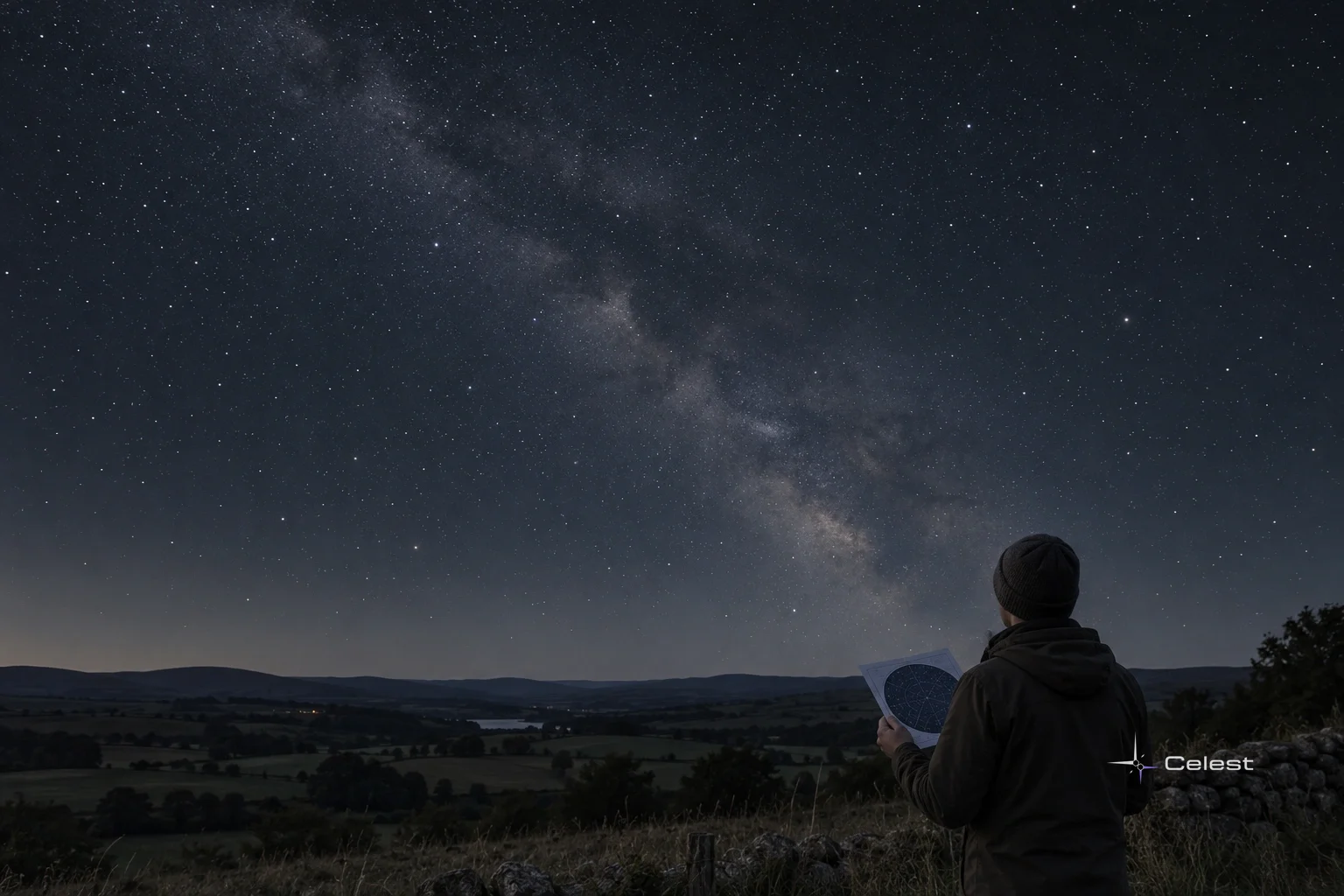
Cassiopeia is a northern constellation you can recognise by five bright stars arranged in a zigzag like a W. Depending on how the pattern has turned, it may look more like an M. You do not need a telescope to learn its main outline.
Find it among the northern constellations, then compare the pattern with a live sky map set to your location and date. Let the map turn with the sky rather than expecting the W to stay upright. Learning the whole shape is more useful than searching for one isolated bright star.
Cassiopeia at a glance
Keep these distinctions in mind while you learn the pattern:
- Type: one of the 88 official constellations.
- Sky region: northern sky, with visibility depending on your latitude.
- Main pattern: five bright stars forming a W-shaped zigzag.
- Abbreviation: Cas on astronomical charts and object names.
- Traditional figure: a seated queen from Greek mythology.
The W is only the beginning
The familiar outline is an asterism, a recognisable arrangement of stars. A modern constellation is larger: it is an area of sky with an agreed boundary. Cassiopeia includes the space around and between its easily recognised stars, not just the connecting lines on an illustration.
The International Astronomical Union divides the whole sky into 88 such areas. This lets an astronomer describe where a galaxy, cloud or star appears without suggesting that everything in that direction belongs to the same physical group.
There is no single distance to Cassiopeia. A constellation is a direction on the sky. A distance given for a cloud within its boundaries belongs to that cloud, not to every point of the W.
The queen in the name belongs to Greek mythology, alongside the king Cepheus in the neighbouring constellation. The story supplies a memorable figure, while the chart boundary supplies the modern astronomical meaning. You can recognise the stars without needing to trace a human figure around them.
Why the pattern turns around
Earth's rotation makes northern star patterns appear to move around the north celestial pole, the point toward which Earth's axis points. Polaris sits close to that point. Cassiopeia and the Big Dipper lie roughly on opposite sides of Polaris, providing two useful landmarks in the northern sky.
The W does not keep the same angle to your horizon. A pattern drawn upright in a book can look tilted or inverted outdoors. Before deciding you have found the wrong group, rotate your chart to match what you see.
Visibility also changes with latitude. A description written for far-northern observers does not automatically apply to someone much farther south. Use the night sky guide for your location rather than relying on an unqualified claim that the constellation is always visible.
A different sky in infrared
In ordinary visible light, the bright stars make the main outline easy to pick out. Infrared telescopes record longer wavelengths that human eyes cannot detect. Their images reveal interstellar dust and many stars that do not stand out in the familiar view.
WISE mapped a broad region around Cassiopeia and Cepheus filled with dust clouds. Many are nebulae, clouds of gas and dust where stars are forming. The colours in the infrared image represent the instrument's measurements, rather than colours you should expect above a dark hillside.
How to see it
Start without binoculars and look for the complete five-star zigzag. Match the angles between the stars to your chart, allowing for the pattern's orientation. The first goal is recognising that arrangement reliably, rather than memorising five new names at once.
Once you have the outline, try binoculars and compare the richer field around it. More points of light become visible, but the wider view remains useful for keeping your bearings. Professional infrared clouds are not a realistic colour target for this exercise.
Where one generation may start another
One region in Cassiopeia, W5, lies about 6,500 light-years away; a light-year is the distance light covers in a year. Spitzer's infrared observations show older stars in hollowed-out cavities and younger stars around their rims.
Radiation and winds from massive stars can compress nearby gas as they carve those cavities. The age pattern supports the idea that this compression helped another generation form. The W that first catches your eye is therefore a way into a sky region where astronomers can investigate how stars affect the birth of their neighbours.
Leave a comment
Comments appear after moderation.