Orion Nebula: A Nearby Nursery for Massive Stars
A fuzzy patch in Orion’s Sword is the nearest region where massive stars are forming. Binoculars reveal a glowing cloud; a telescope shows the bright stars shaping it.

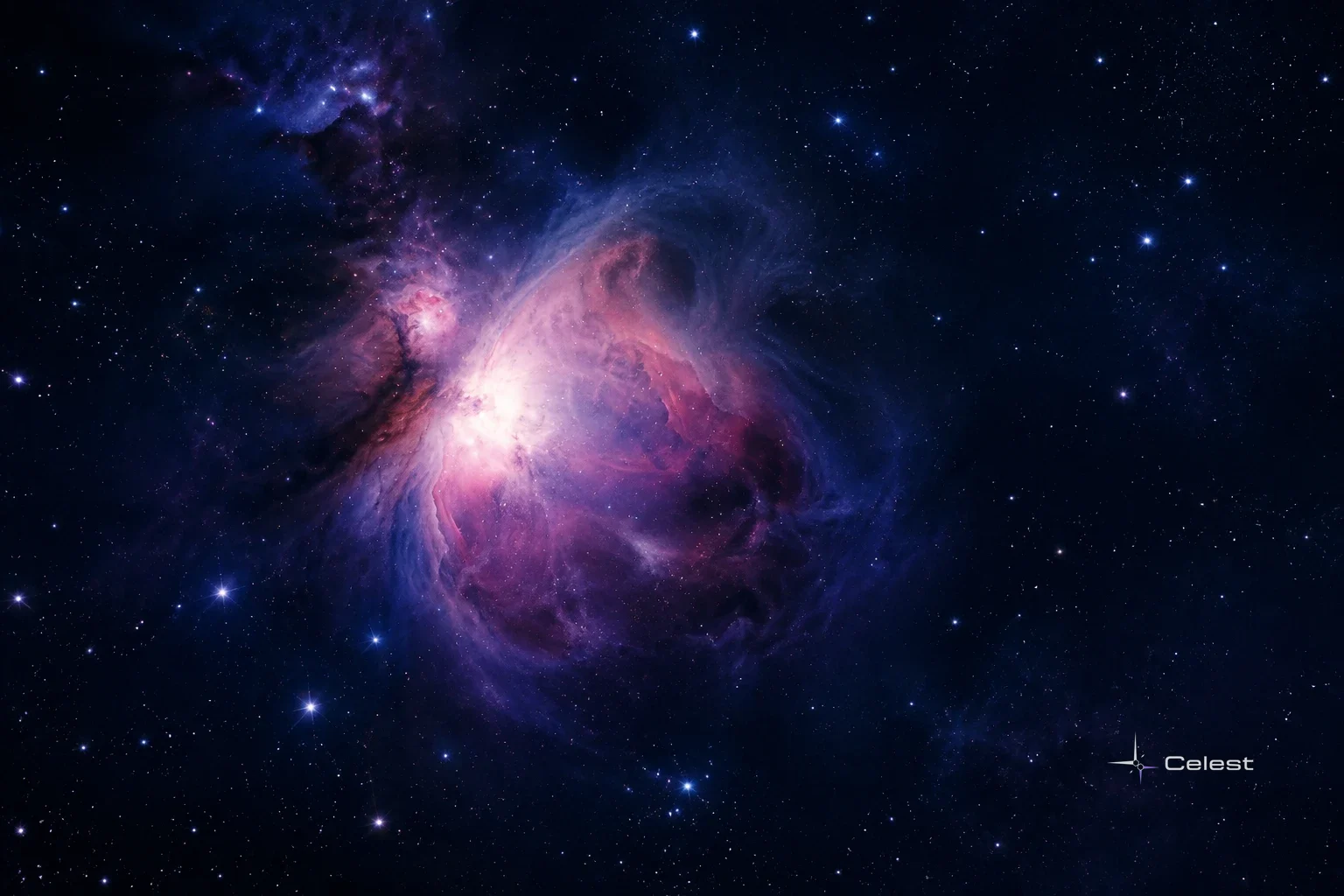
Look at the middle 'star' in Orion's Sword — the short line of three points hanging below Orion's Belt — and you're not looking at a star at all. You're looking at a cloud of glowing gas and dust roughly 1,300 light-years away, lit from inside by newborn suns.
That's the Orion Nebula, and it's the nearest place in the galaxy where massive stars are actively being made.
Catalogued as Messier 42, M42 and NGC 1976, and once called the Great Nebula in Orion in older books, it sits in the constellation Orion, just south of the Belt. At magnitude 4.0 it can be noticed with the naked eye under a reasonably dark sky.
Light pollution makes the surrounding glow harder to distinguish, while binoculars reveal the cloud much more clearly.
Check what's up tonight before you go looking for it.
Orion Nebula at a glance
- Type: diffuse nebula, reflection and emission type (Messier 42 / M42 / NGC 1976)
- Where: constellation Orion, just south of Orion's Belt, the middle point of the Sword
- Distance: About 1,300 light-years; published estimates differ with the measurement method and part of the region being measured
- Size: about 25 light-years across, listed as 65 × 60 arcminutes on the sky, with a mass around 2,000 times that of the Sun
- Brightness: Magnitude 4.0 overall, with a bright center and much fainter outer glow
- Best seen: evening skies from November through March in the Northern Hemisphere
The nebula is close enough for telescopes to resolve disks of gas and dust around individual young stars, which makes it a valuable place to study how planetary systems begin.
What makes it glow
Much of the nebula’s glow is powered by ultraviolet radiation from a few very hot, massive stars at its center, the Trapezium. They sit among a much larger population of young stars. Their radiation makes hydrogen emit light, while dust scatters starlight. Photographs record these processes as different colors.
The red glow is hydrogen-alpha emission, a specific wavelength of 656.3 nanometres given off when excited hydrogen atoms lose energy. The blue-violet haze around it is simply starlight bouncing off dust — reflection, not emission. That's why long-exposure photos of M42 show such a strong colour contrast between the core and its outer wisps.
Brightness drops off fast as you move outward. The central region peaks at about magnitude 17 per square arcsecond, while the outer bluish glow fades to roughly magnitude 21.3 per square arcsecond. That gap explains why the core is an easy target and the faint outer structure is not.
The colour puzzle: nebulium
Early spectroscopic observers noticed a greenish tint running through nebular light alongside the red and blue-violet regions, and it didn't match any known element's spectral line. For a while, the working guess was a brand-new element, nicknamed 'nebulium.'
There was no new element. The mystery line turned out to come from ordinary oxygen atoms emitting light under very low-density conditions — a transition that is normally suppressed by frequent collisions in dense gas. Better atomic physics closed the case, but the name stuck around in old astronomy texts.
The Trapezium and the stars behind it
What looks like one blazing spot at the nebula's heart is actually four stars, the Trapezium, packed into a space just 1.5 light-years across. The four brightest points form a small trapezoid. Those stars belong to a much richer cluster, and several are themselves multiple systems that require more specialized observations to investigate.
The Trapezium is just the bright tip of something bigger. According to ESO, roughly a thousand stars in this region are only about a million years old, crowded into a volume smaller than the gap between the Sun and its nearest stellar neighbours — and tens of thousands of stars have formed here within the last ten million years alone.
Zoom out further and the Trapezium sits inside the Orion Nebula Cluster, an association of about 2,800 stars spread across 20 light-years. And that cluster is just one bright knot inside the Orion molecular cloud complex, a structure hundreds of light-years across that also contains the Horsehead Nebula and Barnard's Loop.
Why it matters — and what's still disputed
Because it's so close and so bright, M42 has become one of the most studied objects in the sky. Astronomers have directly observed protoplanetary disks — the raw material of future planets — along with brown dwarfs, turbulent gas motion and the ionising effect of the nearby massive stars.
A landmark infrared mosaic, taken over the nights of 20-21 December 1999 with the ISAAC instrument on the VLT's ANTU telescope by Mark McCaughrean and colleagues, gave the deepest wide-field infrared view of the region at the time. It revealed dust disks silhouetted against the glow, including one called Orion 114-426, only about 900 astronomical units across.
That same infrared work fed into a genuine scientific argument. Some teams reported free-floating objects of roughly 5 to 15 Jupiter masses and called them planets.
McCaughrean pushed back, arguing the objects could instead be older, more massive brown dwarfs left over from an earlier round of star formation — noting that some previously reported faint sources turned out brighter than thought, while others 'seem not to be there at all.'
Many astronomers, he pointed out, wouldn't call something a planet unless it actually orbits a star.
The region's history has loose threads too. High-speed runaway stars such as AE Aurigae and Mu Columbae have been linked to earlier stellar encounters in Orion. Their paths help astronomers reconstruct what happened in this crowded star-forming region.
How to see it
M42 is a Northern Hemisphere winter target, at its best in evening skies from November through March, when Orion climbs high after dark. Give your eyes about twenty minutes to adjust before you start looking for faint detail, and check observing conditions and the Moon's phase beforehand — a bright Moon will wash out the fainter parts of the cloud.
- Naked eye: a small, slightly fuzzy patch below the three Belt stars — no colour, just a soft glow that doesn't look quite like a point of light.
- Binoculars: the fuzzy patch becomes an obvious cloud with a brighter central region. Expect a mostly gray view rather than the strong colors in photographs.
- Small telescope: an intensely bright core, layered structure fanning outward, the Trapezium stars clearly separated, and wispy extensions reaching into the surrounding dark sky.
A larger telescope gathers more of the faint outer light, but small telescopes already reveal the bright core and some of the surrounding structure. A darker site helps too, so it's worth checking a light-pollution map if the view from home looks washed out.
The small patch below Orion’s Belt is a place where stars and planetary systems are still taking shape. The glow in your binoculars comes from young stars already changing the cloud that formed them.
Leave a comment
Comments appear after moderation.