Antares: The Red Supergiant with a Restless Atmosphere
The bright red heart of the Scorpion hides an extended, moving atmosphere. Maps of its light reveal gas motions and long-lived surface structures that help explain how massive stars lose material.

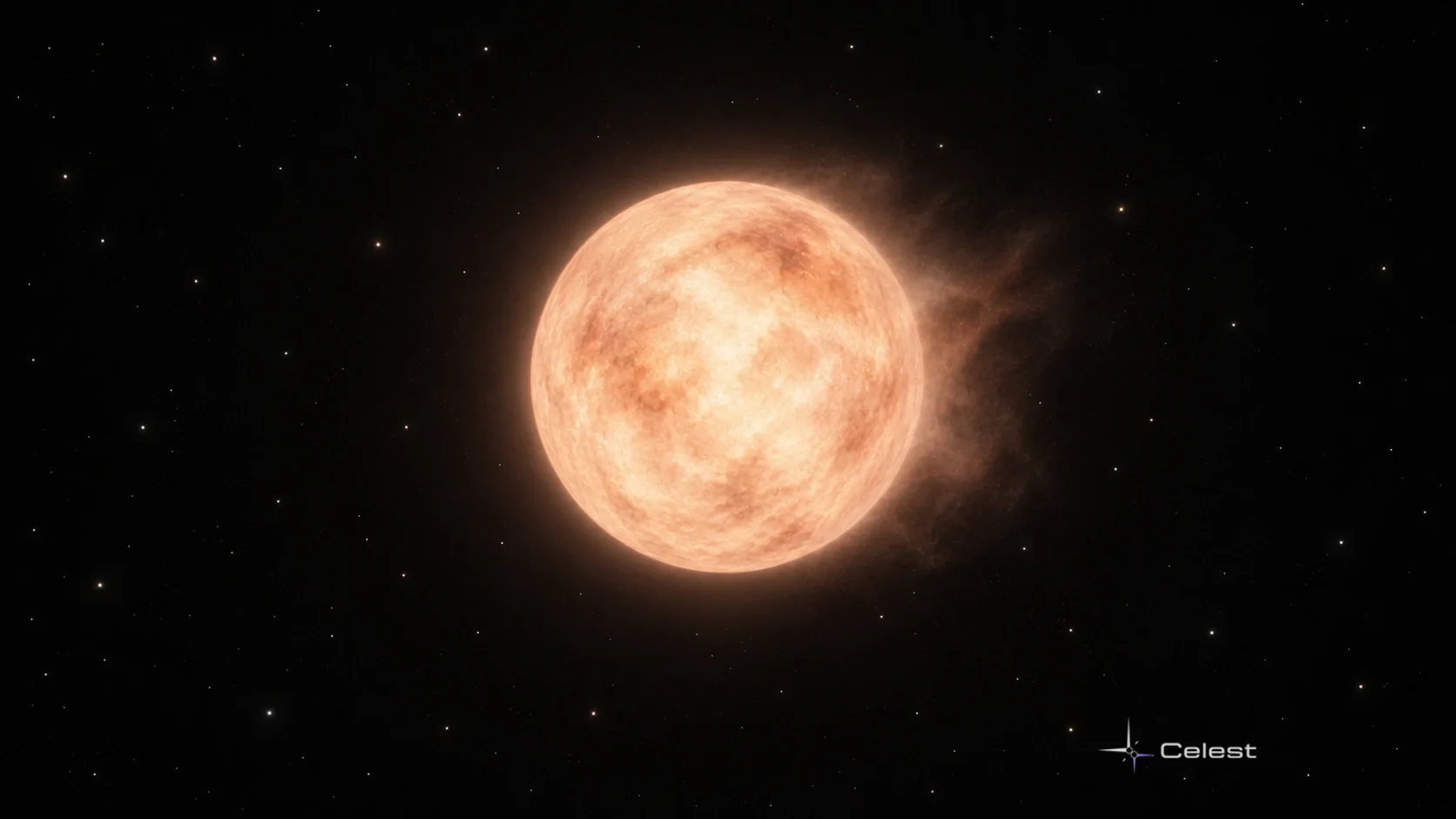
Antares is the orange-red heart of Scorpius and its brightest star. It is a red supergiant: an evolved massive star with enormously expanded outer layers. Its warm colour makes it a useful landmark to compare with other stars in the bright-star guide.
Look for the Scorpion’s curved figure on your live sky map, then identify the bright heart. The point visible to your eyes is only the starting place. Specialised observations reveal a large, moving atmosphere whose behaviour is more complicated than that modest dot suggests.
Antares at a Glance
Its appearance and physical structure answer different questions.
- Other name: Alpha Scorpii, or α Scorpii.
- Constellation: Scorpius, the Scorpion.
- Distance: roughly 550 light-years.
- Star type: a relatively cool red supergiant.
- Approximate scale: about 700 solar diameters in ESO’s 2017 overview.
- Neighbour: a much fainter hot stellar companion.
An Expanded Star with Thin Outer Layers
Antares is large because its outer layers have expanded during an advanced stage of stellar evolution. Its comparatively cool surface gives the reddish appearance.
The 2017 overview describes a diameter about 700 times the Sun’s, but a mass of only about 12 Suns. Those are different properties. A very extended star can spread its material over a much larger volume, leaving low-density outer layers rather than a solid enormous surface.
The same description estimates that Antares began with around 15 solar masses and lost roughly three during its life. These approximate values supply context for the mass-loss problem, rather than one exact present-day measurement or a forecast for the next observing season.
A Map That Measures Gas Motion
In 2017, observations combined light from several telescopes with measurements across near-infrared molecular lines. The resulting reconstruction mapped the atmosphere’s motion over the star’s disc. It measured a different property from the warm colour you see unaided.
Spectral lines shift as gas approaches or recedes along our view. Comparing those shifts across the reconstructed image revealed large clumps moving in different directions, with velocities roughly 20 kilometres per second toward or away from us.
That number describes the measured sightline motions, not one universal outward wind speed. The molecular-line atmosphere extended to about 1.7 stellar radii in the analysis. Other layers observed at other wavelengths need not end at precisely that same boundary.
The published map uses red and blue to encode motion away from and toward us. Those colours do not turn half of the star physically blue. Its empty ring-like region marks places where velocity measurements were unavailable, rather than a dark ring surrounding Antares.
Surface Convection Is Not the Whole Explanation
Convection moves hotter material upward and cooler material downward. It transports energy inside stars and can create large structures at a supergiant’s surface. The 2017 study found that convection alone could not explain the observed turbulence and the extent of the outer atmosphere.
That result did not remove convection from the star. A different 2025 analysis used polarization in spectral lines to reconstruct surface brightness structures. It found convective cells that could last several months, with the largest spanning a scale around 30 percent of the stellar radius.
The scale is relative to radius, not a statement that one cell covers 30 percent of the entire surface. The reconstruction also depends on a model of how the polarization forms. It is a way of probing the photosphere, the visible light-emitting layer, rather than a small-telescope photograph.
The two studies therefore address related layers with different techniques. The moving surface and the more distant gas can both contribute to the broader problem: how material rises through a supergiant’s extended surroundings and eventually leaves the star.
A Fainter Companion Gives Another Target
Antares has a hot main-sequence companion, much fainter than the red supergiant. A suitable telescope under good conditions may separate it from the bright primary. Detecting that neighbour and reconstructing the supergiant’s atmosphere are very different observing challenges.
The giant’s glare is part of the difficulty. Start by confirming its reddish point before expecting the companion. A conceptual image showing a stellar surface or an extended gas layer explains the physics without reproducing what a beginner’s eyepiece will show.
Find the Heart Before Exploring Farther
Scorpius is most prominent on evenings in northern summer and southern winter. Because it lies south of the celestial equator, observers at different latitudes do not see the complete figure equally well. Use the bright heart and your chart as practical first landmarks.
After identifying Antares, try the nearby-looking globular cluster M4 with suitable equipment. It is a separate, much farther group of stars, not the supergiant’s atmosphere. Check observing conditions when choosing a session for the fainter cluster or companion.
Moving Gas Helps Explain a Star’s Wider Influence
Antares is expected eventually to become a supernova, but these atmospheric measurements provide no exact explosion date. Their immediate value is in testing how an evolved star moves and loses material.
Red-supergiant winds help enrich the surrounding interstellar environment. Understanding how gas reaches those extended layers connects a familiar red point with matter that can influence later stellar generations, even while the mechanism driving all that mass loss remains unsettled.
Leave a comment
Comments appear after moderation.