Equuleus Constellation: A Small Pattern With Stellar Rhythms
The Little Horse holds a rapidly oscillating magnetic star and a binary system whose orbit helps measure stellar masses.

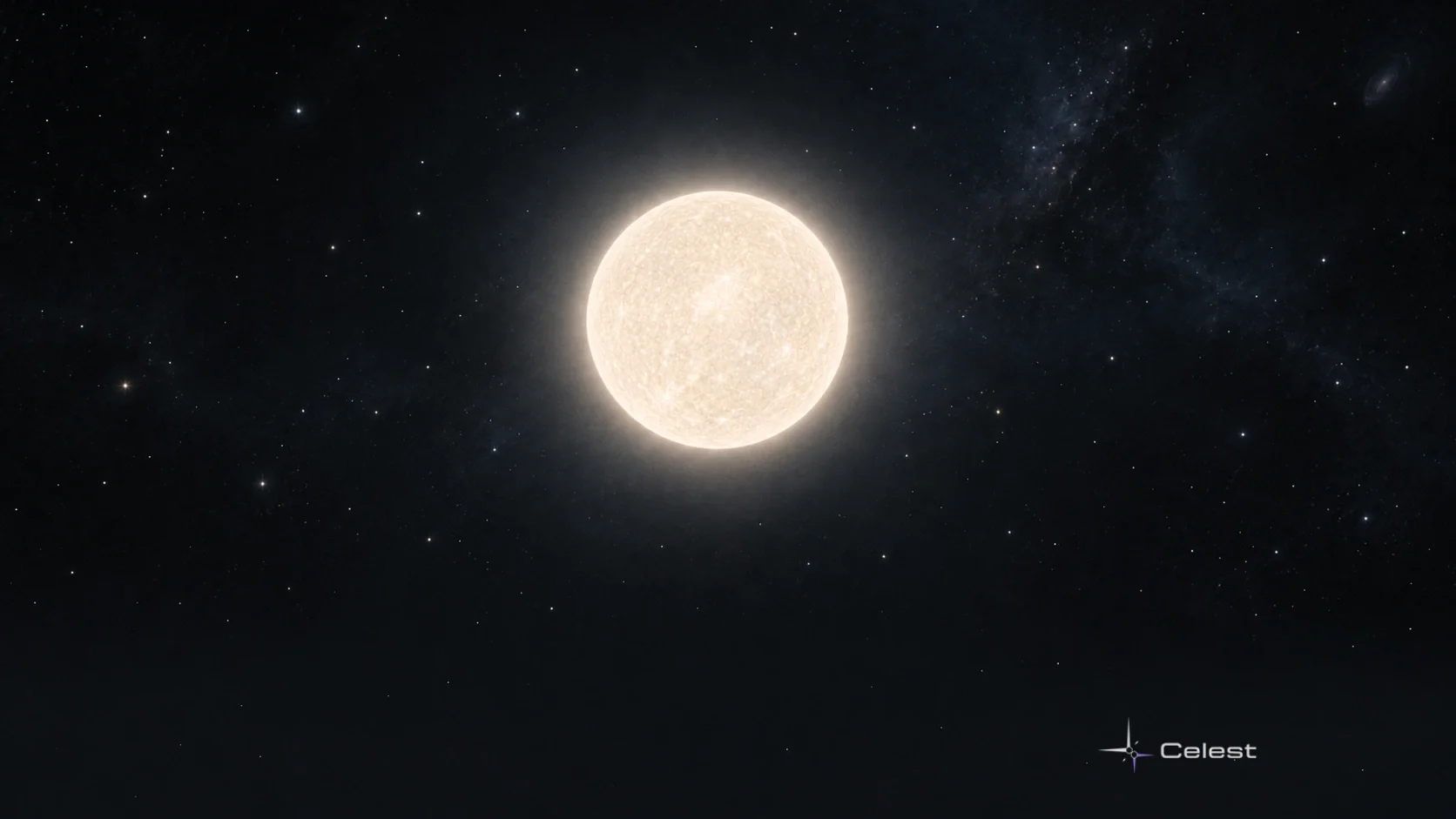
Equuleus is a small constellation just north of the celestial equator, the projection of Earth’s equator onto the sky. Its stars look modest beside the larger patterns nearby. Yet the region contains a magnetic star whose vibrations help probe stellar physics, and a binary whose orbit helps determine the masses of its components.
The Little Horse lies between Delphinus, Aquarius and Pegasus. Use the constellation guide to distinguish their boundaries, then compare the pattern with the live sky for your observing time. Equuleus is a separate region from Pegasus, despite the two horse-related names.
Equuleus at a glance
Keep these identifiers together when comparing a chart with the sky.
- Official abbreviation: Equ.
- Brightest star: Kitalpha, also designated Alpha Equulei.
- Neighbours: Delphinus, Aquarius and Pegasus.
- Evening season: Early northern autumn or early southern spring.
- Research highlights: Gamma Equulei’s pulsations and the binary Delta Equulei.
A Magnetic Star with Several Rhythms
Gamma Equulei belongs to a class of magnetic stars that show rapid pulsations: repeated movements in the stellar material that also affect the light we measure. Studying those movements is called asteroseismology, the investigation of a star’s interior through its vibrations.
In a 2008 study, Gruberbauer and colleagues analysed 19 days of uninterrupted brightness measurements from the MOST satellite. They found seven frequencies associated with five pressure-driven vibration patterns and two harmonics, rhythms at multiples of the dominant frequency. Seven measured frequencies therefore did not mean seven unrelated physical oscillations.
The overlapping rhythms also explained changes in the strength and timing of the main signal. Two nearby frequencies can reinforce and partly cancel one another, a phenomenon called beating. The authors’ result challenged an explanation based on randomly excited oscillations.
Magnetism complicates the interpretation.
A 2024 investigation used the infrared instrument CRIRES+ to examine iron and cerium features in Gamma Equulei’s spectrum, its light separated by wavelength. Magnetic fields split such features into components. The two elements yielded different estimates of the field strength, so choosing the spectral feature matters when interpreting the measurement.
The researchers also reported indications that the measured field changed through the pulsation cycle. That is a result to test and interpret, rather than a reason to draw visible magnetic loops around an ordinary view of the star.
Two Stars That Help Measure Stellar Mass
Delta Equulei is a binary: two stars moving around a shared centre of mass. Its usefulness comes from measurable orbital motion. A reliable orbit connects the pair’s movements with the masses that produce them, providing a demanding comparison for models of how stars work.
The 2005 PHASES study combined 27 exceptionally precise measurements of the stars’ relative positions with earlier position measurements and radial velocities. A radial velocity describes motion toward or away from the observer, inferred from shifts in spectral features.
Both kinds of motion contributed to the orbital model.
The study reported component masses measured to roughly one-percent precision. This describes the uncertainty of that analysis, not the masses themselves. Its remaining limitation came from the precision of the velocity measurements; improving just the positions would not remove that bottleneck.
Rapid Vibrations and a Very Slow Turn
Pulsation and rotation are different processes. Stellar material can oscillate while the star as a whole turns much more slowly. A quick recurring brightness signal is therefore insufficient, on its own, to identify the time needed for a complete rotation.
In 2015, Bychkov and colleagues fitted a long record of Gamma Equulei’s magnetic measurements and inferred a rotation period of about 97 years, with an uncertainty of about three years. Their observations covered 67 years, only part of the proposed cycle. The long period is an inference from that fit, rather than an observed complete turn.
How to Find the Little Horse
Early autumn evenings are a useful starting point for northern observers, including Romania; early spring evenings suit the Southern Hemisphere. The constellation’s position near the celestial equator makes it accessible from most of the inhabited world at suitable times of year.
Start by identifying its three neighbouring constellations on your chart, then compare the few brighter stars within Equuleus. Kitalpha is the brightest reference. The diagram’s connecting lines describe a recognised pattern; the points of light are what you need to match.
Choose a darker site using the observing conditions, and try binoculars if the fainter stars are difficult to distinguish. Let your eyes adjust before deciding which points you can identify. The practical first goal is to recognise the small region, rather than reproduce professional measurements of its stars.
Independent Measurements Test the Models
Gamma Equulei also has measurements beyond its changing light. A 2010 interferometric study, combining light from separated telescopes to measure an extremely small apparent diameter, inferred a radius of 2.20 ± 0.12 times the Sun’s. Its temperature and total light estimates also depended on accounting for a nearby companion.
A pulsation model must fit a real star with independently constrained properties. Radius, temperature, magnetic behaviour and vibration frequencies provide different checks on the same explanation. Equuleus offers that wider lesson: a faint-looking region can help test stellar interiors because several measurements constrain what a successful model must explain.
Leave a comment
Comments appear after moderation.