Spica: Two Hot Stars That Reflect Each Other’s Light
The bright landmark of Virgo is two hot stars completing an orbit in about four days. Their mutual gravity changes their shapes, and a small reflected-light signal offers another way to study the pair.

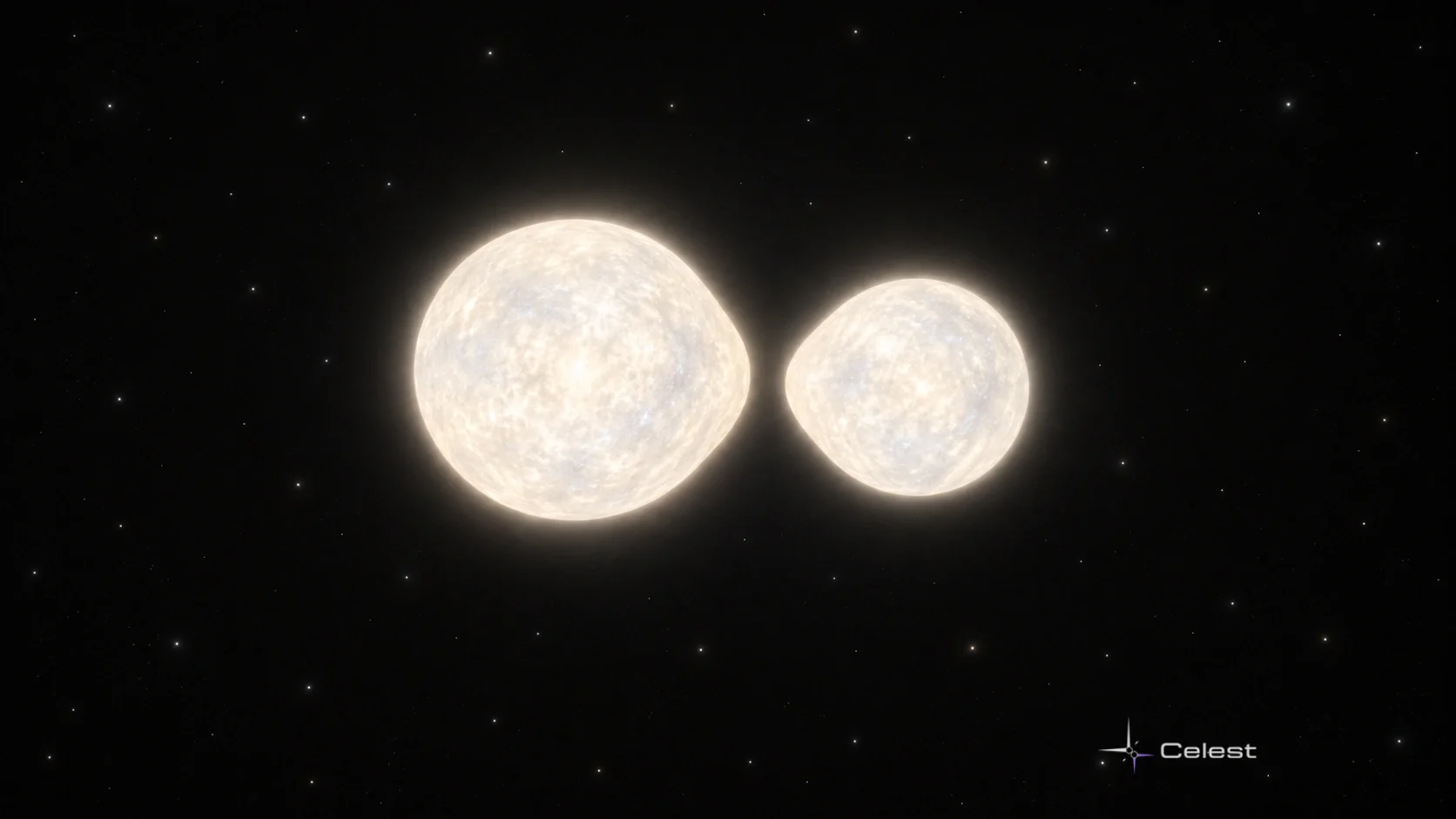
Spica is Virgo’s bright blue-white landmark, but its light comes from two hot stars rather than one. They orbit each other in just over four days. Compare its cool colour with orange Arcturus in the bright-star guide.
Follow the curve of the Big Dipper’s handle toward Arcturus, then continue toward Spica. Match that route to your live sky map, because its orientation changes with the time and place. The star is easy to recognise without separating its two components.
Spica at a Glance
The single-looking point is a close, physically connected pair.
- Other name: Alpha Virginis, or α Virginis.
- Constellation: Virgo, the Maiden.
- Distance: roughly 250 light-years.
- Star types: two hot B-type stars.
- Orbit: about 4.01 days in the cited overview.
- Distinctive effects: tidal distortion, stellar pulsations and reflected light.
How Two Stars Became One Familiar Point
The components are too close together for ordinary visual separation. Instead, the system was identified as a spectroscopic binary in 1890. Each star contributes its own spectral lines, whose positions change as that star moves toward or away from us.
A spectrum separates light by wavelength, revealing features that a bright point conceals. Those changing lines allow astronomers to follow two motions even when the objects cannot be split into two dots by your observing equipment. A binocular view does not need to resolve the pair to be useful.
The four-day orbital period also differs from the time taken for the light to reach Earth. At roughly 250 light-years, Spica sends us a view from about two and a half centuries ago. The circuit of the pair and the journey of its light measure entirely different things.
Their Gravity Changes More Than the Orbit
Spica’s stars are close enough for their mutual gravity to distort their shapes. The pull differs across each star, creating tides rather than leaving a perfect sphere. This is an effect inside a stellar pair, not evidence that the stars are colliding or currently exchanging a visible gas stream.
The larger member also pulsates: its structure supports repeated motions that affect its size and light. The 2016 analysis identified three independent oscillation modes. One had a rhythm related exactly to the orbital frequency, suggesting a tidal origin for that particular motion.
That connection gives the close companion another role. It can influence a star’s behaviour as well as its path through space. It does not mean every variation in Spica follows one simple four-day clock, or that you can watch the surface expand through ordinary binoculars.
Stars Can Reflect Light as Well as Produce It
Stars generate their own light, but that does not prevent them from redirecting some light arriving from elsewhere. In Spica, each component illuminates the other. A 2019 study found that reflection between their atmospheres explained most of a small, orbit-related polarization signal.
Polarization describes preferred directions in the oscillation of light waves. Reflected glare from water or glass can have this property, which is why polarizing sunglasses reduce it. Astronomers measure that property with sensitive instruments to investigate the light from stars.
The reflected contribution is small. The models indicate that the hot stars reflect only a few percent of the light falling on them, while most of the light reaching us is their own emission. They are luminous gaseous stars, not shiny solid mirrors.
The important clue is how the polarization changes through the orbit. Tracking that subtle pattern can reveal information about the pair’s orientation. The analysis therefore adds something beyond measuring brightness or asking whether a telescope splits the two stars.
A Binary Gives Stellar Models a Measurable Test
Following an orbit allows the stars’ masses to be calculated through gravity. The 2016 study obtained roughly 11.4 solar masses for the larger component and 7.2 for the smaller, with uncertainty of about 1.2 and 0.8 solar masses respectively.
Those values concern mass, not diameter. The same analysis found radii about 7.5 and 3.7 times the Sun’s. Keeping the mass and radius estimates together avoids turning a statement about matter into an exaggerated size comparison.
The model-based age was about 12.5 million years, with roughly one million years of uncertainty. In that analysis, masses from the orbit agreed with estimates from stellar-evolution models within the observational errors. Spica supplied a useful check rather than another unexplained disagreement.
Try the Route Through Arcturus
Begin with the familiar curve of the Big Dipper’s handle if it is visible in your evening sky. Follow it to warm-coloured Arcturus, then use the chart to continue to blue-white Spica. Compare those colours before trying to learn every fainter star around Virgo.
The constellation is most prominent on evenings in northern spring and southern autumn. Spica also belongs to the larger Diamond of Virgo sky pattern. Check observing conditions when choosing a session, and remember that chart lines connect landmarks without being real luminous structures.
A Small Reflected Signal Opens Another View
The reflection result offers a way to investigate close stellar pairs that other methods may miss, and to constrain their orientation. That matters because the angle of an orbit helps determine the stars’ masses. A tiny contribution to the light can therefore answer a large structural question.
When you next find Spica, its blue-white point contains more than two sources of light. It carries evidence of mutual gravity, internal motion and light passed between the stars: several relationships hidden inside one easy landmark.
Leave a comment
Comments appear after moderation.