Camelopardalis Constellation: A Cascade of Stars
The Giraffe has few bright naked-eye landmarks, but binoculars uncover a striking chain of stars. A compact cluster, a spiral galaxy and the remnants of a stellar eruption add different physical stories behind the apparent pattern.

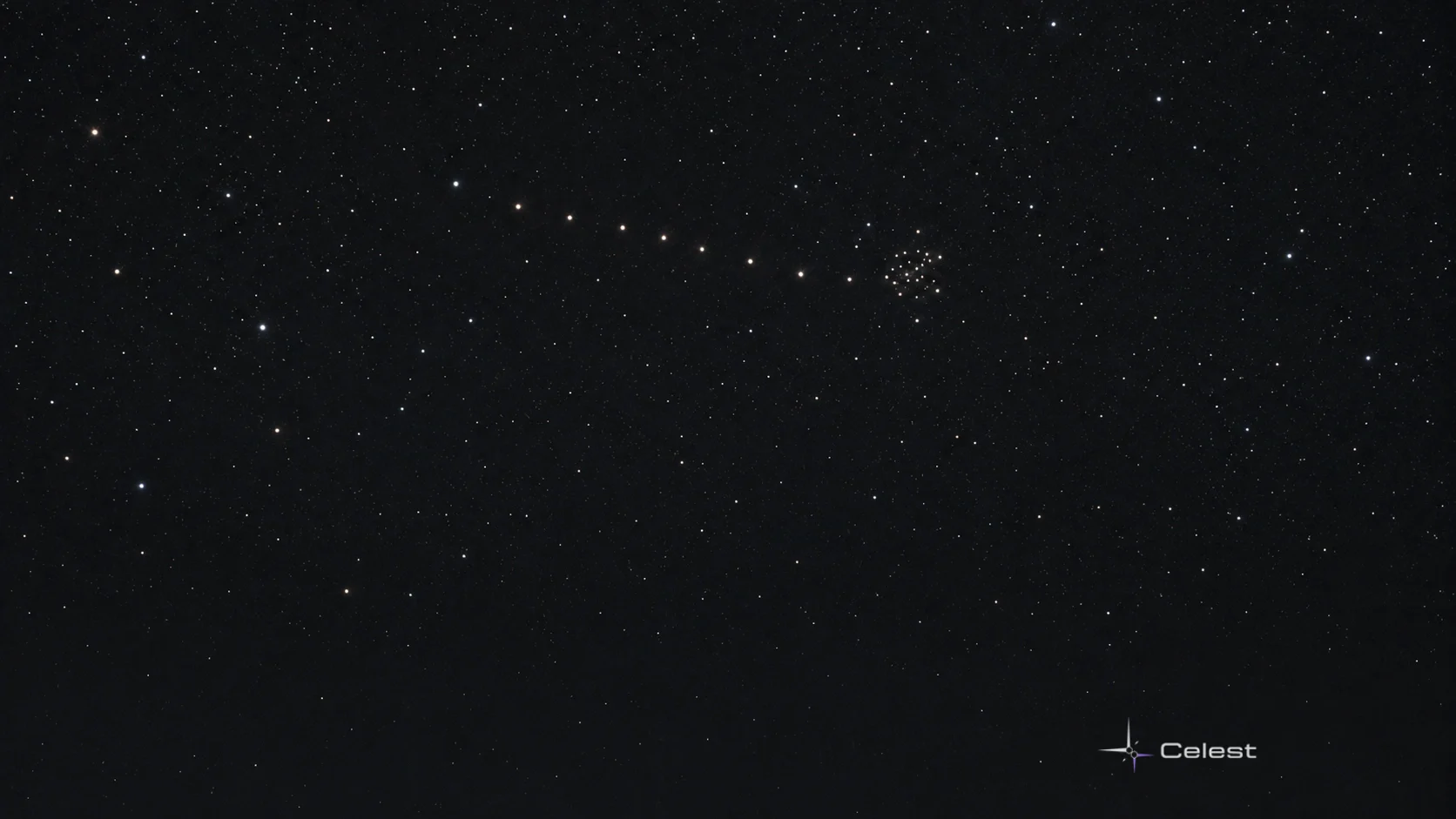
The Camelopardalis constellation, the Giraffe, occupies a broad northern sky region with relatively few bright landmarks. Binoculars reveal a much richer field, including Kemble’s Cascade, a striking chain of stars beside the open cluster NGC 1502. Begin with the constellation guide to separate the region from the smaller patterns within it.
Set the live sky map to your time and location, then compare Camelopardalis with neighbouring Cassiopeia, Perseus and Auriga. The faint outline is only the starting point: this direction also contains the spiral galaxy NGC 2403 and a stellar system whose surrounding gas preserves evidence of an ancient eruption.
Camelopardalis at a Glance
Choose the broad binocular pattern before moving to smaller or fainter objects.
- Traditional figure: the Giraffe, Camelopardalis in Latin.
- Official abbreviation: Cam.
- Northern evening season: late winter.
- Binocular pattern: Kemble’s Cascade, an apparent chain of roughly 20 stars.
- Compact stellar grouping: the open cluster NGC 1502.
- Galaxy to explore: NGC 2403, also called Caldwell 7.
How Do You Find the Faint Giraffe?
Use neighbouring constellations to establish the region before following its fainter stars. Cassiopeia, Perseus and Auriga provide useful chart context. Match their orientation to the actual sky rather than assuming the page always points the same way; Camelopardalis stretches across a large area near the north celestial pole.
Late winter evenings offer a useful general season in the north. Visibility depends on latitude, and farther-south observers see less of the region. In arctic and more northerly temperate locations, it is circumpolar, meaning its stars remain above the horizon as Earth rotates.
Check the observing conditions, then choose one field to learn. Kemble’s Cascade rewards a broad binocular view, while a galaxy needs a more detailed chart. Knowing which kind of object you expect helps distinguish a line of stellar points from the diffuse glow you seek farther away.
What Kind of Pattern Is Kemble’s Cascade?
Kemble’s Cascade is an asterism, a recognised pattern that is not a separate official constellation. NASA’s 2023 description gives about 20 unrelated stars in its chain. Their apparent alignment is part of our view from Earth, rather than evidence that they form one physical stellar group.
The pattern spans more than five full-Moon widths on the sky. This is an angular comparison, not a physical size comparison with the Moon. Use a wide field to follow the line instead of enlarging one small section until the broader pattern disappears.
Near one end sits NGC 1502, a compact open cluster. Open clusters are physical groups understood to have formed together, held relatively loosely by gravity. The chain and the cluster therefore illustrate different relationships, even though both appear in the same binocular field.
First identify the Cascade’s direction on the chart, then look for the more concentrated grouping near its end. A photograph’s diagonal can reverse when the view is rotated, so follow the surrounding stars as well as the apparent line. The pleasing pattern helps you navigate without establishing membership by itself.
What Can You See in NGC 2403?
NGC 2403 is a spiral galaxy also catalogued as Caldwell 7. NASA’s catalogue places it approximately 12 million light-years away. A light-year is a distance, the path light covers in a year; this figure belongs to the galaxy, not every object within Camelopardalis.
Binoculars or a telescope can reveal an elongated diffuse patch under suitable skies. Identifying that glow is different from seeing the detailed spiral structure in a Hubble photograph. Use a detailed field chart and learn the nearby points before deciding an uncertain patch is the galaxy.
Professional images reveal dusty structure and star-forming hydrogen regions. Hot young stars release ultraviolet light that energises the surrounding gas. Some conspicuous points, meanwhile, are foreground stars in our Milky Way rather than members of the galaxy, another reminder that one image can combine different distances.
NGC 2403 also hosted Supernova 2004dj, observed in 2004. Hubble followed the event with imagery and further observations used to investigate stellar explosions and the material they release. A recorded outburst adds a dated physical event to a galaxy that otherwise appears as a quiet patch.
What Does the Gas Around Z Cam Reveal?
Z Camelopardalis, usually shortened to Z Cam, is a binary system containing a white dwarf and a companion supplying material. A white dwarf is a dense stellar remnant. Gas forms an accretion disc as it approaches the compact star, and disc activity contributes to the system’s recurrent dwarf-nova outbursts.
A classical nova involves a different process: material accumulated on the white dwarf undergoes unstable nuclear fusion. NASA’s 2007 GALEX account described a faint shell around Z Cam as evidence of such a stronger eruption thousands of years earlier. Its familiar present behaviour had not told the whole story.
A 2023 research abstract reported deeper imaging with the Condor Array Telescope and a second, even fainter shell. The older eruption’s age remains uncertain; the observations do not fix an exact historical date or forecast another eruption. Studying expanding gas adds information that a single view of the star cannot provide.
Camelopardalis brings these distinctions into one region: an apparent chain, a physical cluster, a distant galaxy and material carrying traces of past stellar activity. Recognising the pattern starts the exploration. Measurements reveal which stars belong together and what their present light leaves unsaid about their history.
Leave a comment
Comments appear after moderation.