Milky Way: Our Galaxy Seen From Within
The pale band across a dark sky is part of the galaxy we live in. Its dark patches are often clouds hiding background starlight, and those same clouds can become bright subjects for infrared telescopes.

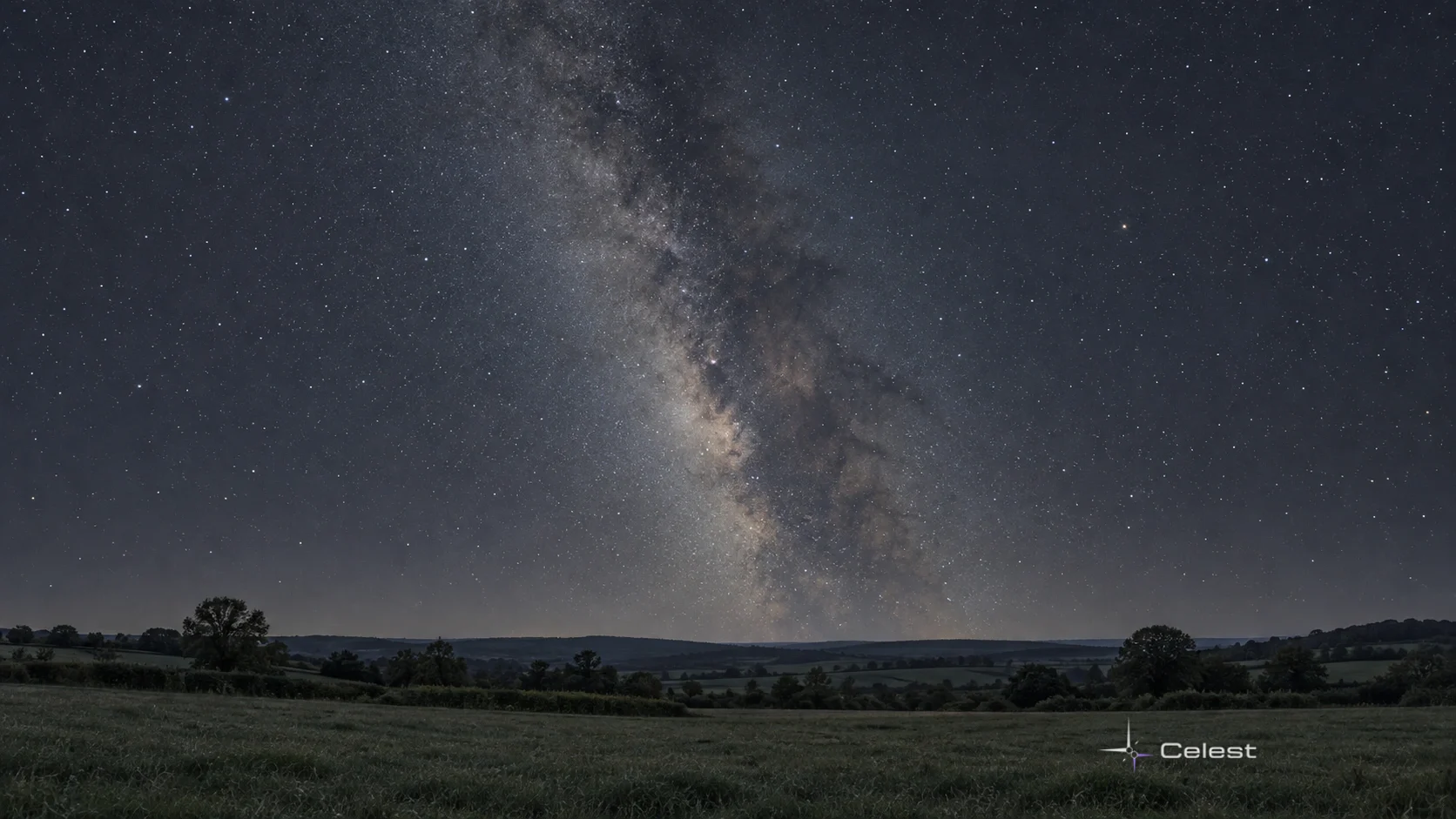
The Milky Way is the galaxy containing our Sun and Solar System. From a dark location, part of it appears as a faint pale band across the sky. We see that band from within the galaxy’s disk, looking through concentrations of stars, gas and dust. Use the constellation guide to learn the sky around it.
The darker patches within the band are interesting too. Some mark clouds obscuring background starlight rather than empty breaks in the galaxy. Change the observing wavelength, and the same material can reveal a very different view.
Milky Way at a Glance
- Type: a barred spiral galaxy, reconstructed from observations made inside it.
- Our location: within its stellar disk, away from the central region.
- Disk scale: roughly 100,000 light-years across, without a sharply defined outer edge.
- Solar System’s galactic orbit: about 240 million years in NASA’s general overview.
- Appearance from Earth: a broad faint band, clearer under a dark sky.
- A notable dark feature: the Great Rift, caused by intervening dust clouds.
The familiar stars forming constellations are part of this same galaxy. Explore individual stars alongside the wider band: a nearby bright star and the unresolved glow of many more distant stars offer different views of our galactic surroundings.
Why Do We See a Band Rather Than a Spiral?
The Milky Way contains a broad disk of stars and interstellar material. Looking along that disk puts a great deal of distant starlight into similar directions. Looking away from it generally samples a different, less crowded view. That concentration creates the pale strip running around our sky.
We have not sent a camera far outside the Milky Way to photograph the whole structure from above. The familiar spiral drawings are reconstructions. Astronomers use markers such as young stars and glowing gas clouds, mapping their positions to infer the arms and other large-scale features.
The stellar population is also estimated, not individually counted in a complete census. NASA’s educational overview gives roughly 100 billion stars and notes the difficulty of counting from inside. Many are faint or hidden, so the handful of familiar constellation patterns represents a small part of a much larger system.
The Dark Rift Is Material in the Way
The Great Rift forms a striking dark division through parts of the luminous band. Clouds of gas and dust between us and inner regions dim or block much of the visible starlight. The dark appearance therefore carries information about intervening material, rather than proving there are no stars behind it.
For northern observers, a familiar stretch runs from the Summer Triangle toward Sagittarius. Its exact placement during your observing hour changes with the date and location. A photograph’s composition should not be treated as the same overhead view for every observer.
This is different from simply noticing a gap between bright constellation stars. A broad dark lane against the Milky Way’s faint background glow shows the effect of material along that line of sight. A dark viewing location and time to adjust make those details easier to notice.
Infrared Can Reveal Hidden Stars
Infrared observations often see farther through dust than visible-light images. Astronomers can use them to study stellar populations otherwise obscured from our eyes. It is not an unlimited ability: particularly dense clouds still appeared dark in a Hubble infrared view released in 2016.
The bright colours in such published images represent measurements translated into a visible display. Infrared itself is outside human vision. A red-looking feature in an infrared picture may follow that image’s mapping scheme, rather than describing the colour you would see from a spacecraft window.
Dust Can Also Be the Source of Light
There is another role for infrared beyond seeing through clouds. ESA’s Herschel observatory detected the glow from dust particles themselves at far-infrared wavelengths. Material that interferes with an optical view can become the subject of a different measurement.
The Herschel panorama presented in 2016 combined several hundred hours of observing and covered almost 40 percent of the galactic plane. It was not one instantaneous photograph or a complete map of every star. Its filaments and dense knots helped researchers examine how gas and dust gather into regions where stars form.
What Should a First Watch Look Like?
Expect a subtle pale haze, not the vivid colours and intricate detail of a long-exposure photograph. A camera collects light over time and processing can strengthen contrasts. Your eyes give a different experience, especially before they have adjusted to darkness.
Check the Moon before choosing an outing. Bright lunar light reduces contrast in the faint band, while a darker interval makes the dust lanes easier to detect. Start with a broad naked-eye view, tracing the pale band and the darker lanes within it.
The best visible part also depends on the season and hemisphere. A northern summer recommendation should not be copied into a universal appointment. Learn your sky’s constellations and allow time to notice the faint background between brighter stars.
A Dark Patch Can Tell More Than an Empty Gap
The Milky Way’s band places us inside a galaxy, and its dust reminds us that the view is selective. Some stars are hidden by material along the path. At other wavelengths, that material can glow and reveal structures associated with the formation of new stars.
That is the useful change of perspective for your next dark-sky watch. The pale light and dark lanes are two parts of one physical scene. A region looking dark to your eyes can still contain material, obscure distant stars and produce light that another kind of telescope can detect.
Leave a comment
Comments appear after moderation.