Arcturus: An Orange Giant Beyond the Sun’s Current Stage
A bright point with a warm colour belongs to a star that has expanded beyond the Sun’s present stage. Its apparent simplicity hides a much larger atmosphere.

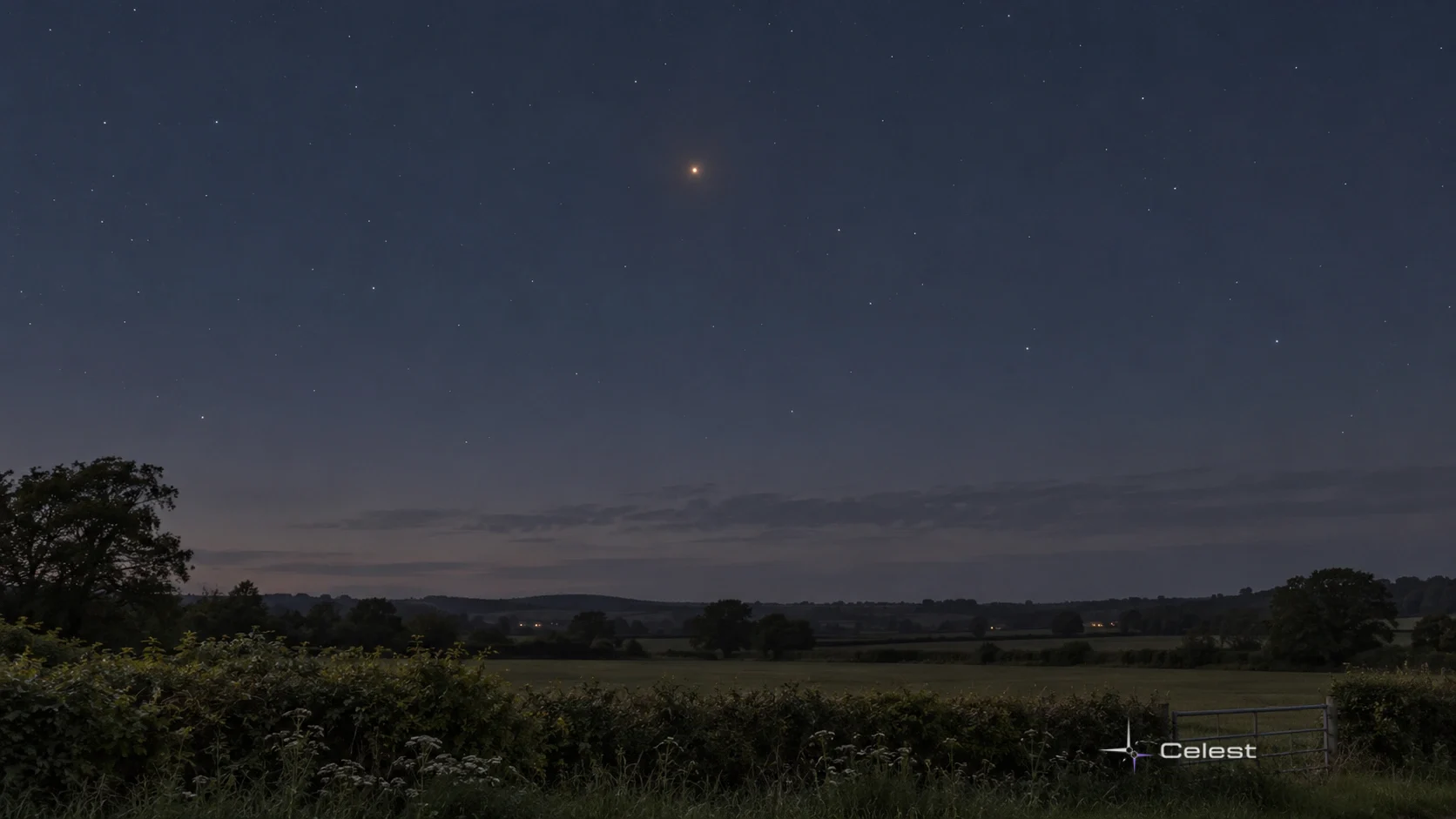
Arcturus is a bright orange giant star in Boötes, the constellation traditionally called the herdsman. It lies about 37 light-years away and is one of the most prominent stars in the night sky. A familiar curve of stars in the Big Dipper can help lead you toward it.
Use the bright-star guide to check its identity before you explore the surrounding region.
Match that information with the live sky map for your location and time, rather than relying on a fixed direction from a seasonal illustration.
Arcturus at a Glance
- Constellation: Boötes.
- Appearance: a bright point with a warm orange colour.
- Distance: approximately 37 light-years.
- Stellar type: an evolved red giant.
- Size: about 25 times the Sun’s radius in one well-studied analysis.
- Finding clue: follow the curve of the Big Dipper’s handle.
An Orange Point With a Much Larger Body
From Earth, Arcturus looks like a point. That appearance does not tell you its actual size. Distance makes a giant star appear small, just as it does other stars beyond our solar system.
A 2011 analysis by Ramírez and Allende Prieto inferred a radius about 25.4 times the Sun’s, with a quoted uncertainty of 0.2 solar radii. A diameter comparison gives the same ratio, so the star can be described approximately as 25 times wider. The same study inferred a mass of about 1.08 solar masses, with uncertainty of 0.06.
The contrast is useful: a star can expand greatly without needing a mass 25 times the Sun’s. Radius measures how far its outer layers extend; mass measures the amount of material. They are different properties, even when a picture makes a large object feel automatically heavier.
What the Warm Colour Means
Arcturus belongs to the red-giant category, although its visible colour is better described as orange. The word red is part of the broad stellar classification, not a promise of a vivid crimson point in your eyepiece.
Colour relates to the effective temperature of the light-emitting surface. The 2011 analysis found about 4,286 kelvins, with uncertainty of 30 kelvins. The effective temperature characterises the light-emitting layers, rather than the much hotter core.
Hotter stellar surfaces tend to look bluer or whiter, while cooler ones tend toward redder colours. Intrinsic brightness also depends on the emitting area. Apparent brightness in our sky adds another factor: distance. Being among the brightest-looking stars does not make Arcturus the most powerful star in the galaxy.
A Star Beyond the Sun’s Present Stage
Red giants have moved beyond the long phase in which their cores fuse hydrogen. Their outer layers expand and cool as their internal structure changes. The category gives a useful explanation for Arcturus’s large size and warm colour, without establishing every detail of its current interior.
The same 2011 study estimated an age around 7.1 billion years, with uncertainty extending roughly 1.2 billion years lower and 1.5 billion years higher. That makes an older-than-Sun comparison reasonable: our Sun is about 4.6 billion years old and is still a main-sequence star.
The estimate is not an exact birthday or a countdown. Stellar ages come from combining observations with models, and the uncertainty matters. A beginner can retain the main point without treating every decimal as a permanent fact: Arcturus represents an evolved stage beyond the Sun’s current one.
How to Find Arcturus
Locate the Big Dipper, the recognisable pattern in Ursa Major, on a chart set to your observing session. Follow the gentle curve of its handle outward. The traditional mnemonic is to “arc to Arcturus.” It gives you a path through the sky, not one fixed compass bearing for the whole year.
Confirm the position against the map before identifying a bright orange point. Other stars can also have warm colours. The combination of brightness, neighbouring stars and the handle’s curve is more dependable than colour alone.
The observing conditions page helps you choose a clear session and consider the local sky. Start with unaided eyes while the star and the Dipper are usefully placed. Binoculars can help compare the surrounding field, but they do not turn the stellar point into a visible giant globe.
What a Telescope Can and Cannot Show
An ordinary telescope view still shows Arcturus as a stellar point. A halo, a cross or an enlarged bright spot can come from the optics and the image recording process. Those features should not be mistaken for a direct view of the star’s physical edge.
You can still learn something from that modest view. Identifying Arcturus connects a position and a colour with measurements of a very different kind: temperature, radius and an estimated evolutionary stage. The visible point is the starting landmark, while detailed scientific measurements tell the larger story.
Old Light From an Evolved Giant
A light-year is a distance, not an age. At roughly 37 light-years away, the light you receive from Arcturus began its journey about 37 years earlier. The star itself is billions of years old; the two timescales answer different questions.
On your next observation, follow the curve of the Dipper and pause at the orange point. It marks a star whose mass can be near the Sun’s while its atmosphere extends much farther outward. That contrast is a small, visible introduction to how stars change during their lives.
Leave a comment
Comments appear after moderation.