Betelgeuse: Orion’s Red Supergiant and Its Changing Light
The orange-red shoulder of Orion changes for more than one reason. Its dramatic fading exposed dust forming near the star, while newer observations suggest a faint companion disturbs its extended atmosphere.

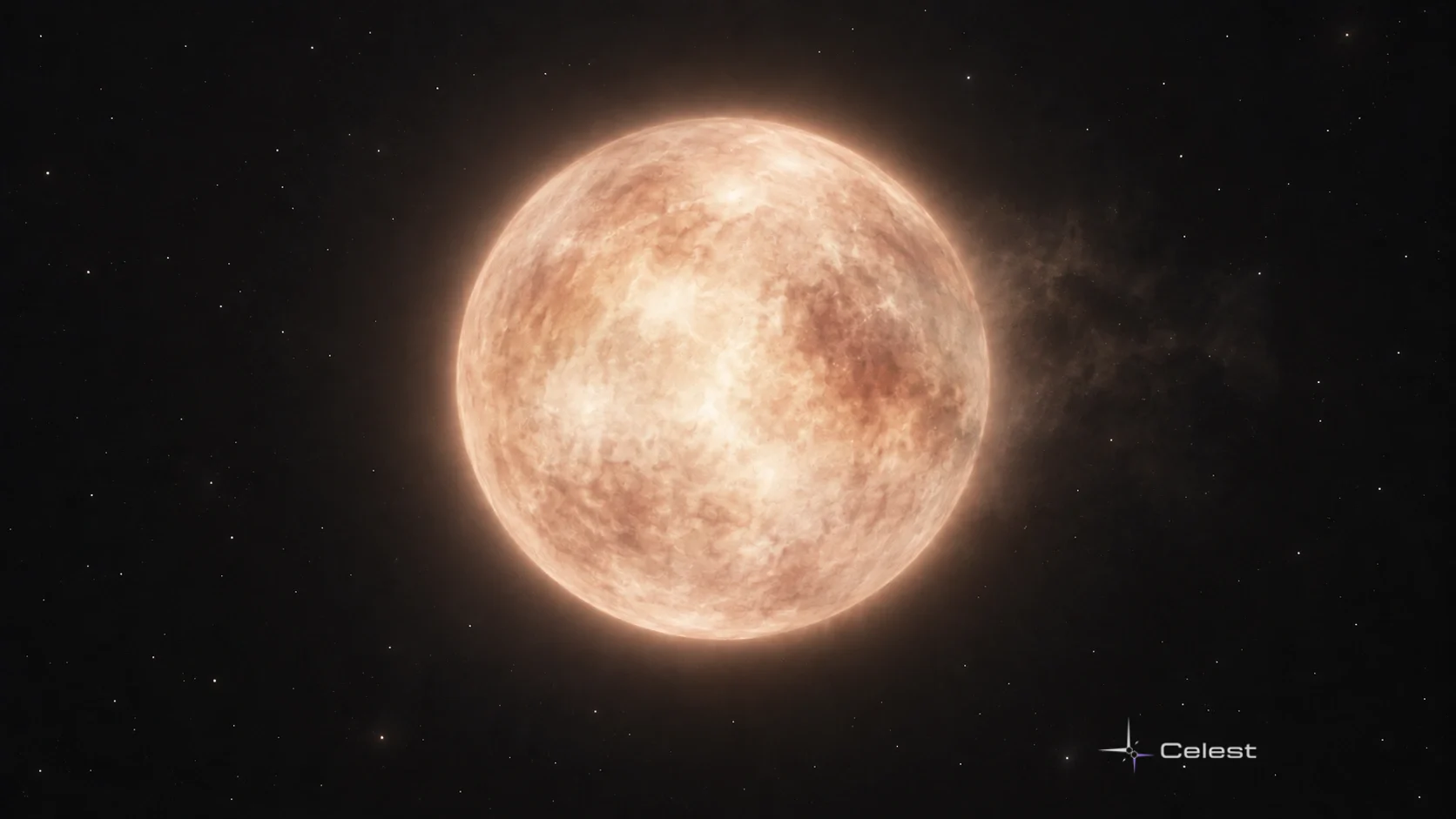
Betelgeuse is Orion’s orange-red supergiant, a star whose outer layers have expanded enormously. Its light changes, sometimes dramatically, and nearby gas and dust help explain why. Compare its warm colour with blue-white Rigel in the bright-star guide.
Start with Orion’s three nearly aligned belt stars, then look toward its bright shoulders. The orange-red landmark is Betelgeuse. Check the live sky map for the orientation of Orion on your observing date, rather than treating left or right on a picture as a permanent direction.
Betelgeuse at a Glance
The large red star carries several different kinds of change.
- Other name: Alpha Orionis, or α Orionis.
- Star type: a red supergiant, in an expanded advanced stage.
- Sky landmark: a shoulder of Orion, north of the belt stars.
- Age: roughly 10 million years in NASA’s approximate profile.
- Distance: several hundred light-years; official rough descriptions differ.
- Brightness: variable, with repeating and irregular changes.
A Young Star Can Already Be a Supergiant
Ten million years is young compared with the Sun’s roughly five-billion-year history. Betelgeuse nevertheless occupies a much more advanced stage because it is considerably more massive. Greater mass speeds up the use of the fuel that supports a star’s light.
Its expanded outer layers are hundreds of times the Sun’s size, while its surface is cooler. NASA’s profile gives a rough surface temperature of 3,300°C, compared with about 5,500°C for the Sun. Its orange-red appearance is therefore not a sign that its surface is hotter than a blue-white star’s.
The precise physical scale also depends on interpretation and adopted distance. One NASA overview uses around 700 light-years; a January 2026 report uses roughly 650, while its Orion overview gives about 550. Those rough values should not be mistaken for one exact modern measurement.
The common implication is that light reaching your eyes began its journey centuries ago. A sudden change noticed from Earth concerns when that changed light arrives here, not an instantaneous message from the star.
What Happened During the Great Dimming
In late 2019 and early 2020, Betelgeuse faded far more strongly than in its ordinary variations. Images followed a particularly dark southern region of its visible surface. By April 2020, its usual brightness had returned.
The 2021 analysis connected the event with an expelled gas bubble and a cooling surface patch. The combination allowed dust to form close to the star, blocking part of its light along our view. Fading did not require the whole star to stop producing light.
This distinction changed what the event revealed. The observations supplied evidence of dust forming rapidly around a cool evolved star. Material leaving a stellar surface can become part of the surrounding environment, rather than simply disappearing when it stops contributing to the bright point.
Several Changes Share the Same Bright Point
Betelgeuse is a semiregular variable, meaning some brightness changes have an approximate rhythm while others are irregular. Its roughly 400-day pulsation timescale differs from a much longer secondary cycle. The extraordinary dust-related fading was a separate event, not merely another perfectly timed repetition.
Newer observations add a possible interaction. A January 2026 Hubble report described a dense gaseous wake in the extended atmosphere, traced through nearly eight years of changing light. The interpretation links that disturbed gas with a companion moving through the giant’s outer surroundings.
An artist’s illustration can explain the proposed arrangement without constituting a resolved picture of the small star. Different observations answer different questions: changing spectra trace gas behaviour, while a separate imaging search tries to identify the source beside the giant.
New Companion Evidence Still Needs Interpretation
A July 2026 report presented December 2024 VLT observations as the strongest direct-image evidence yet for likely Betelgeuse B. The team inferred a companion with roughly two to three solar masses, while saying another observation on the other side would provide further confirmation.
An August 2026 preprint proposed a different explanation for part of that point’s brightness: light from Betelgeuse scattered by dusty material associated with the companion. That model seeks to reconcile disagreeing mass estimates. It does not establish that Betelgeuse is single.
The evidence for an interaction and the exact properties of the companion are therefore separate questions. More observations at different wavelengths can help distinguish a star’s own light from light redirected by its surroundings.
What You Can Notice in Orion
Begin with the belt and compare the bright corners around it. Betelgeuse is the warm-coloured shoulder; Rigel is the blue-white foot. Their colour contrast is visible without resolving their stellar surfaces, and provides a useful first comparison of different temperatures.
Return to the same pattern on later nights if you want to follow brightness changes. Keep the stars you compare consistent instead of interpreting every glance as a new event. Check observing conditions before a planned comparison so the background sky does not become an unnoticed part of it.
A Changing Surface Is Not an Explosion Clock
Betelgeuse is expected eventually to undergo a supernova, but its fading does not supply an exact date. Dust formation, pulsation and a companion’s influence concern different physical processes and should not be collapsed into one prediction.
The immediate discoveries are about how an enormous star loses material and interacts with its surroundings. Its outer layers can change in ways observable during a human lifetime, even while the timing of its final collapse remains uncertain.
Leave a comment
Comments appear after moderation.