Capella: A Bright Point With Two Giant Stars
Two giant stars dominate the familiar bright point in Auriga. Their orbit and different stages of evolution turn a naked-eye landmark into a useful test of how stars change.

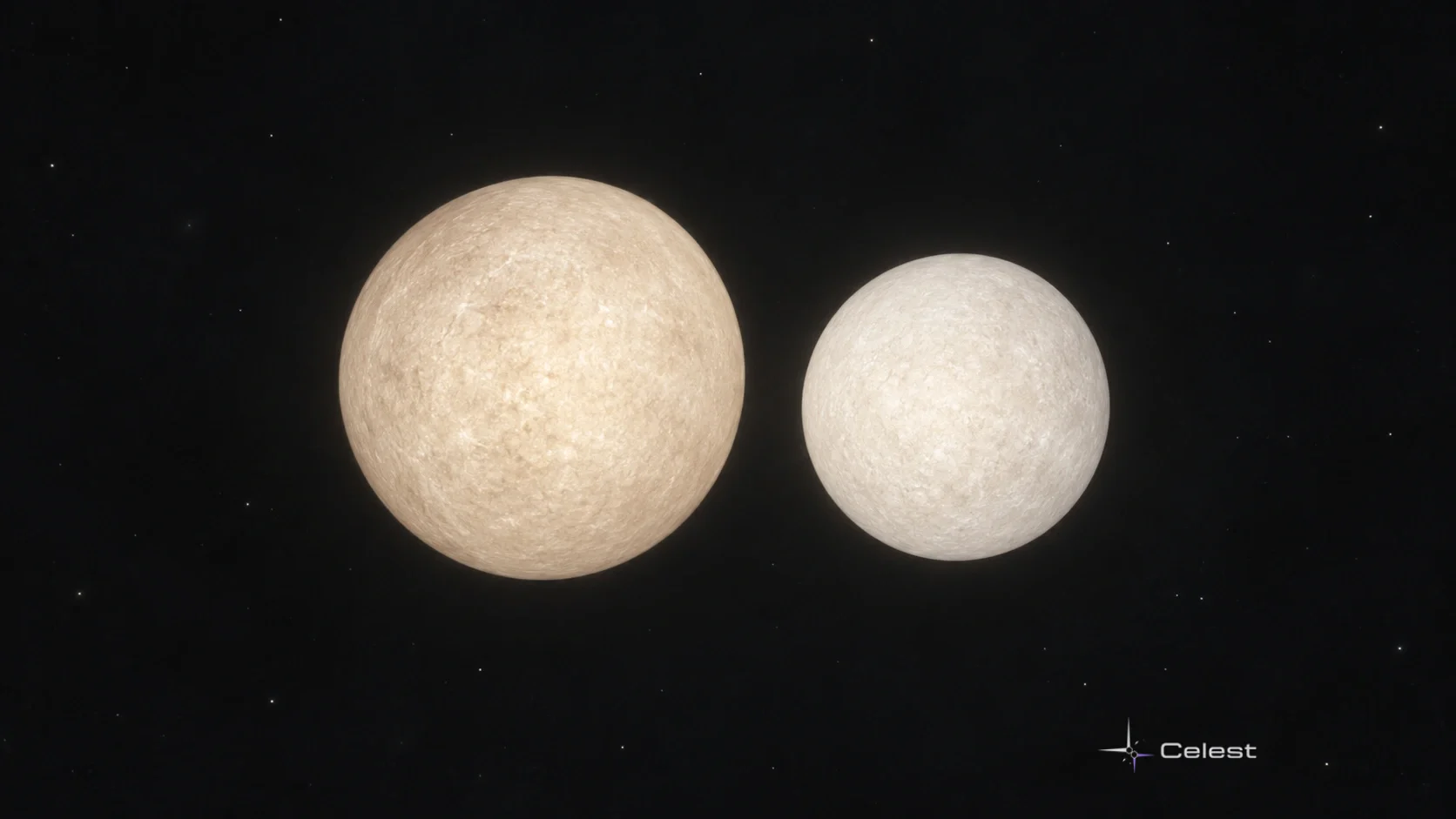
Capella is the brightest star-like point in Auriga, the Charioteer, about 43 light-years away. Its light comes mainly from two giant stars in a close orbit, with a much fainter pair farther out. Use the bright-star guide to compare this golden landmark with the surrounding sky.
Auriga sits beside Gemini, whose conspicuous Castor–Pollux pairing can cause confusion. Match the neighbouring patterns with the live sky map for your date and location before identifying a bright point as Capella.
Capella at a Glance
The familiar point and the physical system are different views of the same object.
- Constellation: Auriga, the Charioteer.
- Other designation: Alpha Aurigae.
- Distance: approximately 43 light-years.
- System: two bright giants with a farther, fainter red-dwarf pair.
- Main-pair orbit: about 104 days.
- Ordinary view: one bright point with a pale golden colour.
Two Giants Dominate the Light
A red dwarf is a small, relatively cool star. Capella’s distant pair is much fainter than the two central giants, so the bright point you recognise is dominated by the close pair. Calling the central object a binary describes that pair, rather than erasing the system’s other two members.
The giants are not identical. A 2015 analysis by Torres and colleagues inferred radii around 12 and 9 times the Sun’s. The reported values were 11.98 ±0.57 and 8.83 ±0.33 solar radii. The larger star also had the cooler effective surface temperature.
Effective temperature describes the layers that emit the starlight, not the temperature inside the core. The same analysis gave approximately 4,970 ±50 and 5,730 ±60 kelvins. Size and colour therefore provide different parts of the portrait, even though the combined light appears as one point.
A Close Pair With a Measurable Orbit
The bright giants circle one another in about 104 days. The 2015 orbital solution placed their typical separation at roughly 111 million kilometres. The period belongs to their mutual orbit, not the rotation of either star or the much wider motion of the faint companions.
Distance makes the close pair difficult to separate visually. A scientific illustration showing two large globes is an explanatory view from imagined nearby space; it is not the appearance a beginner should expect in an eyepiece.
The distance estimate has also improved through measurement. The 2015 orbital analysis gave 13.159 ±0.015 parsecs, about 43 light-years. A parsec is another astronomical distance unit. The older shorthand of forty light-years is coarser, rather than evidence that the system suddenly moved three light-years away.
How Motion Helps Astronomers Measure Mass
Spectroscopy separates light into wavelengths and reveals recognisable features within it. When a star moves toward or away from us, those features shift. Repeated measurements let astronomers follow the motions of Capella’s two giants through their orbit.
Combining those motions with the measured orbital geometry gives estimates of mass. Each giant contains roughly two and a half times the Sun’s mass. The 2020 STELLA analysis refined earlier results by about one percent, a small change that matters in precise tests of stellar models.
Other wavelengths answer other questions. During Chandra’s early observations in 1999, Capella produced a detailed X-ray spectrum containing features associated with magnesium, neon and iron. That is evidence about energetic stellar material, not a prediction of the colours you see while stargazing.
Giants Can Be Younger Than the Sun
The giant label describes an evolved state and expanded outer layers. It does not mean the star must be older than every smaller star. More massive stars move through their lives faster than lower-mass ones.
The 2015 models gave Capella’s main pair a shared age range of roughly 590–650 million years. Our Sun is about 4.6 billion years old and remains in its long hydrogen-burning main-sequence stage. Capella’s giants can therefore be younger while already having evolved further.
Even the pair does not occupy precisely the same stage. The 2015 comparison placed the larger primary near the end of core helium burning, while the secondary was moving rapidly toward the giant stage. Those are model interpretations built from measurements, with more detail than the combined naked-eye point reveals.
How to Observe Capella
Learn Auriga’s position on the chart, then identify its brightest landmark. Keep the neighbouring Gemini pattern in view so that you do not mistake one constellation for the other. The useful permanent relationship is between patterns; a fixed direction from an old monthly guide is not permanent.
Choose a session through the observing conditions page, and start with unaided eyes. Binoculars can help compare the surrounding stars. The warm-coloured point remains useful even when you cannot see separate components.
If it twinkles strongly when low in the sky, compare it again when better placed. Light passing through Earth’s atmosphere can change the apparent colour and steadiness, without requiring the stars themselves to transform rapidly.
One System Tests More Than One Stellar Clock
Capella gives researchers two giants whose shared setting can be compared with different radii, temperatures and stages. An orbital measurement helps constrain their masses; a spectrum tests composition and motion; models connect those measurements with evolution.
The lesson goes beyond discovering a hidden companion. A star’s age alone does not tell you which stage it has reached. The material it began with and the pace of its evolution matter too, so two giants younger than the Sun can already show a later chapter of stellar life.
Leave a comment
Comments appear after moderation.