Castor: Six Stars Behind One Bright Point in Gemini
The whiter head of Gemini is a hierarchy of three stellar pairs. Some members move around companions in days, while the bright visual pair follows an orbit lasting centuries.

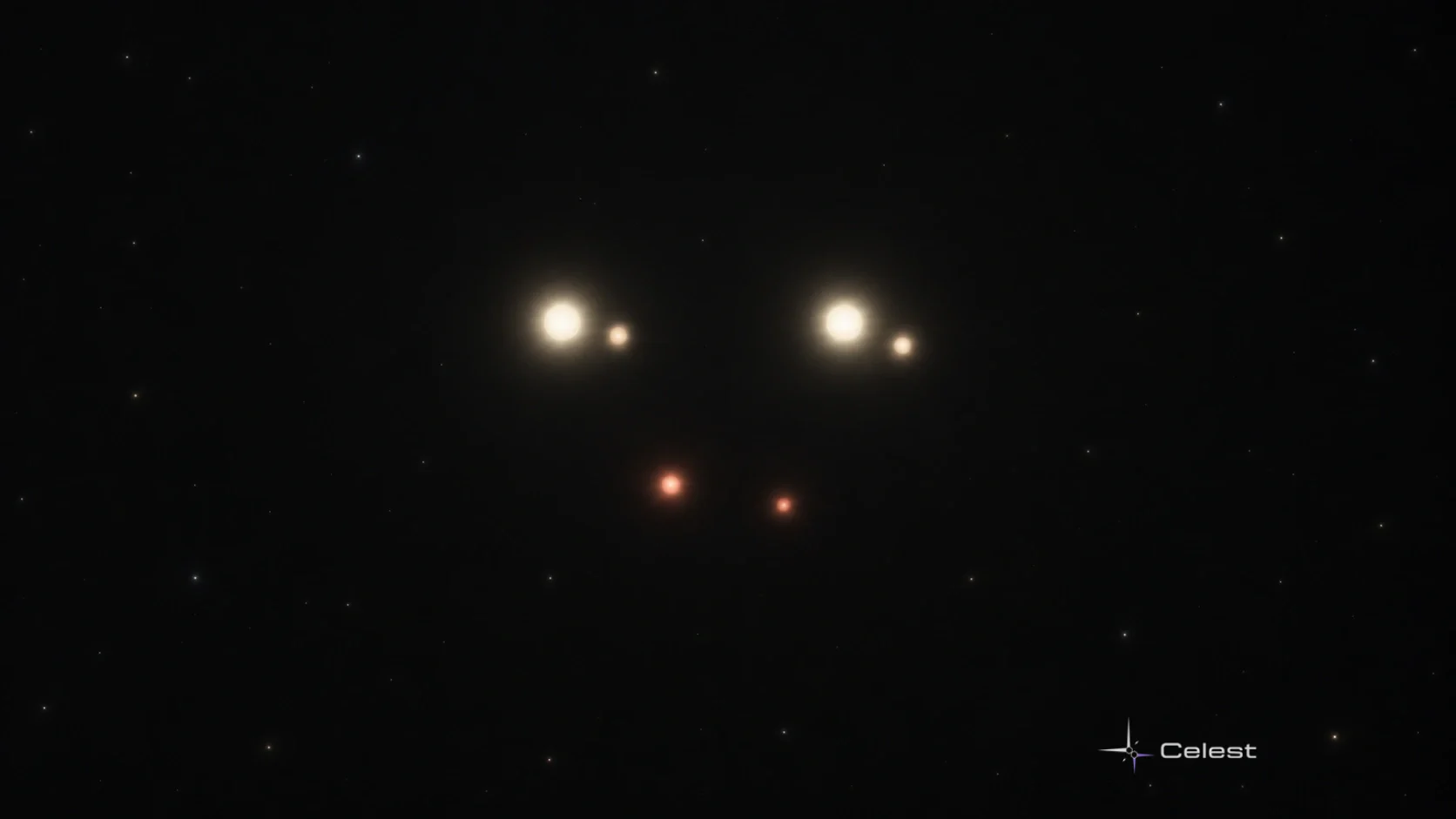
The Castor star system contains six stars, although it looks like one bright point beside Pollux in Gemini. Its light comes from three stellar pairs arranged in a larger gravitational hierarchy. Compare the two familiar head stars in the bright-star guide.
Castor appears whiter and slightly fainter than Pollux, roughly 51 light-years away. Use the live sky map to find it from Orion on your observing night. Pollux looks paired with it in the constellation drawing, but belongs to a separate physical system.
Castor at a Glance
The bright landmark contains several layers of structure.
- Other name: Alpha Geminorum, or α Geminorum.
- Constellation: Gemini, the Twins.
- Distance: approximately 51 light-years.
- Total members: six stars, organised as three binaries.
- Bright visual pair: Castor A and B, each hiding a close companion.
- More distant pair: Castor C, also called YY Gem.
Three Pairs, Rather Than Six Equal Neighbours
The labels A, B and C refer to three parts of the hierarchy. Castor A contains a bright A-type star and a faint cool companion. Castor B has a similar arrangement. Castor C consists of two cooler M dwarfs, small stars with a different appearance from the bright primaries.
A and B also orbit each other as a wider pair, while C lies farther from them. Each level has its own scale and motion. A drawing of six equally spaced stars on one circular track would miss the structure that makes the system interesting.
This is a real stellar family rather than a chance alignment. Its physical relationships are established through measurements, not simply the number of dots a telescope can show. The apparent pairing of Castor and Pollux is a different matter: that relationship helps you read the constellation.
Different Orbits Run on Different Clocks
The broad orbit between A and B takes about 450 years in the 2022 analysis. Older descriptions give 467 years. The change reflects a refined orbital estimate after additional observations, rather than a claim that the stars suddenly sped up.
Inside A, the close companion follows an orbit of about nine days. The two M dwarfs of YY Gem move much faster still, completing their own circuit in roughly 19 hours in the cited overview. One system therefore includes motions measured in hours, days and centuries.
YY Gem is also an eclipsing binary. From our viewpoint, one dwarf can pass in front of the other, changing the measured light. An eclipse reveals the geometry of that particular pair; it does not mean all six stars take turns crossing the same shared line of sight.
Better Resolution Reveals What Glare Hides
An amateur telescope can separate the brighter visual pair under suitable conditions. That does not display all six members. The close companions in A and B were especially difficult to distinguish beside their much brighter primaries.
The 2022 work used CHARA interferometry, combining light from several telescopes to gain much finer angular resolution. It spatially resolved those close companions and combined the results with decades of velocity measurements and centuries of visual positions.
This layered approach gives different observations different jobs. Positions trace the apparent orbit; changes in spectral lines reveal motion toward or away from us. High-energy observations had also supported the presence of cool dwarf companions, whose activity can produce X-rays unlike the ordinary visual light of the bright A-type stars.
The Orbits Do Not Form One Flat Arrangement
The new three-dimensional solution showed that the orbital planes differ considerably. The short-period orbit inside A is almost at right angles to the wider A–B orbit. B’s inner plane also has a substantial tilt relative to that outer orbit.
These angles describe planes within the system, not directions on your sky chart. The hierarchy is therefore more complicated than three nested rings lying flat on a page. Its measured arrangement offers clues for studying how the system developed and how its components influence one another.
The same study determined the masses of the four stars in A and B to better than one-percent precision. Using primary-star sizes with stellar models, it inferred an age near 290 million years. The age remains a model estimate, while the orbital masses provide measurements those models must explain.
Find the Twins, Then Separate the Tasks
Start from Orion and use your chart to continue toward Gemini’s two heads. Compare warm-coloured Pollux with whiter Castor before looking for anything fainter. The constellation is especially prominent in evening skies in northern winter and southern summer.
If you have a telescope, try the bright A–B visual pair as a separate observing goal. Check observing conditions, then treat the split as one layer of the system. A six-star illustration describes relationships that your eyepiece view will not necessarily reveal.
One Point Can Preserve Centuries of Evidence
Castor’s wide pair has been followed for more than three centuries, helping show that a double star can be a physically orbiting system. Modern resolution adds companions and tilted orbital planes to that long record.
The result is more than a surprising star count. Castor links a simple naked-eye landmark to several different gravitational clocks, and lets measurements across very different timescales test the history of one complex stellar system.
Leave a comment
Comments appear after moderation.