Corona Borealis: A Portrait of the Northern Crown
A U-shaped arc of seven stars tucked between two bright guide stars, Corona Borealis hides a star that dims without warning and one that explodes.

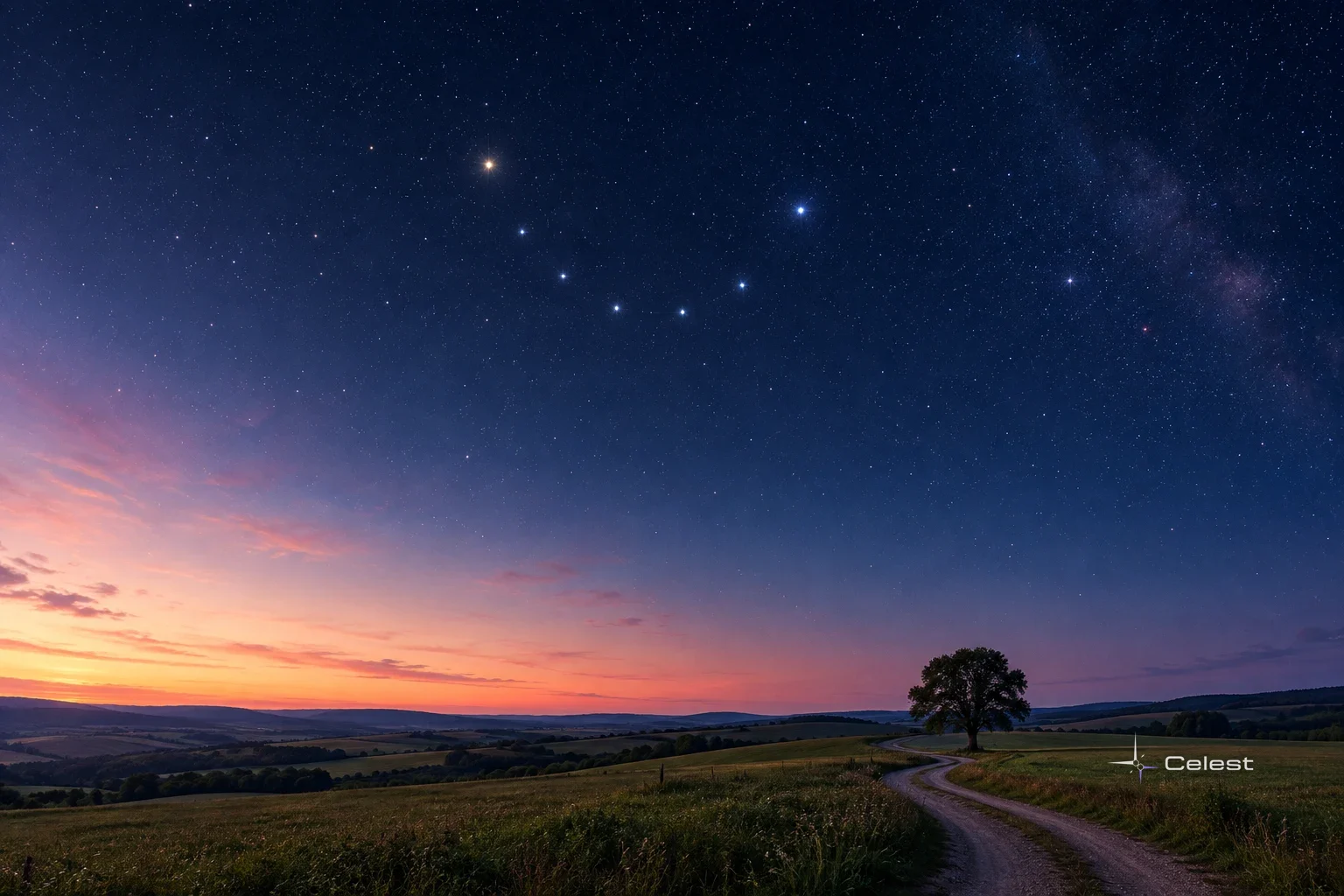
Corona Borealis, the Northern Crown, is a small constellation that actually looks like what it's named for — seven stars curving into a neat U, like a tiara set against the dark. It sits between Boötes and Hercules, roughly along the line joining the bright stars Arcturus and Vega.
The crown itself spans a little less than a fist-width at arm's length, but its outline is unmistakable once you've picked it out. Behind that simple shape hide two of the oddest stars anyone can watch, and a dust-faint galaxy cluster more than a billion light-years beyond them.
Corona Borealis at a glance
- Type: An officially recognized constellation, one of the 88 listed by the International Astronomical Union and one of Ptolemy's original 48 from the 2nd century CE.
- Where: Right ascension roughly 15h14m to 16h22m, declination about +25.8° to +39.8° — well north of the celestial equator, visible from about latitude +90° down to around −50°.
- Size: About 179 square degrees, one of the smaller constellations in the sky.
- Brightest star: Alphecca, magnitude about +2.2; the other six main stars run from roughly 3rd to 5th magnitude.
- Distance markers: Alphecca sits about 75 light-years away; the background Abell 2065 galaxy cluster lies more than a billion light-years beyond it.
- Best seen: Late-spring and early-summer evenings for northern observers; it appears lower toward the northern horizon from southern latitudes.
A crown of seven stars
Trace the arc and you're looking at seven stars arranged like beads on a string, curving into a shallow semicircle open toward the west. Alphecca, also called Gemma — Latin for jewel — sits near the center of the curve and outshines the rest at magnitude +2.2.
On one side of Alphecca sits Beta Coronae Borealis, traditionally called Nusakan, from an Arabic phrase meaning roughly "the two series." It's actually two stars locked so close together, about 0.25 arcseconds apart, that ordinary small telescopes cannot split them; its light shifts slightly on a roughly 41-day cycle as a strong magnetic field sweeps around it.
Rho Coronae Borealis is a fainter, Sun-like star in the same constellation with confirmed planets. Its worlds are detected through measurements of the star rather than seen as points beside it in a backyard telescope.
The shape has read as a crown since classical antiquity. The most common Greek myth ties it to Ariadne, daughter of King Minos of Crete — Dionysus gave her a jeweled crown, and one version of the story says he set it among the stars to remember her.
Other cultures saw the same stars differently: a cracked dish in western Asia, a boomerang in Aboriginal Australian tradition, a ring of dancing maidens for the Cheyenne and Shawnee, and a council of elders for the Pawnee.
Alphecca is bright enough to anchor a search from the bright stars you already know, in the broad stretch of sky between Arcturus and Vega.
Stars that misbehave
Two stars in this small group act nothing like ordinary stars, and both earned their nicknames the hard way.
Alphecca itself hides a secret: it's an eclipsing binary, two stars orbiting so that one passes in front of the other roughly every 17.4 days, dimming the combined light by about 0.1 magnitude — too small to notice by eye, but measurable with instruments.
Despite sitting far from the Big Dipper on the sky, Alphecca is thought to belong to the Ursa Major Moving Group, a loose family of stars, including most of the Dipper, sharing a common motion through space.
R Coronae Borealis, nicknamed the Fade-Out Star or the Reverse Nova, does the opposite of what a nova does. English amateur astronomer Edward Pigott identified its variability more than two centuries ago. Most of the time it sits near magnitude 6, right at the edge of naked-eye visibility — a star rich in carbon and helium but starved of hydrogen.
Every so often it puffs out a cloud of carbon dust that blocks its own light, and the star can drop by anywhere from 1 to 9 magnitudes, sometimes to less than a thousandth of its normal brightness, before climbing back over months or years.
T Coronae Borealis, the Blaze Star, works the other way around. It is a recurrent nova, a system that can erupt and brighten enough to see without a telescope. Its well-observed eruptions in 1866 and 1946 were about 80 years apart; that interval is not a precise countdown.
Planets hiding in the crown
Several stars in Corona Borealis host confirmed planets. Many were found through tiny shifts in the wavelengths of a star’s light, caused as an orbiting planet pulls the star toward and away from Earth.
- Epsilon CrB: an orange giant with a super-Jupiter of about 6.7 Jupiter masses, orbiting every 418 days at 1.3 AU.
- Kappa CrB: a star with a debris disk and a gas giant of roughly 2.5 Jupiter masses on a 3.4-year orbit.
- Omicron CrB: a gas giant of about 0.83 Jupiter masses circling every 187 days.
- HD 145457: a planet of about 2.9 Jupiter masses on a 176-day orbit.
- XO-1: roughly 560 light-years away, with a Jupiter-sized planet crossing its star's face about every 3.9 days.
Beyond the visible stars, the constellation holds one deep-sky prize for large instruments: the Abell 2065 galaxy cluster, a swarm of more than 400 galaxies spanning about one degree of sky, sitting roughly a degree southwest of Beta Coronae Borealis.
Its members glow at magnitude 16 to 18, so faint that even seasoned observers need a 20-inch or larger telescope to pick out the brighter ones. Distance estimates vary in the details, but every figure lands past a billion light-years.
How to see it
Look for Corona Borealis on evenings from spring into summer in the northern hemisphere, when it climbs high overhead after dark. From southern latitudes it appears lower in the northern sky, and from far enough south it never rises. Whether the crown sets at all depends on your latitude.
Check what's visible tonight for your location and observing time. The seasonal window shifts in the evening as the year advances, so you do not need to aim for one exact month.
Finding it takes three steps:
- Find Arcturus, the bright orange-white star anchoring Boötes, and Vega, the bright white star of Lyra farther east.
- Look for a faint U-shaped arc between them, sitting closer to Arcturus — that's the crown, with Alphecca as its brightest point.
- From Alphecca, follow the arc to Iota Coronae Borealis, then extend the same distance again to find Nu Coronae Borealis, a wide pair of orange stars.
Through binoculars, Nu Coronae Borealis splits easily into its two orange stars, separated by about 360 arcseconds, though they're not gravitationally bound and only appear paired by chance.
A small telescope opens up Zeta Coronae Borealis, a blue-white and greenish-white pair about one magnitude apart and separated by roughly 6 to 7 arcseconds — comfortably split at moderate magnification on a steady night.
Check observing conditions before heading out; a calm, low-turbulence night makes close doubles like this far easier to separate. Nothing short of a large telescope will reveal Abell 2065's galaxies, and even then only its brighter members appear as faint smudges.
A crown still watched closely
Nobody can predict exactly when R Coronae Borealis will dim again, or when T Coronae Borealis will next flare into a recurrent nova outburst. Both depend on physical processes still not fully understood, which is why observers keep tracking their brightness night after night.
R Coronae Borealis can quietly disappear from a binocular field as dust hides it. A bright eruption of T Coronae Borealis would do the opposite: add an easily visible point beside the familiar crown. Learning the ordinary pattern first gives you something to compare when the sky changes.
Leave a comment
Comments appear after moderation.