Orion Constellation: The Hunter in the Winter Sky
A hunter drawn in stars of wildly different ages and distances, anchored by a Belt so straight it doubles as a signpost to the rest of the winter sky.

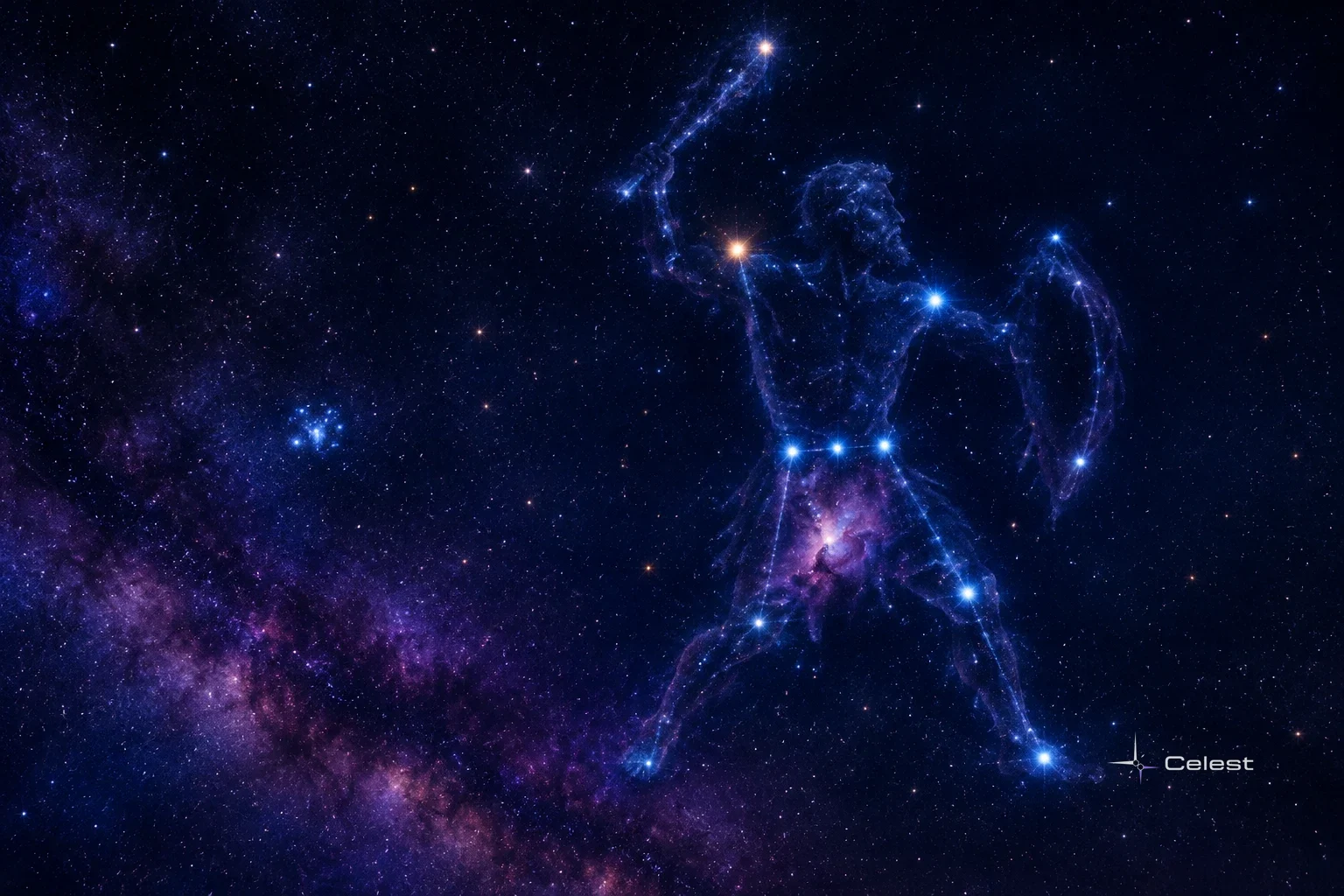
Orion is a pattern of bright stars shaped like an hourglass with a straight row of three stars — the Belt — cutting across its middle. It sits almost exactly on the celestial equator, which is why parts of it are visible from nearly everywhere on Earth at some point in the year.
The Belt is the giveaway: three evenly spaced stars in a short, tidy line that nothing else in the sky quite matches.
What you're looking at is not one object but a crowd of stars, some far closer than others, plus a cloud of gas where new stars are still being born. Orion is a shape in the sky, not a single place in space, and that difference matters for everything below.
Orion at a glance
- Type: One of the 88 modern constellations, and one of 48 charted by the 2nd-century astronomer Ptolemy
- Where: Straddles the celestial equator, near right ascension 5h and declination +5°
- Size: 594 square degrees, the 26th largest of the 88 constellations
- Visible from: Latitudes between +80° and −68°, covering almost the whole planet at some point in the year
- Best seen: January evenings; the exact position at a given hour depends on your location
- Main pattern: An hourglass of four bright stars wrapped around the three-star Belt
Orion borders Taurus, Eridanus, Lepus, Monoceros and Gemini. You can check what else shares the sky with it using Celest's constellation guide, which lays out neighboring patterns without assuming you already know your way around.
The hunter's shape
Four stars mark the corners of the hourglass: Rigel and Saiph at the bottom, Betelgeuse and Bellatrix at the top. Between them, at the waist, sit the three Belt stars — Alnitak, Alnilam and Mintaka — close together and almost identical in brightness.
Below the Belt hangs the Sword, a short vertical line of fainter points. Its middle object looks like a fuzzy star but isn't one; that's the Orion Nebula, covered further down. Above the hourglass, a fainter star called Meissa marks the hunter's head.
The Belt works as a signpost. Extend its line southeast and you land on Sirius, the brightest star in the night sky. Extend it the other way, northwest, and you reach Aldebaran in Taurus. A line across the two shoulder stars points toward Procyon, and a line from Rigel through Betelgeuse leads to Castor and Pollux in Gemini.
Learning one shape gets you four more landmarks for free.
Bright stars, different depths
Betelgeuse, the orange shoulder star, is hundreds of light-years away and varies in brightness — bright enough to be one of the sky's most recognizable bright stars despite that distance. Rigel, the blue-white foot, is another brilliant landmark, roughly 863 light-years away and around magnitude 0.13.
Bellatrix and Saiph lie at different depths too, while the Belt stars are distant, intrinsically luminous stellar systems. Their similar apparent brightness does not mean they are all equally far away. Meissa, marking the head, belongs to this wider population of hot stars.
Most of these are hot blue supergiants belonging to a loose family of young, massive stars called the Orion OB1 association. Betelgeuse is the outlier — a cooler, redder supergiant that may be a runaway member of the same group, drifting away from its birth cluster rather than staying put like its neighbors.
The Sword and the Orion Nebula
The middle of the Sword holds M42, the Orion Nebula, at magnitude +4.0 and roughly 1,300 light-years away. It spans about 65 by 60 arcminutes — wider than the full Moon — even though most of that glow is too faint for the eye to register as more than a small smudge.
With the naked eye it looks like a soft, colorless patch rather than a sharp star. Binoculars turn that patch into an obvious cloud with a brighter center. A telescope can separate the Trapezium, four bright young stars at its heart; the visual nebula is usually much less colorful than photographs.
A small telescope brings the Trapezium into clear view along with wispy extensions of gas; an 8-inch or larger telescope gives the fullest visual picture.
The nebula is only the brightest patch of something much larger. It belongs to the Orion Molecular Cloud Complex, a sprawling region of collapsing gas that covers most of the constellation and also contains the Horsehead Nebula and Barnard's Loop.
Explore more of these with Celest's deep-sky guide, which covers nebulae and clusters beyond what the naked eye alone can show.
Ultraviolet radiation from the Trapezium stars lights and erodes the surrounding gas. Disks of gas and dust around other young stars show that planetary systems are developing inside the same region.
How to see it
Orion is prominent in Northern Hemisphere winter evening skies and Southern Hemisphere summer evening skies. It remains an evening target into the following spring or autumn, setting earlier as the season advances. Close to the equator, within about 8° either side, it passes almost directly overhead.
Around its annual passage near the Sun, Orion becomes difficult to see at night, then returns to the pre-dawn sky.
A simple route works well once Orion is up:
- Find the Belt — three close, evenly bright stars in a short line; nothing nearby looks like it.
- Drop down to the Sword — a fainter, shorter line hanging below the Belt's middle.
- Follow the Belt southeast to reach Sirius, unmistakably the brightest star around.
- Follow it northwest to reach the orange star Aldebaran in Taurus.
The Belt and hourglass stars can be found from a city balcony. Darker skies help reveal the nebula’s faint extensions and other diffuse targets; check Celest’s Moon guide when planning a session around those details.
With a small telescope, several more targets open up: M42 and M43 together, M78 at magnitude +8.0, the Flame Nebula (which needs dark skies and low magnification), the multiple star system Sigma Orionis at magnitude +4.0, planetary nebula NGC 2022 near Meissa, and the compact 37 Cluster, NGC 2169.
What comes next for Orion
Betelgeuse is often named as the red supergiant most likely to end its life as a supernova sometime in the next million years — not a forecast for next week, but a reminder that the shape overhead is not permanent. When it happens, one corner of the familiar hourglass will change forever.
Orion also leaves a yearly trace that has nothing to do with its stars: the Orionid meteor shower peaks each October as Earth passes through debris shed by Halley’s Comet. Under good dark-sky conditions, about 10–20 meteors an hour may be seen; their paths appear to trace back toward Orion. Track the next peak with Celest's meteor shower guide.
Every star in this pattern is drifting at its own speed and in its own direction. The hourglass holds its shape only from Earth's current vantage point — a coincidence of timing that later skywatchers, tens of thousands of years from now, won't get to see the same way.
Leave a comment
Comments appear after moderation.