What Is a Constellation, Really?
The 88 official constellations divide the whole sky into regions. Their familiar outlines connect stars that can lie at very different distances.

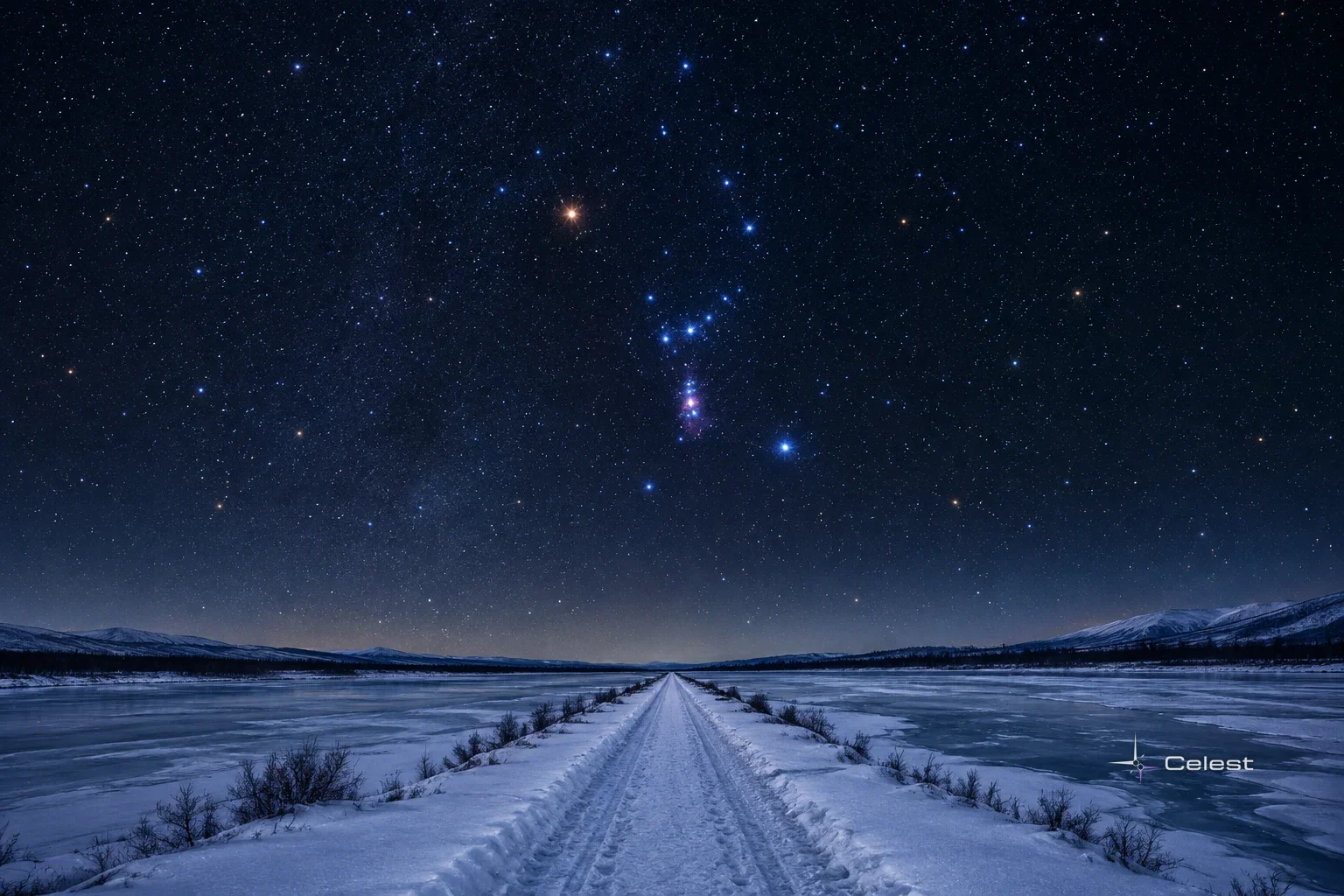
In modern astronomy, a constellation is one of 88 officially bounded regions of the sky. The familiar star patterns gave those regions their names: animals, objects and mythological figures that people have pictured among the stars for thousands of years.
The pattern and the region are related, but they are not the same thing. A star can belong to Orion's region without being part of the Hunter's familiar outline. The International Astronomical Union uses the regions as a fixed map covering the whole sky.
Every direction you look belongs to one of those 88 regions, whether it contains a bright star, a faint galaxy or apparently empty sky. The constellation guide breaks down which of the 88 you can actually find from your yard, and the night sky guide shows what's up tonight from your location.
How it works
Seeing a constellation is a perceptual process as much as a visual one, built in stages.
- Low-level vision picks out individual bright points against the dark background of the sky.
- Mid-level vision groups nearby stars of similar brightness into a shape, using proximity and brightness alone.
- High-level vision attaches meaning to that shape — a bear, a hunter, a scorpion, depending on the culture doing the looking.
That sequence explains why so many unrelated cultures landed on similar shapes. A 2022 study published in Psychological Science, reported by Astronomy Magazine, used a computational model and found that proximity and brightness alone account for many of the constellations recognized across different societies.
Astronomers still lean on these fixed patterns today, using them as markers to point toward objects like the Andromeda Galaxy, cataloged as Messier 31, inside the constellation Andromeda — one entry among the many deep-sky objects mapped this way.
Not a physical family of stars
Stars that form a familiar outline are not necessarily neighbors or members of one physical group. Some can be related, but sharing a constellation does not establish a connection between them.
Two stars that look side by side can lie at very different distances from Earth. Their apparent closeness tells you that they sit in similar directions in the sky, not that they are close together in space.
That confusion sometimes bleeds into astrology, the belief that star positions influence human behavior. Astronomy is a separate field: the scientific study of celestial objects, with a different method and a different goal.
The naming itself has always varied by culture. Greek, Roman, Egyptian, Chinese and Indian traditions each projected their own shapes onto the same background of lights, and the 88 recognized today draw mostly from Greek, Roman and Middle Eastern sources.
Why constellations differ around the world
Which patterns you can see depends on where you're standing and when you're looking. The Southern Cross climbs high across the Southern Hemisphere but never rises far enough north to be seen from most of Europe or North America.
Earth's yearly orbit around the Sun changes things too. As the planet moves, a different slice of sky faces away from the Sun at night, so the constellations overhead in January aren't the ones overhead in July.
Which constellations stay visible all year depends on your latitude. Some rise and set seasonally; others circle close enough to the celestial pole to stay above your horizon. A dark site reveals more of the faint stars that complete their shapes.
The light-pollution map can help you find a spot dark enough to see more of them.
See it for yourself
On a clear night, step outside and give your eyes about twenty minutes to adjust to the dark. Choose a pattern that is up at your location: Orion's three-star Belt or the Big Dipper's familiar handle are useful starting points. The Big Dipper is an asterism, a recognizable pattern within the larger constellation Ursa Major.
Notice how your eye does the grouping automatically, pulling nearby bright points into a shape before you've consciously tried. That automatic grouping helps you recognize a familiar shape before you have identified every star in it.
Open the live sky map to match what you're seeing to the region's name. Then remember that the stars forming that shape may never have crossed paths at all — gathered only by the accident of standing on Earth and looking up.
Leave a comment
Comments appear after moderation.