Deneb: A Distant Supergiant in the Summer Triangle
The faintest corner of the Summer Triangle is an enormous star. Deneb connects a simple naked-eye landmark with a difficult question about how massive stars change late in their lives.

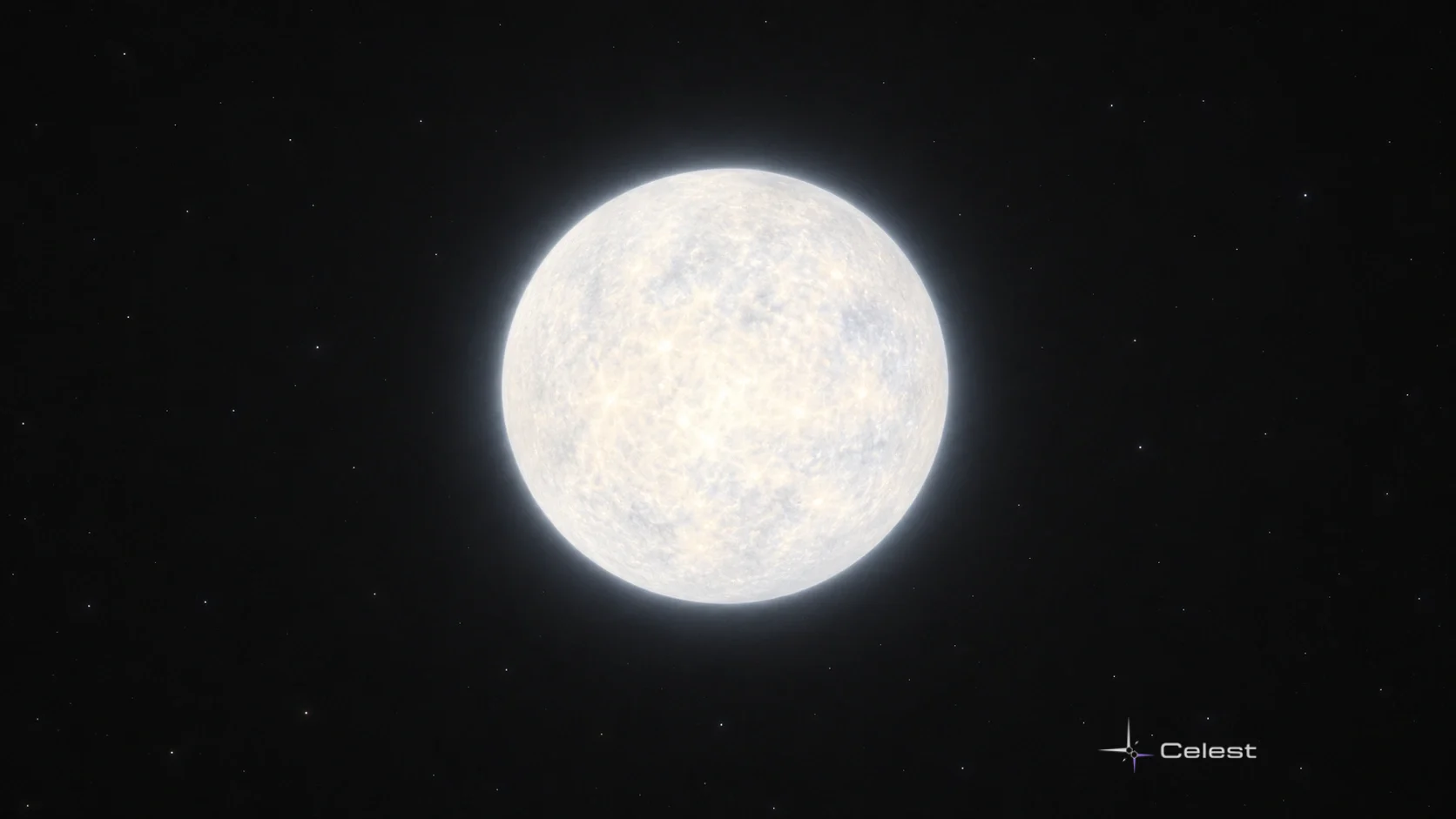
Deneb is a blue-white supergiant in Cygnus, the Swan, and one corner of the Summer Triangle. It appears fainter than the triangle's other two landmarks, Vega and Altair, despite producing enormous amounts of light. Compare the three points in the bright-star guide.
Deneb also marks the swan's tail. Use the live sky map to connect that point with the long body of Cygnus, rather than assuming every printed chart has the same orientation as your evening sky.
Deneb at a Glance
Separate its easy-to-see position from physical estimates that require measurements and models.
- Other name: Alpha Cygni, or α Cygni.
- Star type: a blue-white A-type supergiant.
- Apparent brightness: about magnitude 1.25; higher numbers describe fainter stars.
- Sky landmark: the tail of Cygnus and a corner of the Summer Triangle.
- One distance estimate: about 2,600 light-years, with roughly 220 light-years of uncertainty, adopted in a 2008 study.
- Size in that analysis: a radius approximately 200 times the Sun's.
The Fainter Corner Is an Enormous Star
The Summer Triangle is a useful sky pattern rather than a single constellation. Its points belong to three different regions: Vega to Lyra, Altair to Aquila and Deneb to Cygnus. Connecting them on a chart does not place them together in space.
Their appearance also tells only part of the story. Apparent brightness describes the light reaching your eyes. Luminosity describes how much energy a star radiates. A very luminous star can look less brilliant than another if its light travels much farther.
A detailed 2008 analysis estimated Deneb's luminosity at approximately 200,000 times the Sun's. That rounded comparison belongs to a particular atmosphere model and distance assumption. It gives a sense of Deneb's physical scale without turning it into a precisely measured lamp of fixed output.
The same study found a temperature of about 8,525 kelvin, with 75 kelvin of uncertainty, and a radius of 203 solar radii, with an uncertainty of 17. Temperature, emitting area and distance all matter when interpreting the pale point you see.
Why the Distance Comes With a Qualification
The 2008 study adopted 802 parsecs, with an uncertainty of 66, using information about a stellar association. A parsec equals approximately 3.26 light-years. Converting and rounding gives the 2,600-light-year estimate and its roughly 220-light-year uncertainty.
Historical values are different: an ESO image released in 1989 lists 1,400 light-years. Those figures are not two measurements to average casually. They belong to different analyses or adopted information, and a distance change also changes the physical scale inferred from a star's received light.
Keeping the radius and luminosity with their original model makes the comparison meaningful. Mixing one source's shorter distance with another source's large luminosity would produce a set of numbers that never belonged to the same analysis.
Light Reveals More Than a Bright Point
Astronomers estimate these properties by examining Deneb's spectrum, its light separated by wavelength. Absorption features give information about the stellar atmosphere. Comparing many features with calculated spectra helps constrain temperature, surface gravity and composition together.
The 2008 work used detailed optical and near-infrared observations and checked how well its models reproduced the distribution of light across wavelengths. This is a different kind of evidence from measuring an obvious enormous disc in an ordinary backyard view.
Deneb's light changes too. It is the prototype of a class called Alpha Cygni variables. A 2024 analysis described brightness variations on an approximate twelve-day timescale, with irregular interruptions and resumptions. The star does not repeat a perfectly predictable twelve-day cycle.
Another 2024 study examined polarisation, the orientation properties of light waves. It found changes over weeks and suggested changing density in the outward-flowing gas or extended atmosphere. Pulsations could still contribute. Different properties of the same light help distinguish possible causes.
How to Recognise Deneb in Cygnus
Northern summer evenings provide a useful season for learning the triangle. Identify its three bright corners first, then compare Deneb's position with the cross-shaped main pattern of Cygnus. Deneb sits at the tail end; Albireo marks the opposite end toward the swan's beak.
The Milky Way passes through this region. Once you have confirmed the landmark, try following the surrounding fields through binoculars: many more stars become apparent along the swan's body. Use observing conditions to choose a darker outing if artificial light hides that richer background.
A Familiar Landmark With an Unsettled Past
Deneb's stage of evolution remains an important question. The 2008 analysis favoured a star moving toward a red-supergiant phase. A 2024 review still discussed whether stars of this class are making that journey for the first time or returning after an earlier red-supergiant stage.
The difference concerns what has already happened inside the star, not its usefulness as tonight's landmark. Its changing light offers evidence that may help distinguish those histories. Recognising one bright corner of a triangle can introduce a question that a simple sky photograph cannot answer.
Leave a comment
Comments appear after moderation.