Planet Earth: What Makes Our Home World Unique
Earth is the third planet from the Sun: an ocean-covered rocky world with a breathable atmosphere, moving crust and the only life yet confirmed anywhere.

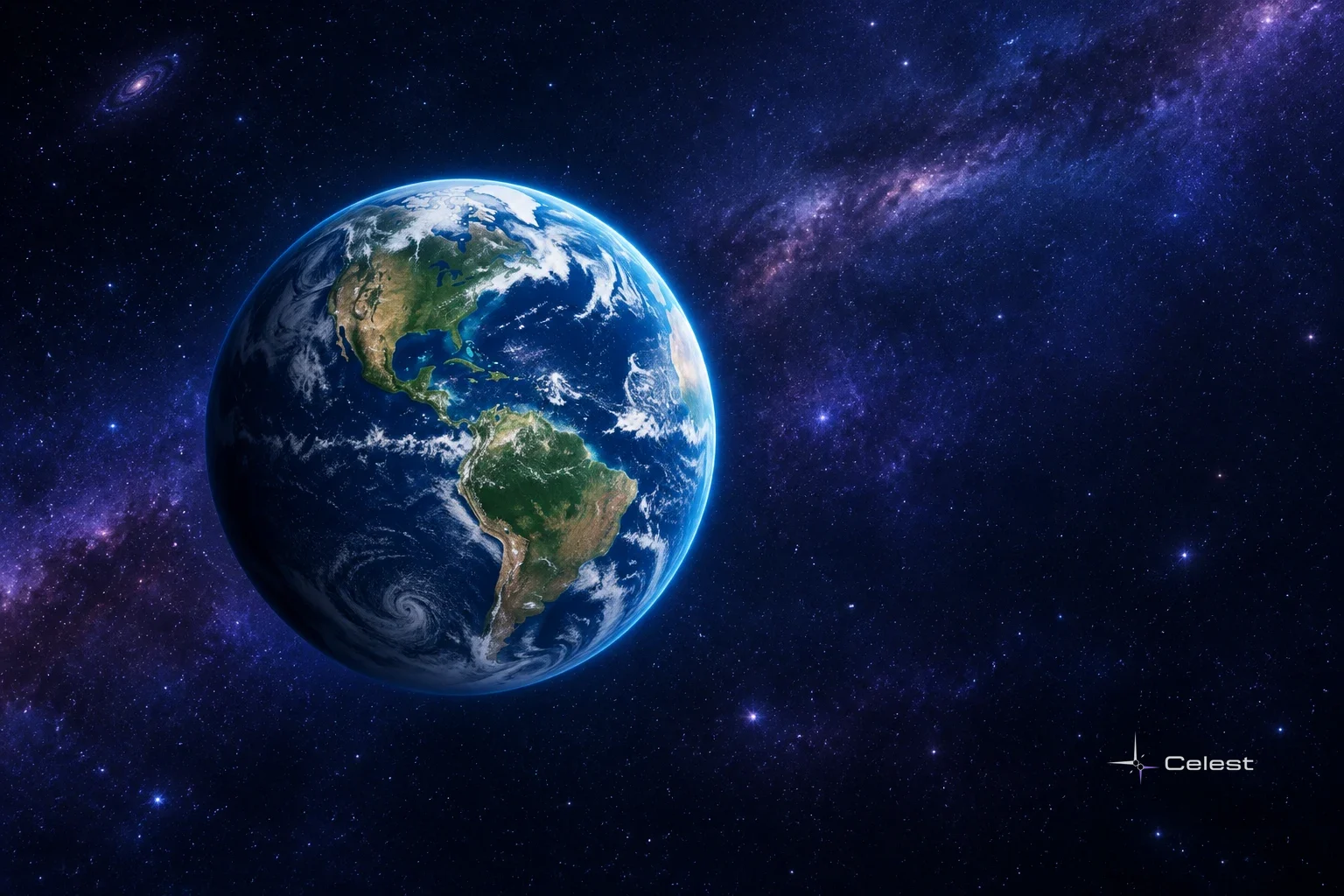
Earth is the third planet from the Sun, the fifth largest in the solar system, and the only place confirmed to host life. Its name comes from Old English and Germanic words that simply mean "the ground" — a fitting name for the one planet humans have never had to look up to find.
From space, oceans and weather systems dominate the view. Beneath them, a layered interior powers a changing surface, while the atmosphere and magnetic field help protect life above it.
Earth at a glance
- Type: Third planet from the Sun, fifth largest in the solar system, the only confirmed home to life.
- Where: Orbits between Venus and Mars, one of eight planets circling the Sun.
- Distance from the Sun: About 150 million km (93 million miles) on average, approximately one astronomical unit; sunlight takes about 8 minutes to arrive.
- Size: Mean radius about 6,371 km (3,959 miles), with a slight equatorial bulge caused by rotation.
- Best seen: From space — photographed whole by the Apollo 17 crew in 1972 and filmed rotating in NASA footage showing day, night and city lights.
Check Celest's night sky guide for what's actually up in your own sky tonight, and the Moon guide for the one natural satellite Earth carries with it.
Formation and the layered interior
About 4.5 billion years ago, gravity pulled Earth together out of the gas and dust disk surrounding the young Sun. As the planet settled, its interior separated into distinct layers, heaviest material sinking, lighter material rising.
At the center sits a solid inner core of iron and nickel, about 1,221 km (759 miles) in radius. Around it is a liquid outer core, then a rocky mantle roughly 2,900 km thick, and finally the crust.
The mantle is predominantly solid rock, not an ocean of magma. Over geological time, that hot rock can deform and flow slowly.
That crust isn't uniform. Continental crust runs about 19 miles thick on average; oceanic crust is thinner, roughly three miles, and denser. Gravity shaped Earth into a sphere, but not a perfect one — the planet bulges slightly at the equator, which is why you'd weigh a touch less standing there than at either pole.
Water, plates and an active surface
Ocean covers about 71 percent of Earth’s surface and holds most of the planet’s water. Much of the volcanic landscape lies underwater, including a vast system of mid-ocean ridges.
Liquid water can remain exposed across huge areas of Earth’s surface, while ice and water vapor move through the same global cycle. Those accessible oceans distinguish Earth from the other planets.
The crust and upper mantle are broken into massive plates that grind against one another in slow motion. When plates snag and slip, the ground shakes as an earthquake. When ocean crust slides beneath a continent, volcanoes rise. When two continental plates collide head-on, mountain ranges like the Himalaya get pushed skyward.
The continents are, quite literally, always on the move.
Atmosphere and magnetic shield
Earth's air is 78 percent nitrogen, 21 percent oxygen, and one percent other gases such as carbon dioxide, water vapor and argon. Greenhouse gases retain some outgoing heat, keeping the surface warmer than it would otherwise be. Human activity is strengthening that greenhouse effect and changing Earth’s climate.
Ninety percent of the atmosphere is packed into just the first 10 miles above the ground. That thin shell breaks up many incoming meteoroids, producing the streaks of light called meteors, and gases like ozone block ultraviolet light that would otherwise damage living cells.
A second, invisible shield comes from below. Motion of electrically conducting liquid in Earth’s outer core helps generate a magnetic field, which the solar wind stretches into a teardrop-shaped region that deflects high-energy particles streaming from the Sun and beyond.
Some particles get funneled toward the poles instead, colliding with the atmosphere there and lighting up the sky as the aurorae.
How to see it
Earth is the ground beneath your feet rather than an object overhead. The clearest supported views of the whole planet have come from orbit or beyond. The Apollo 17 crew’s 1972 Blue Marble photograph shows a nearly fully sunlit Earth, with Africa, Antarctica and swirling weather systems visible together.
A NASA video of the rotating Earth shows the sharp line between day and night sweeping across the globe, with city lights glowing on the dark side. That night-side glow is the kind of detail that would tell a distant observer this world has life and civilization on it.
If you're curious how much of that glow comes from your own region, Celest's light-pollution map helps you assess artificial sky brightness near your observing site — useful context whether you're thinking about Earth from space or just planning your next night outside.
Searching for other Earths
Telescopes, including NASA's Kepler mission, have found thousands of planets orbiting other stars. Some are close to Earth's size, and some orbit where temperatures might allow liquid surface water if their atmospheres and other conditions are suitable. The Transiting Exoplanet Survey Satellite is positioned to find still more.
At the same time, dozens of NASA missions are turned the other way, studying Earth itself from orbit. The two efforts, looking outward and looking inward, aim at the same open question: how many other living worlds share the galaxy with this one.
Leave a comment
Comments appear after moderation.