Jupiter: The Solar System's Largest Planet
Jupiter holds more than twice the mass of all the other planets combined. Its cloud bands, giant storms and four large moons make it a rewarding first telescope target.

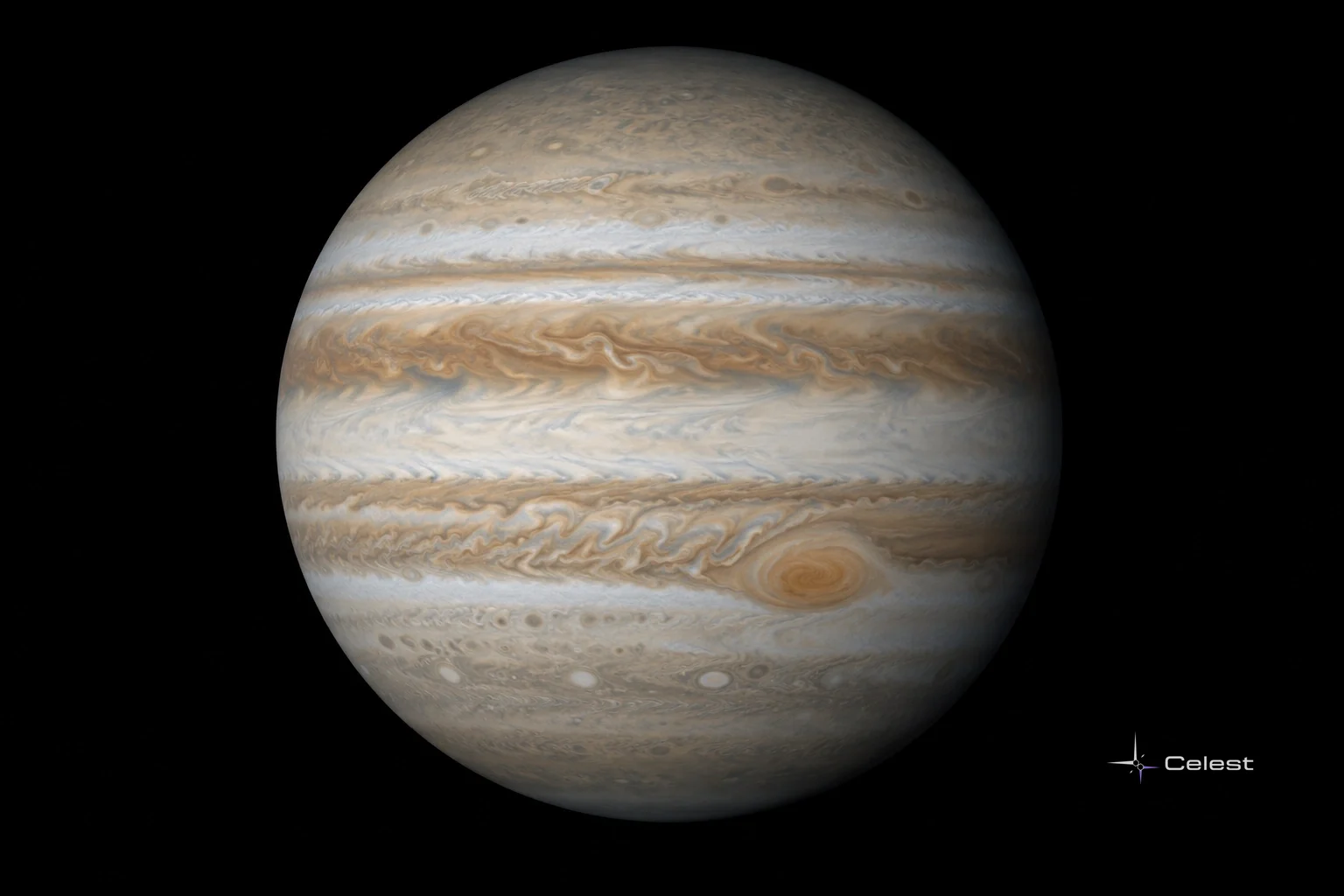
Jupiter is the largest planet in the Solar System and the fifth planet from the Sun, a gas giant built almost entirely of hydrogen and helium. It holds more than twice the mass of every other planet in the Solar System combined, and it's still bright enough to spot without any equipment at all.
That single fact — visible to the naked eye — is what makes Jupiter useful to a beginner. Ancient observers in Babylon recorded it as far back as the 7th or 8th century B.C., long before anyone understood what it was. Check the visible planets guide to see whether it's currently up from where you live.
Spacecraft flybys and orbiters have revealed worlds within this planetary system, from Jupiter’s deep interior to the icy crust of Europa. From Earth, the most accessible sights are its bright disk, cloud bands and largest moons.
Jupiter at a glance
- Type: Gas giant, like Saturn; Uranus and Neptune are classified separately as ice giants
- Where: Fifth planet from the Sun, orbiting at an average 779 million km (484 million miles) — about 5.2 times Earth's distance from the Sun
- Distance from Earth: Changes as Earth and Jupiter move around the Sun; use a live ephemeris for the current value
- Size: Roughly 11 times Earth's width; its mean diameter is about 139,822 km, while its wider equatorial diameter is about 142,984 km
- Brightness: Among the brightest planets in the night sky, usually outshone by Venus; Mars can exceed it near a favorable opposition
- Best seen: When it is high in a clear sky; its observing hours change through the year
The astronomy calendar highlights upcoming alignments and oppositions, when Earth lies between Jupiter and the Sun and the planet is available for much of the night.
A world of bands, spots and dust rings
Jupiter's visible "surface" isn't solid at all. It's the top of a churning atmosphere, about 90% hydrogen and 10% helium, with clouds of ammonia and water vapour streaked into the planet's signature bands. Nobody has pinned down exactly why the bands paint themselves in red, orange and yellow.
Those bands aren't calm. Winds at the equator can reach roughly 540 km/h (335 mph), carrying clouds through the planet’s bands and storms. A small telescope can show the largest patterns, even though their motion is too slow to watch directly over a few moments.
The most famous swirl is the Great Red Spot, a vast storm that has become smaller in modern observations. Historical research distinguishes it from a spot Cassini followed in the seventeenth century: the modern storm has been observed since 1831.
Why this storm has lasted so long, and how it will change, are still open questions.
Jupiter also has rings, though you'd never guess it by eye. NASA’s Voyager 1 discovered the thin ring system in 1979; it is built from dust rather than ice, faint compared with Saturn's bright rings but present all the same — every gas giant in the Solar System has some kind of ring.
Inside: gas, liquid and metallic hydrogen
Descend below those clouds and the hydrogen gas gets squeezed by rising pressure until it turns liquid. Go deeper still, and the pressure strips electrons from the hydrogen atoms, leaving a fluid that conducts electricity almost like a metal — metallic hydrogen.
That electrically active layer is the likely source of Jupiter's magnetic field, the strongest planetary field in the Solar System. It powers auroras that release hundreds of times more energy than the northern and southern lights on Earth.
What sits at the very center is still argued over. Data from NASA's Juno spacecraft suggested Jupiter's core is larger than expected and only partially dissolved into the surrounding metallic hydrogen.
Rather than a sharply separated solid center, the data point toward a dilute or “fuzzy” core, with heavier material mixed into the surrounding fluid. That is why a neat cutaway drawing should be read as a model, not a photograph of known layers.
A miniature planetary system
Jupiter carries its own retinue of moons, and four of them changed the course of astronomy. In January 1610, Galileo Galilei spotted Io, Europa, Ganymede and Callisto — the Galilean moons — and realized they orbited Jupiter, not Earth.
It was the first solid evidence that not everything in the sky circles our planet, a key piece of support for a Sun-centered Solar System.
Each of the four has its own claim to fame:
- Ganymede: the largest moon in the Solar System, bigger than Mercury, and the only moon known to generate its own magnetic field
- Io: the most volcanically active body anywhere in the Solar System, kept volcanically active by tidal heating as Jupiter and neighboring moons tug on it
- Europa: has strong evidence for an ocean beneath its ice shell; tidal heating helps make it a leading place to investigate potentially habitable conditions
- Callisto: the outermost of the four, sitting too far out to feel as much of that gravitational heating
The four Galilean moons are only the largest members of a much bigger family. Astronomers continue discovering and confirming small outer moons, so the total is a changing catalogue figure rather than a fixed property of the planet.
How to see it
Jupiter is one of the easiest planets to find without equipment. It usually shines more brightly than any true star in the night sky when it is well placed. Start with the night sky guide to see if it's above your horizon tonight.
Use your own location and observing time on the map. Jupiter moves against the constellations, and its morning or evening visibility changes through the year, so a dated chart from another city is a poor substitute for the current view.
To the unaided eye, Jupiter looks like a very steady, very bright star. It usually twinkles less than a star because light from its tiny apparent disk averages out much of the atmospheric flicker. Low near the horizon, even a planet can shimmer.
Hold binoculars steady and look for tiny points beside the planet: some of the Galilean moons may be visible, depending on where they are in their orbits. A small telescope adds the main cloud bands and, with suitable conditions and the right face turned toward Earth, the Great Red Spot.
A clear, steady atmosphere matters more for fine planetary detail than an extremely dark site. Check observing conditions, and give the view time to settle before judging what your telescope can show.
What comes next
Two spacecraft are already on their way to find out what's really happening under those clouds and inside those moons. ESA's Juice mission is due to arrive at the Jupiter system in 2031, flying past Europa and Callisto before settling into orbit around Ganymede.
NASA’s Europa Clipper, launched in 2024, is scheduled to reach the Jupiter system in 2030 and make repeated close flybys of Europa to investigate whether its buried ocean could support life.
For a first observation, the moons offer a question you can answer yourself. Sketch their positions, then compare the view on another night: lights that first looked like background stars turn out to be worlds orbiting another planet.
Leave a comment
Comments appear after moderation.