Mars, the Red Planet: A Complete Portrait
Mars is a rust-colored rocky world with giant volcanoes, two small moons and the remains of ancient rivers. Its changing distance from Earth transforms the view through a telescope.

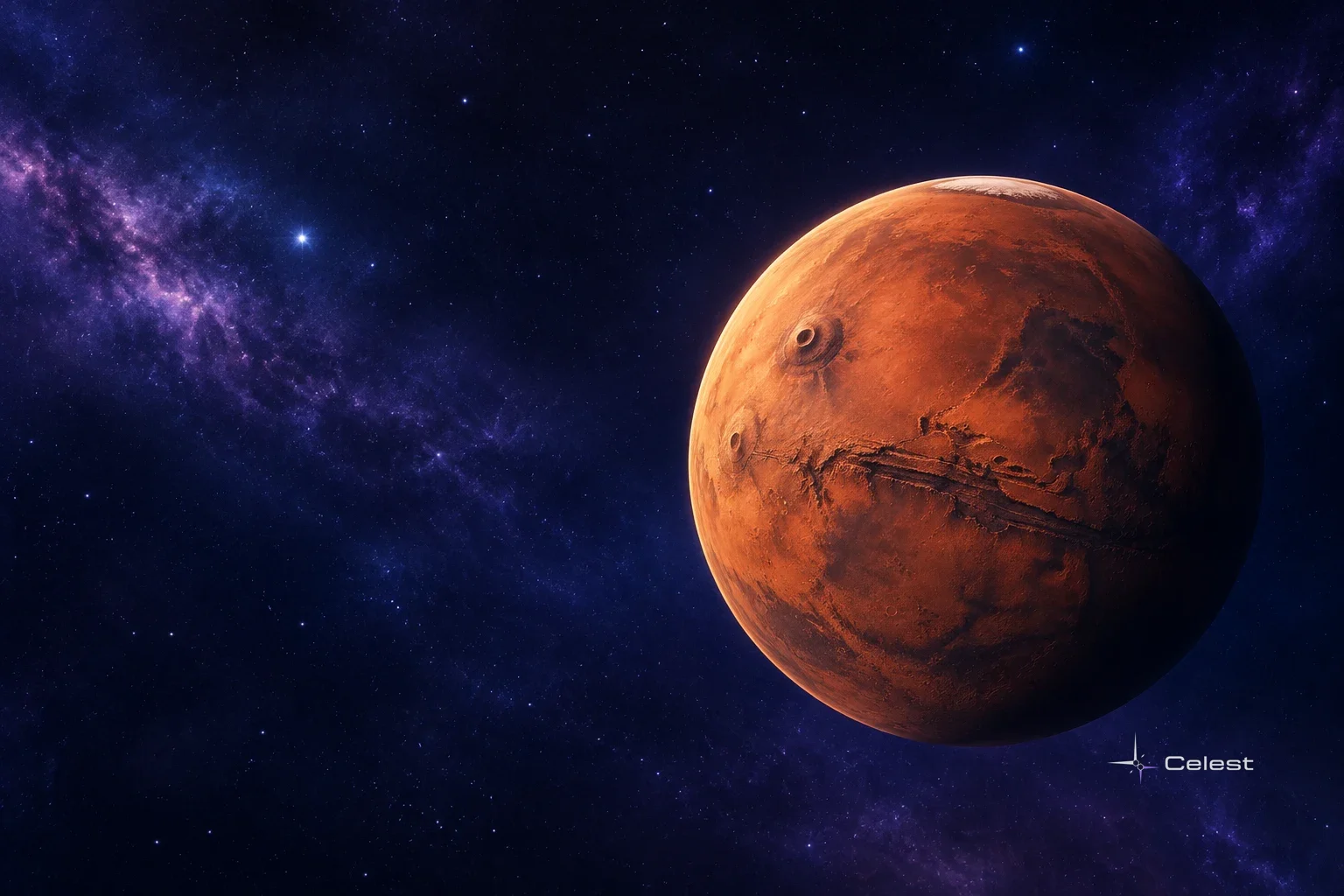
Mars is the fourth planet from the Sun, a rocky world about half Earth's size and tinted rust-red by oxidized iron in its rock and dust. Two small, irregular moons — Phobos and Deimos — orbit it, and even a modest backyard telescope can reveal real Martian geography: polar ice caps and dark, wind-swept markings across its disk.
It's one of the five planets you can track with the naked eye, and the Visible planets guide keeps tabs on where it sits in the current sky. You can also check its exact position anytime on the Live sky map.
Most nights it's just a small, steady, reddish-orange point — until you know what you're looking at, and then it becomes a whole world.
Mars at a glance
- Type: A rocky (terrestrial) planet, the fourth from the Sun
- Distance: About 228 million km on average (1.5 AU); according to the Canadian Space Agency, that's precisely 227,939,200 km, with the elliptical orbit swinging from 206.6 million km at its closest to 249.2 million km at its farthest
- Size: A diameter of roughly 6,790–6,792 km, about half Earth's
- Mass: 6.417 × 10²³ kg, only about 10% of Earth's mass
- Day and year: A sol, the Martian day, runs about 24 hours 40 minutes; a year lasts roughly 687 Earth days, or 1.88 Earth years
- Moons: Two small ones, Phobos and Deimos
The orbital distance is measured from the Sun, not from Earth. Earth–Mars separation changes much more dramatically as the two planets follow their different orbits.
Formation, interior and two small moons
Mars came together with the rest of the solar system about 4.5 billion years ago, part of the same collapsing cloud of gas, dust and ice that flattened into a spinning disk and built every planet from the leftover material.
Inside, Mars has a metal-rich core surrounded by a rocky mantle and crust. Seismic studies are refining that picture; a 2025 analysis of InSight recordings reported evidence for a solid inner core within a liquid outer core. The crust contains iron, magnesium, aluminium, calcium and potassium.
Two captured-looking moons
Phobos and Deimos, discovered by astronomer Asaph Hall in 1877, are small and irregular. Capture from the asteroid population is one proposed origin; how the moons formed remains an open research question.
Phobos is slowly losing that gravitational tug-of-war: it drifts about 2 cm closer to Mars every year. In roughly 50 million years, it may crash into the planet outright or shred apart into a ring. Deimos, farther out, looks smoother because loose surface debris has filled in its craters over time.
The red surface and giant geology
Mars looks red because iron in its rocks and dust has oxidized — rusted — both on the ground and in the fine dust suspended in its thin atmosphere. Seen from Earth, the brighter patches are dust-covered plains; the darker patches are rockier ground swept clean by wind.
Most of that surface is basalt, the same dark volcanic rock that makes up much of Earth's ocean floor. Valleys, deserts, mountain ranges and polar ice caps break up the terrain, and what look like former river deltas suggest Mars was genuinely watery once.
Olympus Mons, tallest volcano anywhere
Olympus Mons is the largest known volcano in the solar system, a shield volcano roughly 624 km across at its base. Its height is measured differently depending on the survey, with estimates running from about 21 km to nearly 25 km — either way, essentially two and a half times Everest's height.
Valles Marineris and Syrtis Major
Valles Marineris is the largest known canyon system anywhere, stretching somewhere between 3,000 and 4,000 km long and plunging roughly 7 to 8 km deep. It formed mostly through tectonic stretching of the crust, not carving by water.
Syrtis Major Planum is a dark, basaltic shield volcano region about 1,000 km wide, extending some 1,500 km north from Mars's equator. Through a mid-sized or large telescope, it shows up as a distinct dark patch on the disk.
Air, water and seasons
Mars's atmosphere is thin and made almost entirely of carbon dioxide, with only small traces of argon, nitrogen, oxygen and water vapor mixed in. It's far too thin, and the wrong mix, for a human to breathe.
A tilt of about 25 degrees, close to Earth’s own, gives Mars four seasons. Its longer year makes them longer overall, but the strongly elliptical orbit means the four seasons are unequal in length.
According to the Natural History Museum, surface temperatures span roughly -153°C to 20°C, though other measurements push the warm extreme closer to 35°C depending on season and location.
Mars almost certainly had liquid water on its surface in the past — canyons, dry lakebeds and river networks all point that way. Stable bodies of liquid water do not remain on the surface today; the atmosphere is too cold and thin. Water does survive as ice.
The polar regions contain extensive water ice, with seasonal deposits of frozen carbon dioxide, or dry ice.
The seasonal caps grow in winter as carbon dioxide freezes out of the atmosphere, then shrink as it turns back into gas in spring and summer. The underlying water-ice deposits preserve a much longer record of Martian climate.
How to see it
Mars’s visibility and apparent size change markedly as Earth and Mars move around the Sun. Around opposition, Earth lies between Mars and the Sun, and the planet is usually at its brightest and available through much of the night. The exact closest approach occurs near opposition, not necessarily on the same date.
Check Mars's exact rise and set time for where you live before heading outside, and glance at the Astronomy calendar and current observing conditions to see whether clouds or haze will get in the way.
What you'll actually see depends on your gear:
- Naked eye: a small, steady reddish-orange point that slowly shifts position against the background stars from one night to the next
- Binoculars: still mostly a bright point, with the reddish color more obvious than to the unaided eye
- Small telescope: a tiny disk where polar ice caps, dark surface markings and, at times, atmospheric haze can appear, depending on your aperture and magnification
A bright Moon can wash out the fainter stars around Mars, though it does not stop you observing the bright planet itself. Check its current phase if your session also includes faint targets.
The next chapter for Mars
The weeks around a favorable opposition give a better chance of seeing surface markings than nights when Mars is distant and its disk is tiny. Even then, a steady atmosphere and a patient look matter more than the word “opposition” on a calendar.
Robotic missions keep probing whether Mars ever supported life in that ancient, wetter era — a question the dry, rust-colored disk in your eyepiece can't answer on its own.
Phobos, meanwhile, is on a slow, one-way trip. At roughly 2 cm closer to Mars each year, it's partway through a countdown that ends, tens of millions of years from now, in a collision or a ring of debris circling the Red Planet.
Leave a comment
Comments appear after moderation.