Venus the Planet: Earth's Twin With a Deadly Twist
Nearly Earth's twin in size, Venus spins backward and bakes under acid clouds. Those clouds hide its volcanic surface from ordinary visible-light views.

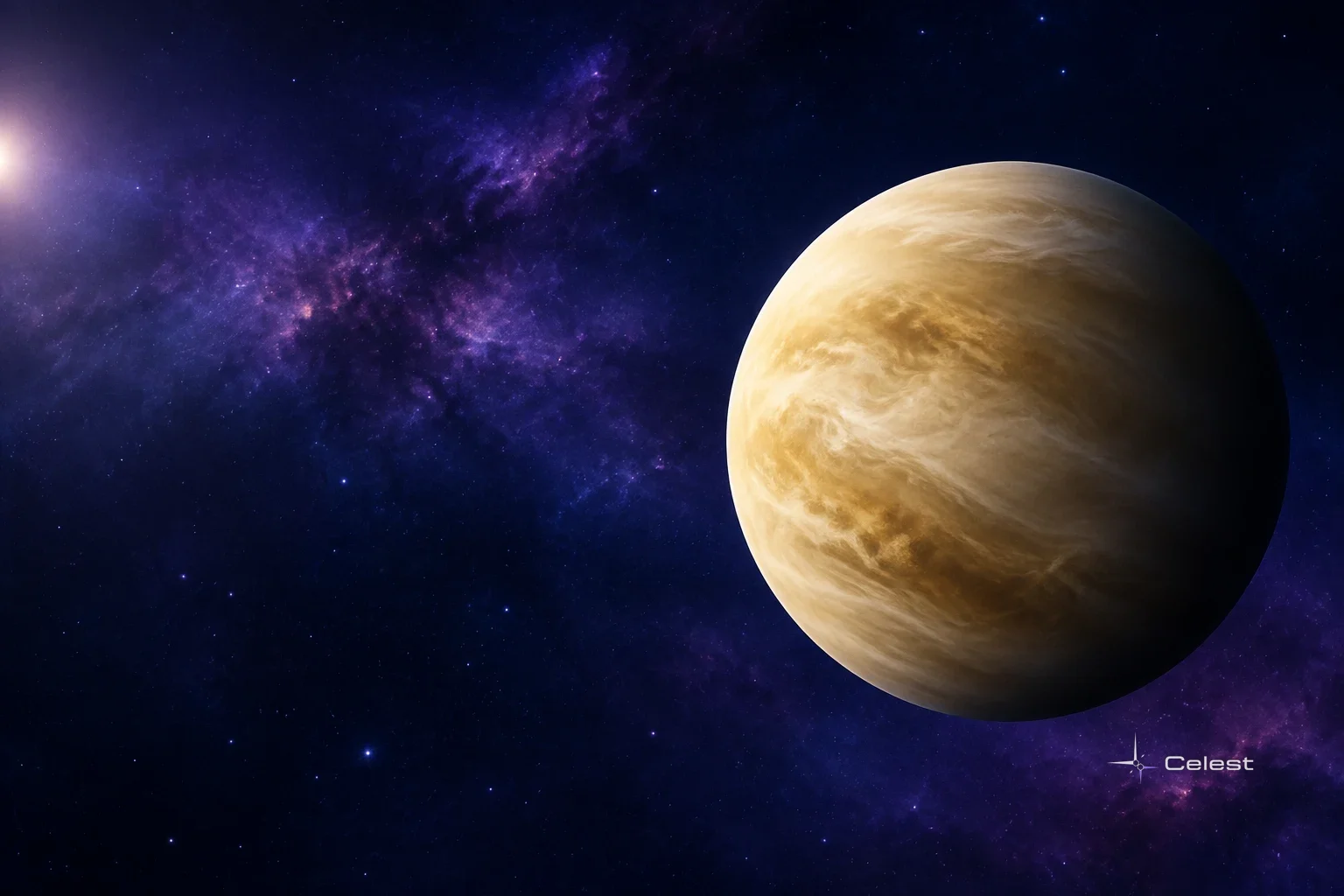
Venus is the second planet from the Sun, a rocky world close enough to Earth's size that early astronomers nicknamed it Earth's twin. The comparison only goes so far.
Venus's atmosphere traps enough heat to make it the hottest planet in the solar system, and the planet itself spins backward, taking 243 Earth days to complete one turn.
Much of what's known about the ground beneath those clouds comes from Soviet landers, American atmospheric probes and radar mapping by orbiters such as Magellan. The thick clouds hide the ground from ordinary visible-light views from space, though dim sunlight does reach the surface.
Seen from Earth, Venus shows up as a brilliant point low near the horizon around sunrise or sunset. Check the visible planets guide for which planets are up on a given night, and the night sky guide to get oriented before heading outside.
Venus at a glance
- Type: Rocky (terrestrial) planet with a solid surface hidden under a thick atmosphere.
- Where: Second planet from the Sun, orbiting between Mercury and Earth.
- Distance: Averages 108,208,000 km (about 67 million miles, 0.7 AU) from the Sun.
- Size: 12,104 km across, roughly 95% of Earth's diameter, with about 82% of Earth's mass.
- Best seen: Low near the horizon around sunrise or sunset, never far from the Sun in the sky.
Those numbers explain the twin nickname. What they don't explain is why a planet this close to Earth's size ended up so hostile.
An Earth-sized world in a runaway greenhouse
Venus probably formed about 4.5 to 4.6 billion years ago, like the rest of the solar system, out of gas, dust and ice that collapsed into a spinning disc around the young Sun.
In its early history, the planet may have looked a lot like Earth does now, possibly holding liquid oceans on its surface for as long as two billion years.
That changed. Venus’s atmosphere is almost entirely carbon dioxide, and its surface pressure is more than 90 times Earth’s. The atmosphere traps heat so effectively that surface temperatures run around 460–480°C, hot enough to melt lead.
The heat stays roughly constant day and night, and pole to pole.
A tiny axial tilt, only about 2.6 to 3 degrees compared with Earth's 23.4, means Venus never really has seasons. There's just one condition, all year, everywhere: hot.
What's hidden under the clouds
Because the clouds never part, the surface has to be studied with landers or with radar carried on satellites and probes. What that work has found is a planet shaped mostly by lava.
Roughly 80% of the surface is smooth volcanic plains, and radar maps reveal a huge population of volcanic features. Changes between Magellan radar images have provided evidence for recent lava flows and a changing volcanic vent.
Venus also has broad highland regions and mountain ranges. Maxwell Montes is the tallest feature on Venus, roughly 870 km long and climbing to about 11.3 km, taller than Mount Everest. Maat Mons, over 8 km high and about 400 km wide, ranks among the largest volcanoes anywhere in the solar system.
Inside, Venus is thought to resemble Earth: a metal-rich core surrounded by a hot rocky mantle, and a basalt crust perhaps 10 to 20 km deep.
Venus has no detected internally generated global magnetic field like Earth’s. Its atmosphere does interact with the solar wind to form an induced magnetic environment, and why it lacks an Earth-like dynamo remains under investigation.
The day that outlasts the year
Venus rotates in the opposite direction to most planets, a pattern called retrograde, and it does so more slowly than any other planet in the solar system: one full rotation takes 243 Earth days.
Stand on the surface, if you somehow could, and you'd watch the Sun climb out of the west and sink into the east, the reverse of what happens on Earth.
One full rotation takes longer than Venus’s roughly 225-Earth-day year. That is a sidereal day, measured against the stars; the solar day, from one sunrise to the next, is shorter, at roughly 117 Earth days, because rotation and orbital motion combine.
No moon, the calmest orbit
Venus has no moons at all, one of only two planets in the solar system without a natural satellite. Its orbit is the most nearly circular of any planet, ranging from about 107.5 million km at its closest to the Sun to about 108.9 million km at its farthest.
Its brightness in Earth’s sky changes as both its distance and the illuminated fraction visible to Earth change.
How to see it
Without any equipment, Venus looks like a steady, brilliant point close to the horizon, showing up either shortly before sunrise or shortly after sunset depending on where it sits in its orbit relative to Earth. It never strays far from the Sun's glow, so dawn and dusk are the easiest times for a beginner to find it.
A small telescope can show Venus changing phase, from a crescent to a more fully lit disk. It will not reveal craters or continents.
The same clouds that keep Venus's surface hidden from spacecraft cameras also hide it from backyard optics, so what you're looking at is simply the top of a sulfuric-acid cloud deck, a corrosive layer often compared to battery acid.
For an evening observation, wait until the Sun has set before aiming binoculars or a telescope toward Venus; never sweep near the Sun with unfiltered optics. The observing conditions page helps you judge cloud cover and the steadiness of the view, and the astronomy calendar is the place to check exactly when Venus is well placed for viewing.
What still puzzles scientists
Comparisons of old radar maps have already shown that Venus is not simply a geologically frozen version of Earth. The next question is how widespread and frequent its volcanic activity is, and how that activity has changed the planet’s surface and atmosphere.
Leave a comment
Comments appear after moderation.