What Is Earthshine on the Crescent Moon?
A crescent Moon isn't fully dark, even in its shadowed half. Here's the phase, the timing and the old name behind that faint glow.

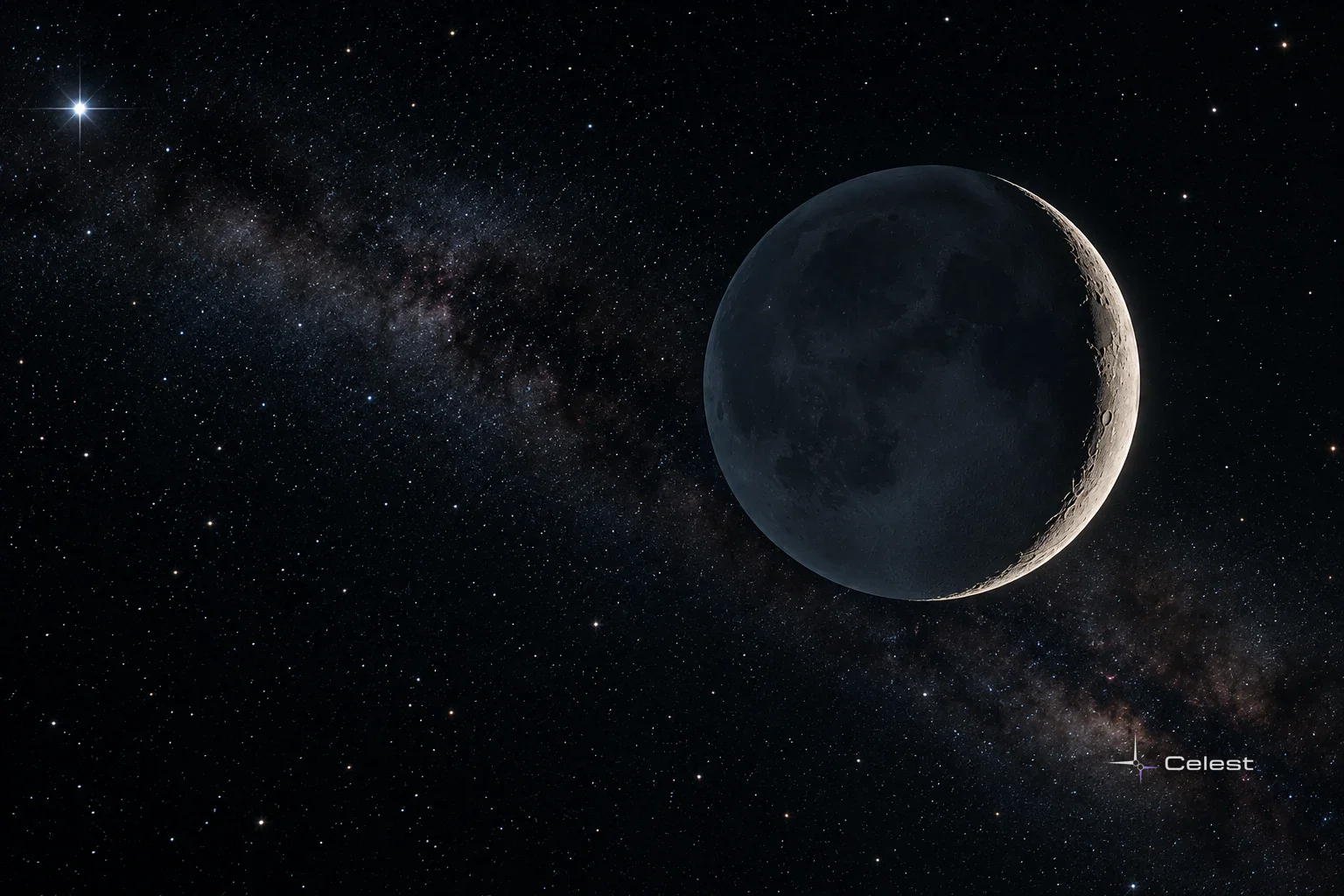
Earthshine is the faint, ashy glow you sometimes see on the unlit part of the Moon's disc — the crescent's shadowed portion looking lit anyway instead of pitch black.
The Moon's dark side isn't actually black to your eye when the crescent hangs low in early twilight. The glow is sunlight reflected by Earth onto the Moon, then reflected back toward your eyes. Skywatchers often call it "the old Moon in the new Moon's arms."
It is easiest to notice on a thin crescent, in the evenings after new Moon or the mornings before it. Check tonight's phase on the Moon guide before heading outside, so you can choose a suitable crescent phase.
What a crescent Moon actually is
A waxing crescent falls between new Moon and first quarter; a waning crescent falls between last quarter and the next new Moon. Only a slim part of the disc facing you is directly sunlit; the remainder can still show a faint glow from earthshine.
The thinnest crescents appear near the Sun in our sky, so twilight is a useful time to look. A broader crescent can remain visible after the sky grows dark. Its illuminated edge faces the Sun; the tips are often called the horns.
Pull up the live sky map and you can see exactly where the Sun sits relative to the Moon on any given evening.
How it works
Getting from an invisible new Moon to a crescent glowing with earthshine follows a fairly predictable sequence:
- New Moon — the Moon sits so close to the Sun in the sky that solar glare hides it completely; there's nothing to see.
- First sliver — a day or two later, a thin waxing crescent appears just above the western horizon and sets soon after the Sun does.
- Climbing and widening — each following evening the crescent sits higher, farther from the sunset point, and lingers a little longer before it sets.
- Earthshine fades — the glow on the crescent's dark portion is easiest to notice while the sliver is thinnest, and it dims as the crescent fattens night by night.
By the time the Moon reaches its wider phases, the lit sliver has grown bright enough to wash out that faint glow entirely. Earthshine belongs to the young, thin crescent, not the half-lit or full Moon.
When to look for the crescent
A young waxing crescent is an evening target, while an old waning crescent appears before sunrise. Check local rise and set times: latitude, season and the width of the crescent change how long it stays visible.
Astronomers use "New Moon" for the conjunction, when the Moon lies near the Sun's direction and is normally invisible. In some calendar traditions the phrase refers instead to the first visible crescent.
Waxing versus waning crescents
An evening crescent waxes: its horns point away from the sunset, and each night it generally moves farther from the sunset point, staying visible longer and gradually turning into a proper nighttime object. Over the next few evenings it generally stays visible later after sunset.
Check its local height and direction rather than assuming the same southwestern view from every location.
A morning crescent wanes instead. Look toward the eastern sky before sunrise and check the local rise time. As it narrows toward new Moon, the visible crescent appears closer to the Sun's direction and becomes harder to catch in the brightening sky.
The crescent's tilt also changes with the season, your latitude and the time you look. It may look like a smile or lean to one side; the bright edge still faces toward the Sun.
Among the other planets, Mercury and Venus show pronounced crescent phases from Earth because their orbits lie inside ours. Check the visible planets guide to see if either is currently in view.
See it for yourself
On the next clear evening, find a low, unobstructed view toward the western horizon shortly after sunset — or the eastern horizon before dawn if you're after the waning crescent. Check observing conditions for cloud cover before you commit to going out.
- Spot the sliver: look for the thin, curved crescent close to where the Sun went down; it won't be up long.
- Check the bright edge: the illuminated curve faces the Sun's direction, even when the crescent looks tilted.
- Look at the dark limb: in the minutes right after sunset, a soft gray glow on the unlit portion is earthshine — easiest to see while the crescent is still slim.
If the dark portion is hard to make out, try again on another clear crescent evening. Look for the faint round outline beside the sunlit sliver: you are seeing sunlight after it has reflected from both Earth and the Moon.
Leave a comment
Comments appear after moderation.