What Is a New Moon, and Why It Matters
Here's what actually happens when the Moon seems to vanish each month — and why that instant isn't the same as the thin crescent everyone pictures.

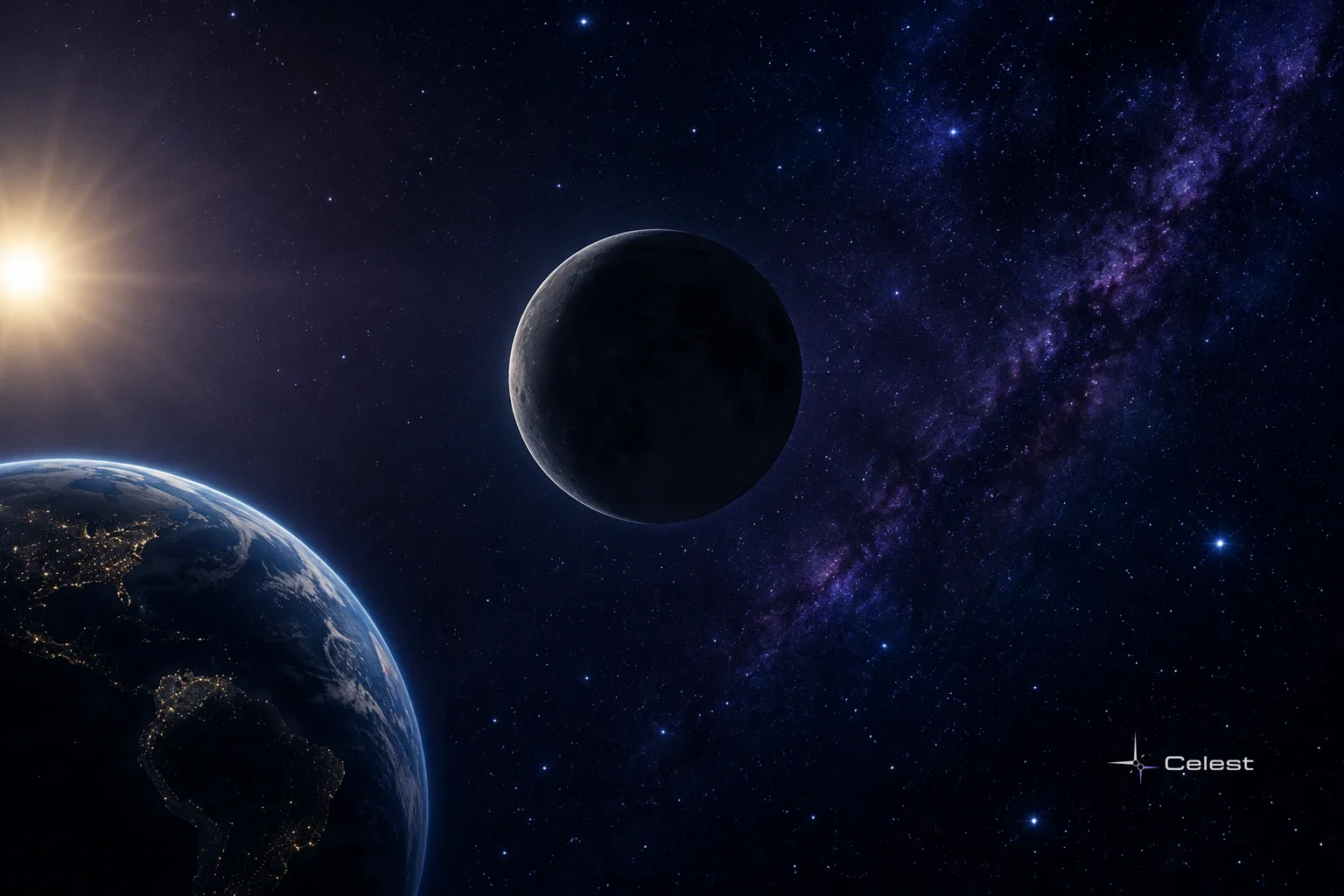
A new moon happens at the exact moment the Moon and the Sun reach the same ecliptic longitude — the same position along the Sun's path across the sky — with the Moon sitting between Earth and the Sun.
At that instant the Moon's near side, the half facing Earth, gets almost no direct sunlight, so the whole disk disappears from view. That's different from the older, everyday meaning of "new moon": the first thin crescent you can actually see low in the west a night or two later.
How it works
The Moon makes no light of its own. It only shows up because sunlight bounces off it, and how much of that lit half faces Earth depends entirely on where the Moon sits in its orbit that night.
- Sunlight always lights half the Moon. As it orbits Earth, the portion of that lit half turned your way keeps changing, which is what produces the whole cycle of phases.
- At new moon, the Moon sits between Earth and the Sun. The illuminated hemisphere faces outward, away from Earth, so almost none of that sunlit surface reaches your eyes.
- The astronomical new moon is one single instant, worldwide. It's the exact moment the Moon and Sun share the same ecliptic longitude, although its local calendar date and clock time can differ between time zones.
- The Moon's orbit tilts about five degrees from Earth's path around the Sun. Because of that tilt, most new moons pass slightly above or below the Sun instead of lining up with it directly.
- Only a precise alignment produces a solar eclipse. When the Moon crosses that tilt at just the right moment, its disk blocks the Sun; on average, that happens between two and five times a year, according to The Planetary Society.
Each of these steps repeats on a rhythm called the synodic month, or lunation — the stretch from one new moon to the next. It averages 29.53059 days, though the Sun's pull on the Moon's slightly stretched orbit lengthens or shortens individual months anywhere from 29.26 to 29.80 days.
You can track exactly where the current cycle stands on Celest's Moon guide, and see upcoming phases and dates on the astronomy calendar.
Not the same as a visible crescent
The biggest mix-up around new moon is picturing a faint sliver of Moon hanging in the sky. Right at the astronomical new moon, though, there's essentially nothing to see — the lit side faces away from Earth entirely.
The visible crescent everyone actually associates with "new moon" comes a day or more later. It's the first sliver of the waxing Moon, low in the western sky just after sunset, a little farther from the Sun's glare. Older calendars marked the start of the month by that first sighting, not by the conjunction itself.
Exactly when — and even on which date — that first crescent becomes visible depends on where you're standing. Latitude, horizon clarity and local sunset time all shift the sighting, which is why calendars like the Islamic and Hebrew ones historically relied on local observation rather than one global instant.
Astronomical new moon vs. first crescent
The astronomical new moon and the first visible crescent describe two different moments, even though both trace back to the same alignment between the Moon and the Sun.
The astronomical new moon is precise and borderless: the Moon and Sun share the same ecliptic longitude at one specific minute, wherever you live. It isn't something anyone can watch, except in the rare case when the geometry lines up into a solar eclipse.
The first visible crescent, by contrast, is local. It's a thin arc that appears low in the west a day or two afterward, timed to your own horizon and sunset — worth checking against current observing conditions before you head out.
The same orbital rhythm that sets the new moon also lines up Earth, Moon and Sun at full moon. Both alignments strengthen the combined tidal pull, producing spring tides that run higher and lower than the usual daily swing.
See it for yourself
You won't spot the astronomical new moon itself. The Moon stays essentially blank in the sky until it edges back into visibility a day or two later — except on the rare occasion it crosses directly in front of the Sun during a solar eclipse.
- Look low in the west after sunset, a day or two past new moon, for a faint curved sliver: the first waxing crescent.
- Give it a clear western view. Buildings, hills and haze can hide a low crescent; wait until after sunset before looking near that part of the sky.
- Check the Moon's current phase on Celest's Moon guide before heading out, so you know whether tonight is even worth the trip.
If clouds hide the crescent tonight, try the next clear evening in the following few days. It will usually be wider and easier to spot, then grow into a half-lit Moon rather than remaining a thin sliver all month.
Leave a comment
Comments appear after moderation.