What Is a Waning Gibbous Moon?
It looks almost full, but it's already changing. Here's the phase that follows every full Moon, and the simple orbital reason behind its slow shrink toward third quarter.

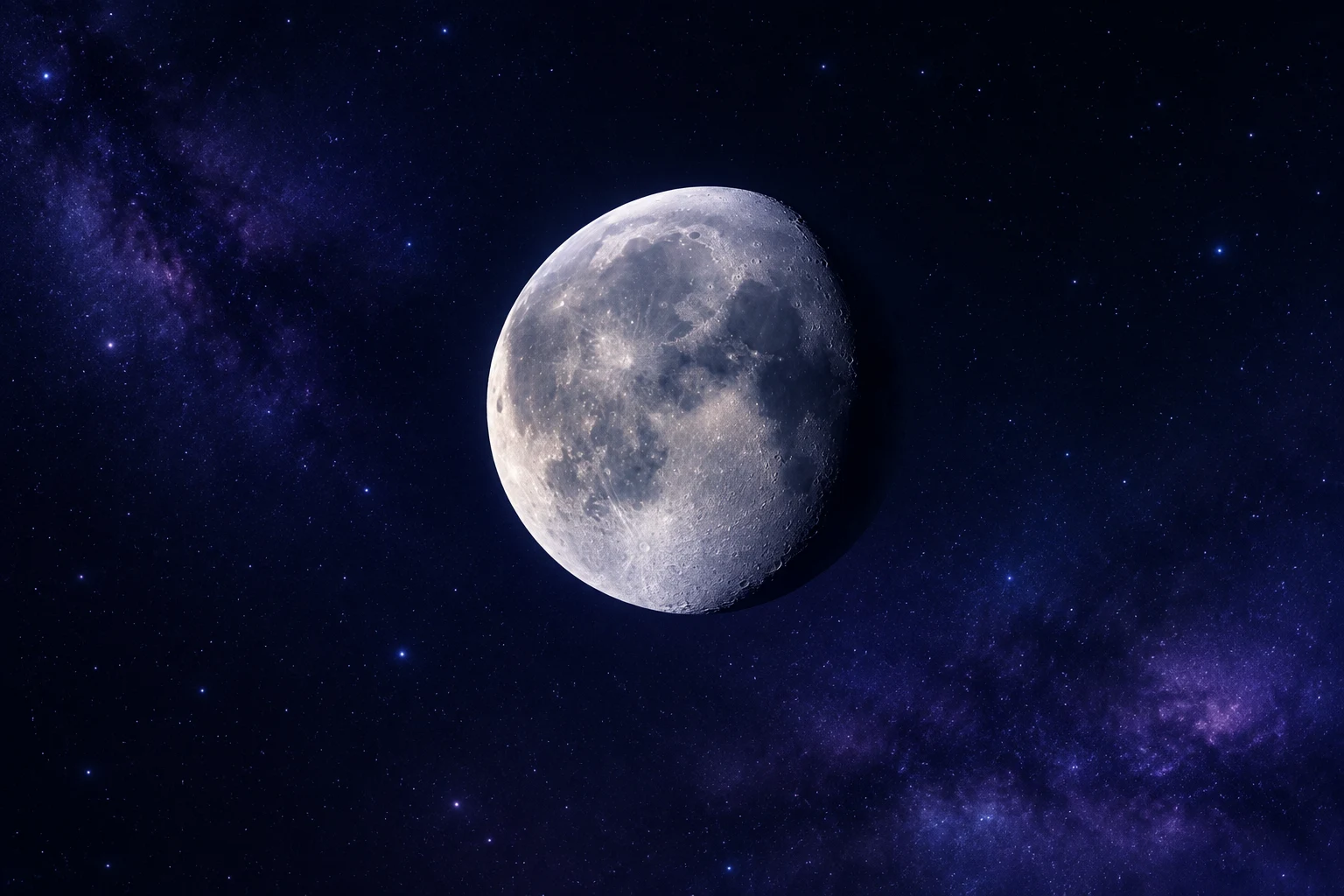
A waning gibbous Moon is the Moon in the nights right after full, when the near side still glows almost completely but a sliver along one edge has slipped into darkness. The waning gibbous Moon is a shrinking, still-mostly-lit Moon — the bridge between a full Moon and the half-lit third quarter that follows roughly a week later.
You'll find it rising in the evening and still hanging in the sky well into the following morning.
Check the Moon guide and you'll see this phase logged as one of eight named stages that repeat about every 29.5 days. During this phase the lit fraction lies between full and half illuminated, decreasing each night.
How it works
The change from a full, round Moon to this narrowing shape follows a simple sequence:
- The Sun always lights exactly half of the Moon's surface, the same way it lights half of Earth at any given moment.
- The Moon orbits Earth while keeping the same face turned toward home, so roughly the same face remains turned toward Earth.
- At full Moon, that entire sunlit half happens to face Earth directly, so the near side looks completely lit.
- Each night afterward, the Moon's position in its orbit turns a bit more of the near side away from the Sun's light.
- That shrinking continues until third quarter, when exactly half the near side is lit — the moment waning gibbous ends.
As the Moon moves onward after full phase, it generally rises later in the night and remains visible after sunrise. Local rise times vary with your latitude and the season.
The illuminated fraction runs from close to 100% down toward roughly 50% over about a week, and the whole stretch counts as waning gibbous rather than a single fixed moment. A Moon spotted a few nights after full can still look nearly round, which is exactly why the phase is easy to mistake for full itself.
Checking the calendar for the most recent full Moon tells you roughly how far into the shrink you're looking.
The mistake most people make
The dark sliver creeping across a waning gibbous Moon is not Earth's shadow falling on it. That's the most common mix-up, and it's an easy one to make since the dark part does look like something is blocking the light.
The real explanation is simpler: the Moon makes no light of its own. Moonlight is just sunlight bouncing off its surface, and the unlit portion you're seeing is the Moon's own night side — the half currently facing away from the Sun, not away from Earth.
Earth's shadow only reaches the Moon during a lunar eclipse, and that's rare precisely because the Moon's orbit is tilted about five degrees relative to Earth's path around the Sun, according to The Planetary Society. Most full Moons pass above or below Earth's shadow entirely, so an ordinary waning gibbous Moon has nothing to do with Earth blocking anything.
Waxing gibbous or waning gibbous?
Waxing gibbous and waning gibbous can look nearly identical at a glance — both are more than half lit and less than full — but they're moving in opposite directions. Waxing means growing toward full; waning means shrinking away from it, toward new.
A few checks separate them:
- Compare successive nights: a gibbous Moon getting fuller is waxing; one getting less illuminated is waning. A phase calendar confirms the direction without relying on a single sunset sighting.
- Which side is lit: for a waning gibbous Moon, the lit portion sits on the left as seen from the Northern Hemisphere and on the right as seen from the Southern Hemisphere — the reverse of a waxing gibbous Moon.
- Rise and set times: a waning gibbous Moon usually rises after sunset and sets after sunrise; check the local prediction rather than treating these times as exact.
None of these require special equipment — just a clear view and a sense of what time it is relative to sunset.
See it for yourself
Use the night sky guide for local moonrise and direction, then try these observations in the days after full Moon:
- Check the local moonrise time, then look in the direction shown on your sky map. Early in this phase the Moon still looks nearly round; later it rises closer to midnight and looks closer to half lit.
- Look again before dawn and compare its position with your map. It can be much higher than the western horizon, especially as last quarter approaches.
- Compare it with the same view the next clear night; the lit portion will be visibly smaller, and checking observing conditions first helps rule out clouds as the reason you can't tell.
Compare the illuminated shape over two or three mornings: the shrinking edge is a more reliable clue than a single glance near sunset.
Leave a comment
Comments appear after moderation.