What Causes the Moon's Phases?
A tour through the real mechanics behind new moons, full moons and everything in between — no shadows, no shrinking, just changing angles of sunlight.

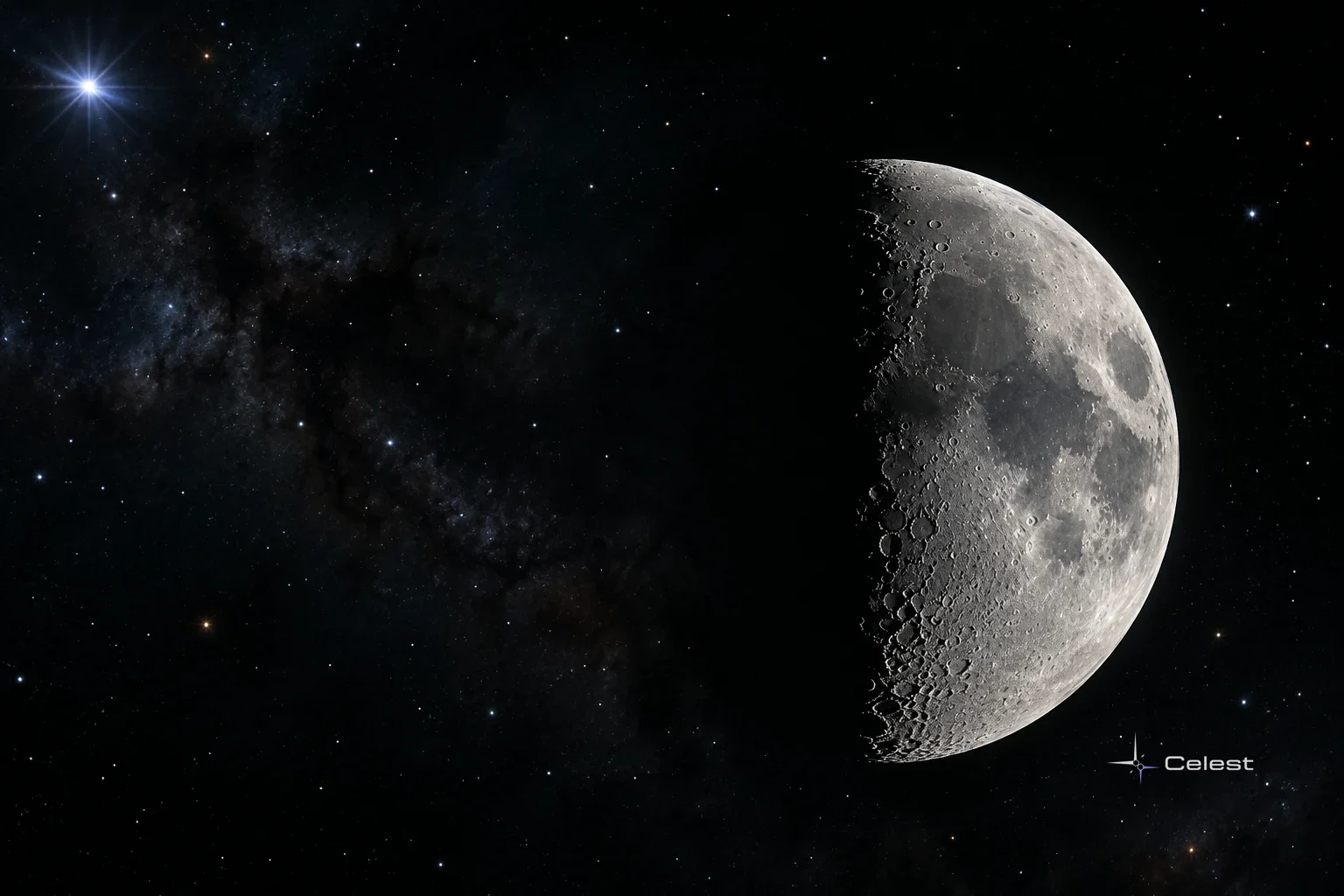
The Moon's phases aren't the Moon changing shape or shrinking away — they're caused by your changing view of the half of the Moon that's lit by the Sun as it circles Earth. One side of the Moon is always bathed in sunlight, the same way half of Earth is always in daylight.
From your spot on the ground, you catch different slices of that sunlit half depending on where the Moon sits in its orbit, and the full cycle repeats about every 29.5 days. Check the Moon guide to see tonight's phase before you look up.
How it works
Start with the Sun. Half of the Moon is always lit, no matter what phase you're seeing. Which portion of that lit half faces you is purely a matter of angle, not a change in how much sunlight is falling on the Moon.
The Moon rotates once on its axis in about the same time it takes to orbit Earth. This keeps roughly the same face turned toward us, although a slight apparent rocking reveals a little more around its edges over time. The night sky guide shows where to find it tonight.
As the Moon travels around Earth, the angle between the Sun, the Moon and you keeps shifting. Some nights you're looking mostly at the Moon's dark half, some nights at its fully lit half, and most of the time at something in between. That shifting angle is the entire mechanism behind every lunar phase.
The Moon takes about 27 days to complete one full orbit around Earth. But Earth is also moving around the Sun during that time, so the Moon has to travel a little farther to line up the same way with the Sun again.
That extra distance is why the phase cycle — new moon to new moon — runs closer to 29.5 days on average, and any single cycle can stretch from roughly 29.26 to 29.80 days because the Sun's pull tugs on the Moon's slightly lopsided orbit.
The eight phases in order
Each phase marks a specific point in that changing angle, and they always happen in the same sequence.
- New Moon — the Moon sits between Earth and the Sun, its lit half facing away from you, so it's invisible at night and rides highest around midday.
- Waxing crescent — a thin curve of light appears and grows a little each night as the illuminated portion increases.
- First quarter — roughly half the visible disc is lit, typically on the right side, one week after new moon.
- Waxing gibbous — more than half the disc glows, still growing toward full.
- Full Moon — Earth sits between the Moon and the Sun, the entire near side is lit, and the Moon rises around sunset and stands highest in the middle of the night.
- Waning gibbous — the lit portion starts shrinking again after full.
- Last quarter — half the visible disc is lit again, now shrinking toward new moon.
- Waning crescent — the remaining sliver narrows before the cycle resets.
Together these eight stages describe one smooth arc: the lit portion grows from nothing to a fully lit disc, then shrinks back down to nothing, over and over.
It's not Earth's shadow
None of this involves Earth's shadow. That's the most common mix-up, and it's worth clearing up early. Earth's shadow only matters during a lunar eclipse, which can only happen at full moon, when the Moon passes directly through that shadow instead of simply sitting opposite the Sun.
According to The Planetary Society, that precise alignment doesn't happen every month, because the Moon's orbit is tilted about 5 degrees relative to Earth's path around the Sun. Most full moons pass above or below Earth's shadow rather than through it.
The same tilt limits solar eclipses, which can only occur at new moon, when the Moon lines up exactly between Earth and the Sun. Solar eclipses happen only a handful of times a year — far less often than the twelve or thirteen new moons that occur annually.
Phases, by contrast, happen every single month without needing any special alignment at all.
Waxing versus waning
Waxing describes the first half of the cycle, from new moon to full, when the lit portion grows a little more each night. Waning describes the second half, from full moon back to new, when that lit sliver shrinks back down.
At first quarter, it's typically the right half of the disc that's lit; at last quarter, the left half. Which side you actually see depends on your hemisphere and the Moon's position in the sky, so don't treat it as a strict rule.
You'll also see "last quarter" and "third quarter" used for the exact same half-lit phase after full moon. Both describe the identical point in the cycle — it's a naming difference between sources, not two separate phases.
See it for yourself
Pick a night just after new moon and watch the sky over the following week. A thin crescent will appear low near sunset and grow noticeably fatter each evening — an easy way to watch waxing happen in real time.
A few practical notes for tracking the cycle:
- Full moon nights wash out faint stars, so check observing conditions before planning any deep-sky viewing around that time.
- New moon nights give you the darkest skies of the month, especially somewhere away from city glow — worth checking the light pollution map for a darker spot nearby.
- Quarter moons rise around midday or midnight, so their half-lit disc is easiest to catch in the evening or early morning sky rather than at the extremes of the night.
Once you've watched one full cycle from crescent to full and back to crescent, the pattern becomes obvious rather than mysterious — just a matter of catching the Moon at a different angle each night.
Leave a comment
Comments appear after moderation.