Halley's Comet: The Comet That Proved Its Own Return
It returns roughly every 76 years, was the first comet ever imaged up close by spacecraft, and won't be near Earth again until 2061 — here's what makes 1P/Halley worth knowing now.

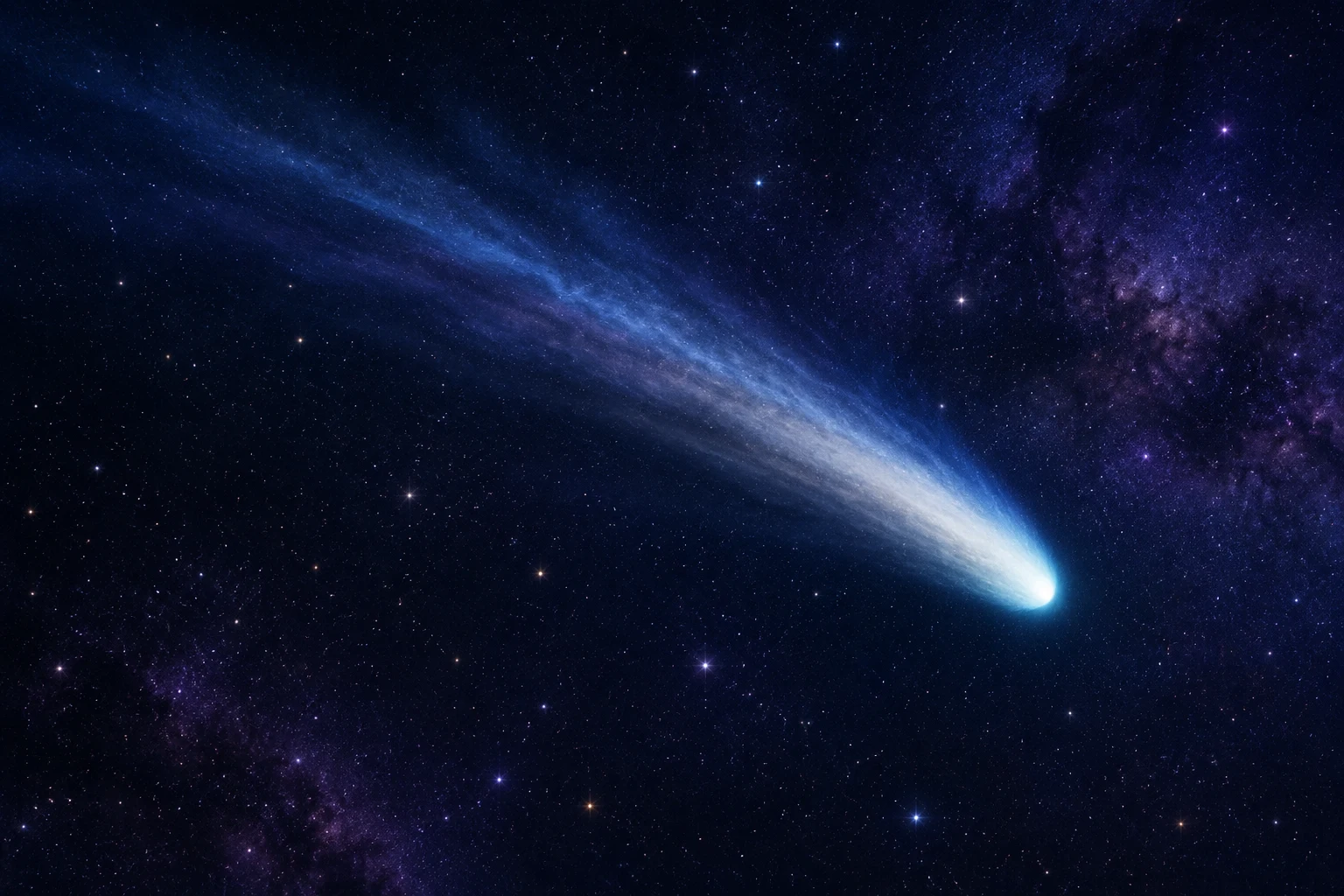
Halley’s Comet, officially designated 1P/Halley, is a famous short-period comet that returns to the inner Solar System roughly every 76 years and can become visible without a telescope. It last visited the inner Solar System in 1986 and is expected back in 2061.
The comet itself is now far too faint for ordinary backyard observing, but the dust it left behind still produces annual meteor showers.
What makes it worth knowing isn't just brightness. Halley's Comet is famous twice over: it was the first comet whose return was ever predicted, and, nearly three centuries later, the first comet examined up close by spacecraft. You can follow other icy visitors passing through right now on Celest's comet guide, but none of them carry quite this history.
Halley's Comet at a glance
Here's the comet reduced to its key numbers, drawn from its 1986 flyby data and current orbital elements:
- Type: Periodic comet, formally 1P/Halley; its roughly 76-year orbit counts as short-period in comet classification.
- Where now: Near aphelion, its farthest point from the Sun, out past the orbit of Neptune.
- Distance: Perihelion about 0.59 au by Wikipedia's figures, between the orbits of Mercury and Venus; aphelion about 35 au.
- Size: Roughly 15 × 8 km, with a mean diameter of about 11 km, measured directly during the 1986 spacecraft flybys.
- Brightness: Reached naked-eye brightness during its 1986 return; currently far too faint for ordinary amateur viewing.
- Best seen: Not visible now. The next favorable return is 2061; today, its debris still produces two annual meteor showers.
The astronomer who predicted its return
Comet Halley owes its name to a moment of pattern-spotting rather than a moment of discovery. In 1705, the English astronomer Edmond Halley published a catalog of the orbits of 24 comets and noticed something odd: the comets seen in 1531, 1607 and 1682 all followed almost identical paths.
Halley concluded they weren't three different comets but one comet, returning roughly every 76 years. He predicted it would come back in 1758 — a bold claim, since no one had ever shown that a comet's return could be forecast at all.
Halley didn't live to see it. He died in 1742, sixteen years short of the date he'd calculated.
On 25 December 1758, a German farmer and amateur astronomer named Johann Georg Palitzsch spotted the comet, and it reached perihelion, its closest approach to the Sun, on 13 March 1759. The gravitational pull of other planets changes its orbital timing, so its returns do not repeat on an exact 76-year calendar.
In 1759, the French astronomer Nicolas-Louis de Lacaille named the comet in Halley’s honor. The successful prediction showed that a comet could return on a calculable orbit, giving powerful support to Newtonian gravitational theory.
An orbit unlike the planets'
Halley's Comet travels a path that looks almost nothing like the neat, roughly circular orbits of the planets. Its orbit is highly elongated, with an eccentricity of about 0.967 by Wikipedia's figures — TheSkyLive's JPL-derived numbers put it slightly higher, at 0.968 — and it's tilted almost 162 degrees from the plane most planets share.
That steep tilt means Halley moves retrograde: backward, against the direction every one of the visible planets travels around the Sun. During its close pass in 1910, the comet moved relative to Earth at about 70.56 km/s (157,800 mph).
The comet's semi-major axis, a measure of its average distance from the Sun, works out to roughly 17.7 to 17.9 au depending on which dataset you use.
That long, stretched orbit carries it from just inside Venus's distance from the Sun out to nearly 35 au in the outer Solar System, on a loop that takes about 76 years to complete.
What the 1986 spacecraft found
When the European Space Agency's Giotto probe and the Soviet Vega 1 and Vega 2 spacecraft flew past Halley's nucleus, the solid icy core at the comet's center, in 1986, they became the first spacecraft ever to photograph a comet up close.
What they found surprised a lot of astronomers. The nucleus measured roughly 15 × 8 km — small enough to fit inside a mid-sized city — and its shape has since been compared to a peanut, a potato, or an avocado.
Its mass came out to around 2.2×10^14 kg, and a density of only about 0.55 g/cm³ pointed to a loosely packed rubble pile rather than a solid chunk of ice.
The nucleus turned out to be almost pitch-black, reflecting only about 4% of the sunlight that hits it, roughly what coal reflects, far darker than astronomers had predicted beforehand.
Britannica notes that about 70% of that dark surface was covered by an insulating crust, with the remaining 30% actively venting gas and dust in jets that shifted as the nucleus rotated once every 2.2 days.
As the comet nears the Sun, those active patches sublimate, turning directly from ice to gas, and build a coma, a temporary atmosphere that can stretch up to 230,000 km across.
Charged gas gets swept into an ion tail that can trail more than 100 million km behind, and a sudden shift in the solar wind can snap that tail off entirely in what's called a disconnection event.
The gas released is mostly water vapor, with carbon monoxide, carbon dioxide, and traces of other compounds; the dust is largely carbon-rich material and silicates. The results broadly supported Fred Whipple's "dirty snowball" model of comets, though Halley itself looks more like a dusty, mostly non-icy body with pockets of ice tucked inside — closer to a snowy dirtball.
How to see it
There's no getting around this: Halley's Comet itself isn't visible right now, and won't be for decades. It's out near its farthest point from the Sun, tens of astronomical units away, far too faint for the eye, binoculars, or any telescope a beginner is likely to own. The next good return is 2061.
What you can see today is its aftermath. Every time Halley swings through the inner Solar System it leaves dust behind, and Earth still crosses two of those trails every year, producing two annual meteor showers. Check Celest's meteor shower guide for this year's peak nights.
Beyond that, the practical move is to plan for what actually is up. Celest's night sky guide shows what's visible from your location on any given evening.
Before you head out for anything, it's worth checking Celest's observing conditions page — clouds and a bright Moon will ruin a meteor shower faster than distance ever could.
What comes next for Halley
The next return to the inner Solar System is expected in 2061. How impressive it looks from your location will depend on its position relative to Earth and the Sun, not simply on the date it is closest to the Sun.
You do not have to wait for that return to see a trace of Halley. The Eta Aquarids and Orionids come from dust it left along its orbit; Earth meets those streams each year.
Each pass by the Sun releases a little more gas and dust from the nucleus. The meteor showers are a visible reminder of that gradual loss: a comet can leave a trail in Earth’s sky long after the comet itself has gone.
Leave a comment
Comments appear after moderation.