Geminids Meteor Shower: December Meteors From an Asteroid
One of the strongest annual meteor showers comes from a rocky asteroid, rather than a typical icy comet. Its brief flashes carry clues to a debris trail with an unusual origin.

In the Celest calendar: Geminids Meteor Shower →
The Geminids meteor shower is a major annual display of shooting stars that peaks in mid-December. Its meteors are linked to debris associated with asteroid 3200 Phaethon. That makes it unusual: many familiar showers come from material left by icy comets, while the Geminids have a rocky parent.
You do not need to find the asteroid to watch its meteors. Earth encounters the debris trail each year, and small particles make brief streaks as they enter our atmosphere. A dark sky and a comfortable, patient watch matter much more than a telescope.
The Geminids at a Glance
- Season: mid-December, with a peak typically near December 13–14.
- Parent body: asteroid 3200 Phaethon.
- Radiant: the apparent starting direction lies in Gemini.
- Entry speed: around 35 kilometres per second.
- Peak potential: roughly 120 meteors per hour under perfect conditions; your count can be much lower.
- Equipment: unaided eyes, a broad view and warm clothing.
An Asteroid Behind the Shooting Stars
Phaethon is a rocky body a few kilometres across. Discovered by the Infrared Astronomical Satellite in 1983, it follows an elongated orbit around the Sun, completing a circuit in about 1.4 years. Astronomers recognised a relationship between its orbit and the Geminid meteors.
The annual shower does not mean that Phaethon itself is approaching Earth every December. Material distributed along the debris stream is what our planet encounters.
The parent object and the particles have different roles in the story.
A meteoroid is a small solid particle in space. A meteor is the luminous event when material enters the atmosphere; a meteorite is surviving material that reaches the ground. The bright streak you watch is therefore not a star coming loose from Gemini. It is an atmospheric event made by a much smaller piece of space material.
Why the Meteors Seem to Come From Gemini
If you trace Geminid paths backward, they appear to meet near a point in Gemini, the Twins. That point is the radiant. Perspective makes the incoming paths appear to spread outward from one region, much as parallel railway tracks seem to converge in the distance.
Gemini provides the shower’s name and its apparent direction. Its stars do not supply the debris. You can see meteors far from the radiant, so staring at one star or using a telescope’s narrow field can mean missing streaks elsewhere.
Use the live sky map to recognise the constellation, then watch a larger expanse of sky. Knowing where the radiant is helps you understand the geometry. It does not turn it into the only place worth watching.
What an Hourly Rate Really Means
Under perfect peak conditions, the shower can produce roughly 120 meteors per hour. Treat that as potential under favourable circumstances, rather than an appointment for two visible meteors every minute. Even a strong shower can arrive in bursts and quiet intervals.
The visible count depends on how dark the sky is, how high the radiant stands and whether moonlight washes out faint streaks. Published standardised rates and a person’s observed count are not interchangeable. A brief urban watch may reveal only a small part of the activity.
Check a year-specific forecast before planning the peak night. The Moon’s phase and exact peak time change, and a general mid-December date does not supply either. The observing conditions page can help you consider the local sky alongside the annual shower information.
How to Watch the Geminids
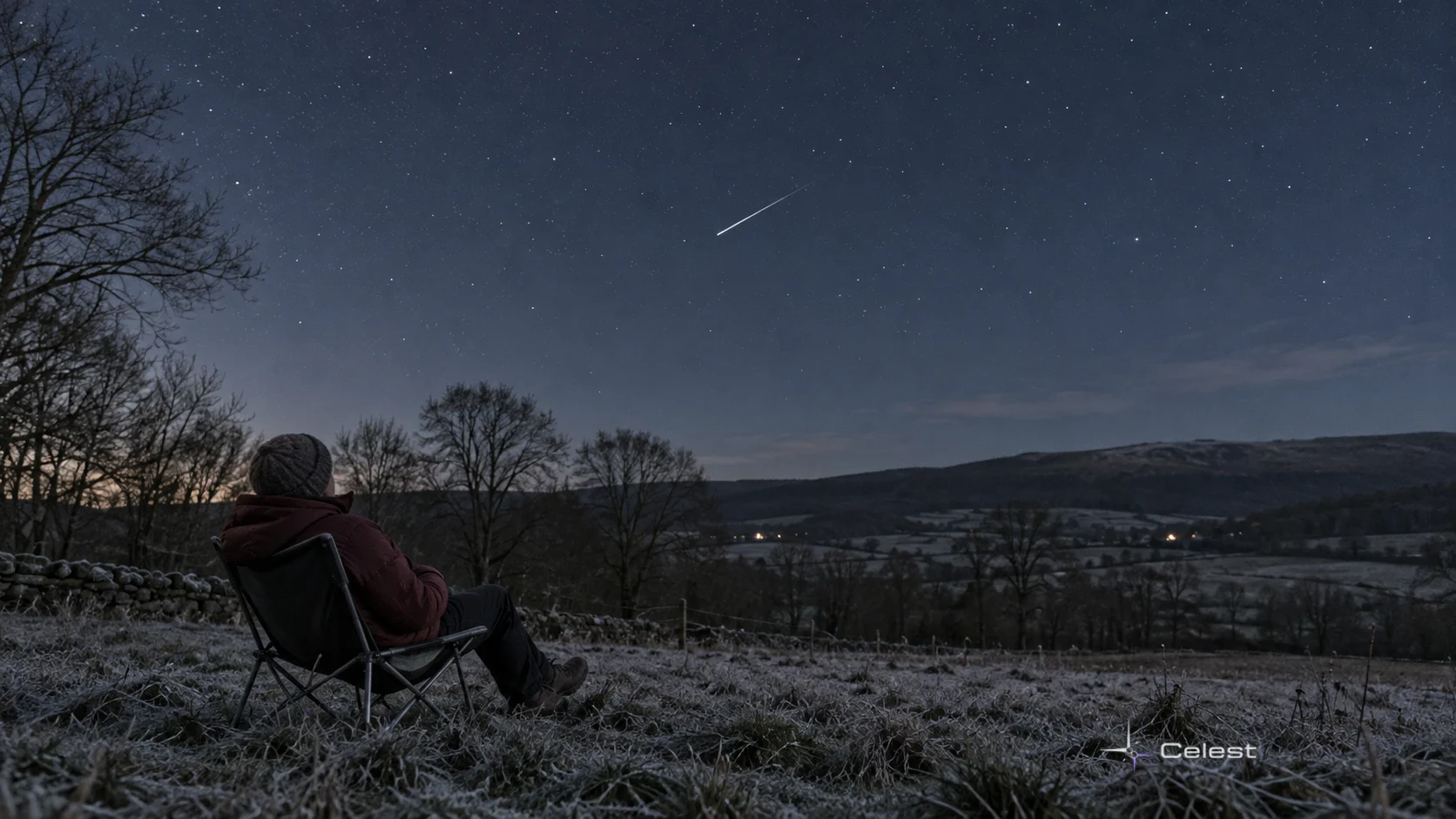
Find a place away from streetlights with an open sky. In Romania and other northern locations, December observing can be cold, so bring warm layers, insulation from the ground and a chair or blanket that lets you look upward comfortably.
Allow roughly 30 minutes for your eyes to adjust to darkness, and avoid repeatedly checking a bright screen. Start with a broad view instead of following one small patch. A steady, comfortable position makes it easier to stay attentive without constantly moving your head.
The shower can offer useful evening activity, with night and predawn hours also favourable. Choose your actual session using the year’s peak forecast and your location. If you see only a few streaks, note the duration and conditions before comparing your count with an ideal hourly figure.
A Debris Trail With an Unfinished Origin Story
Phaethon’s behaviour near the Sun adds another puzzle. A 2023 study found that its short tail is consistent with sodium gas, rather than escaping dust. That short-lived gaseous tail is different from the much larger stream of solid material that makes the Geminids.
Research comparing stream models with the dust environment near the Sun favours a sudden, disruptive origin among the scenarios considered. A collision or another powerful event could be involved, but the evidence does not establish one particular incident as the answer.
The meteors also offer a way to study their material. Instruments can separate the light of a meteor into a spectrum, revealing chemical signatures. That requires measurements; an observer cannot reliably identify a particle’s composition from a fleeting colour alone.
Your winter watch therefore connects two stories. Close to Earth, tiny fragments make a familiar annual display. Farther back in their history, those fragments may preserve evidence of an unusual event involving an asteroid. A bright streak lasts seconds, while the trail it belongs to remains a scientific question.
Leave a comment
Comments appear after moderation.