Ursids Meteor Shower: December Meteors With a Distant Comet
This modest northern shower has occasionally strengthened while its parent comet was far from the Sun. The particles follow their own orbital history, rather than travelling as one cloud beside the nucleus.

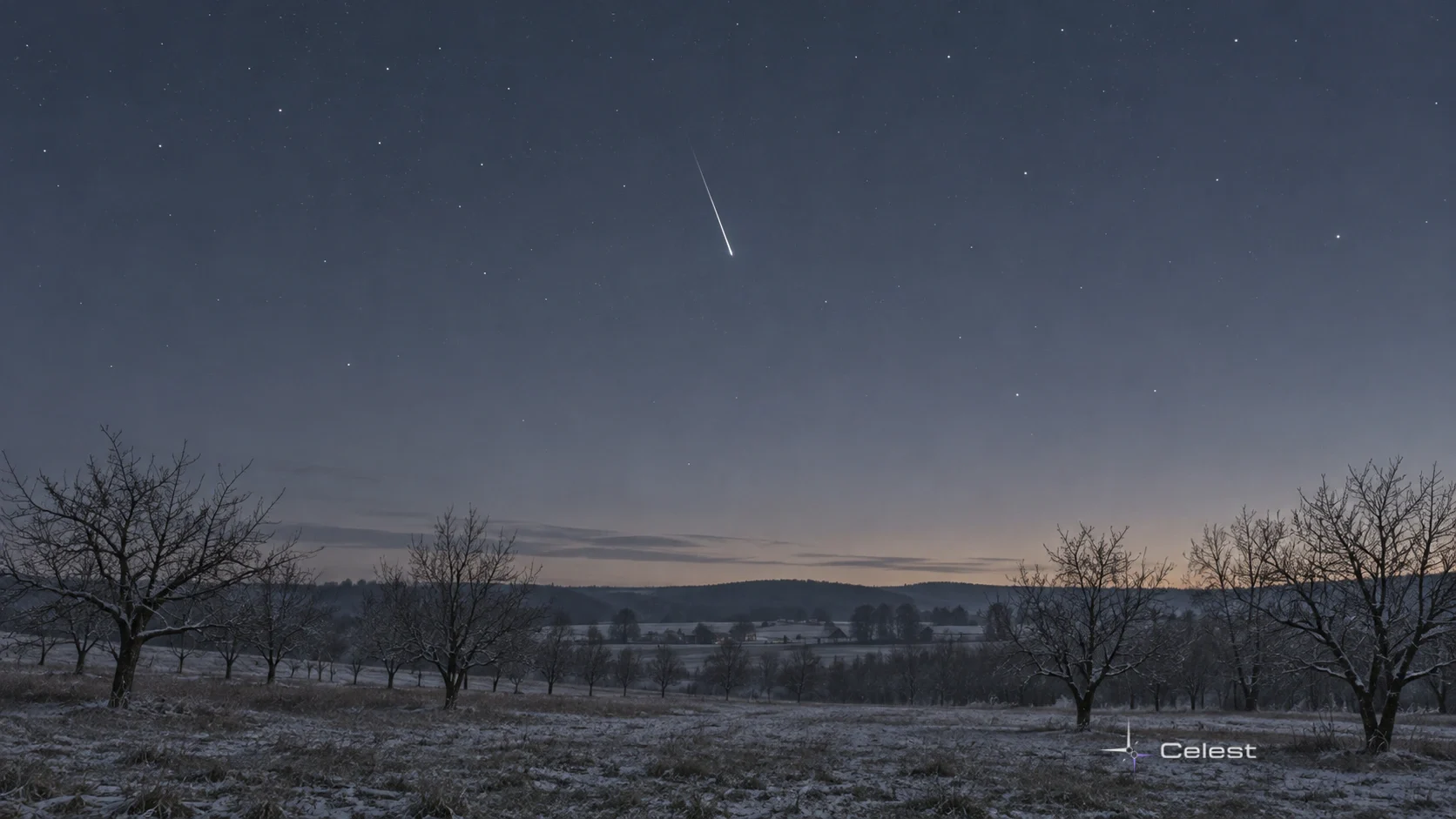
In the Celest calendar: Ursids Meteor Shower →
The Ursids are a late-December meteor shower from material released by comet 8P/Tuttle. Usually modest, they favour northern observers and occasionally reveal much stronger activity. Compare their winter season with other meteor showers before choosing which nights to follow.
Their name points toward Ursa Minor, the constellation containing the Little Dipper. Its bowl provides a useful starting landmark in the constellation guide. The meteors are nearby atmospheric flashes, rather than objects falling from the distant stars in that pattern.
Ursids at a Glance
Use these references to understand the shower, then check the circumstances of the particular return.
- Season: late December, with December 17–26 listed in the 2026 IMO calendar.
- Apparent origin: near Kochab, in Ursa Minor.
- Parent comet: 8P/Tuttle, with an orbit of approximately 13.6 years.
- Ideal reference rate: ZHR 10 under very dark skies and an overhead radiant.
- Ordinary observing benchmark: roughly 5–10 shower members per hour near maximum in favourable northern conditions.
- Atmospheric encounter speed: about 33 kilometres per second.
A Northern Shower Near the Little Dipper
Kochab is one of the brighter stars in the Little Dipper’s bowl. The Ursid radiant lies nearby: extend several shower paths backward, and they appear to approach that part of the sky. Perspective creates the apparent common direction among particles moving along similar trajectories.
Kochab supplies a landmark, not the debris.
The radiant is far north. For many northern observers it never sets, yet its height still changes as the sky appears to turn. It generally becomes better placed later in the night. The final dark hour before dawn is therefore a useful observing window, rather than one fixed clock time for every place.
Farther south, the geometry is much less favourable. A northern observer’s count should not be applied unchanged to someone watching from a different latitude. Seeing the Little Dipper is helpful for orientation; it does not make every part of the shower equally accessible everywhere.
Ten Is a Reference, Not a Personal Count
The zenithal hourly rate, or ZHR, corrects activity to a very dark sky and a radiant overhead. The 2026 reference of 10 lets observers compare showers under the same defined conditions. Your view can include fewer members when the radiant is lower or faint streaks are lost in sky brightness.
Ordinary dark-sky reports often describe about 5–10 Ursids per hour near maximum. Additional sporadic meteors and members of other active showers are a separate population. Counting every December streak as an Ursid would overstate this shower’s activity.
Quiet stretches also matter. A few uneventful minutes do not describe the entire session, just as one brief burst does not establish a sustained hourly rate. Record how long you watched and keep uncertain identifications separate.
The Parent Has Two Adjoining Lobes
Comet 8P/Tuttle takes approximately 13.6 years to orbit the Sun. Earth encounters its dispersed material annually, so the shower does not wait for the nucleus to make another complete journey. The parent and its old particles are following related but distinct paths.
Radar observations made at Arecibo in January 2008 revealed a strongly divided nucleus. A study published in 2010 interpreted its roughly 10-kilometre length and shape as consistent with a contact binary: two lobes joined together. Radar established the broad structure without photographing every surface detail.
The observations also detected relatively large grains moving away from the comet. Their slow motion relative to the nucleus should not be confused with the roughly 33-kilometre-per-second encounter speed of Ursid particles at Earth. Release and atmospheric entry describe different stages of the material’s journey.
How to Give the Shower a Fair Watch
Check the sky calendar for the actual year’s activity before arranging a late-December session. Then compare the Moon’s phase and timing between available nights; extra sky light reduces the faint meteors you can distinguish.
Face a broad part of the northern sky. You do not need to fix your eyes on Kochab: keep enough sky in view to notice longer paths and judge their direction. A comfortable position helps you continue through the gaps between arrivals.
Try watching for about an hour rather than checking for a few minutes. Note the beginning and ending times, changing sky brightness and which streaks plausibly belong to the shower. A small, carefully described count is more informative than a larger total containing unrelated meteors.
Old Dust Can Arrive Without a Nearby Comet
The Ursids have sometimes strengthened while their comet was near aphelion, its farthest point from the Sun. These rare historical episodes challenge the idea that a busy meteor shower always requires its parent nearby.
Orbital models explain how Jupiter’s gravitational influence can help keep some particles grouped while their paths separate from the comet over centuries. Earth may then encounter a concentration of old material at a very different stage of the parent’s orbit.
A 2017 study analysed four Ursid trajectories recorded during the December 2014 outburst. The authors linked that activity to a modelled trail from the comet’s 1392 return. This does not date every Ursid grain or forecast the next outburst. It shows why a brief December flash can record a much longer orbital history.
Leave a comment
Comments appear after moderation.