Taurids Meteor Shower: Two Streams and Autumn Fireballs
Two overlapping streams explain the long Taurid season. Low activity can still include a striking bright meteor, while different observations reveal different parts of the debris family.

In the Celest calendar: Southern Taurids Meteor Shower →
The Taurids are two related autumn meteor showers, the Northern and Southern Taurids, known for slow-moving streaks and occasional bright fireballs. Their seasons overlap for weeks, while their ordinary activity remains modest. Compare the two branches with other meteor showers rather than expecting a dense display throughout autumn.
Both take their names from apparent directions in the Taurus region. Use the constellation guide to recognise the surrounding sky, keeping the nearby meteor paths separate from the much more distant stars behind them.
Taurids at a Glance
The two branches share a broader debris family, but their reference values remain separate.
- Southern season: September 20–November 20 in the 2026 IMO list.
- Northern season: October 20–December 10 in the same reference.
- Ideal hourly rates: Southern ZHR 7; Northern ZHR 5.
- Encounter speeds: about 27 and 29 kilometres per second, respectively.
- Notable feature: occasional fireballs among otherwise sparse activity.
- Associated comet: 2P/Encke, orbiting the Sun in approximately 3.3 years.
Two Streams Make a Long Autumn Season
The Southern branch starts earlier, while the Northern branch continues later. Their overlap explains why Taurid meteors can attract attention across several weeks. It does not make the two showers one uniform stream with a single nightly count.
The names describe different apparent origin directions, rather than dividing observers into northern and southern hemispheres. Viewing geometry still changes with latitude and time, but neither branch’s name is a rule limiting it to one half of Earth.
The radiant is the point from which paths seem to diverge through perspective. During the long Taurid season, those directions drift against the background stars. A chart for one October night is therefore not an exact map for a later November session.
Sparse Activity Can Include a Bright Fireball
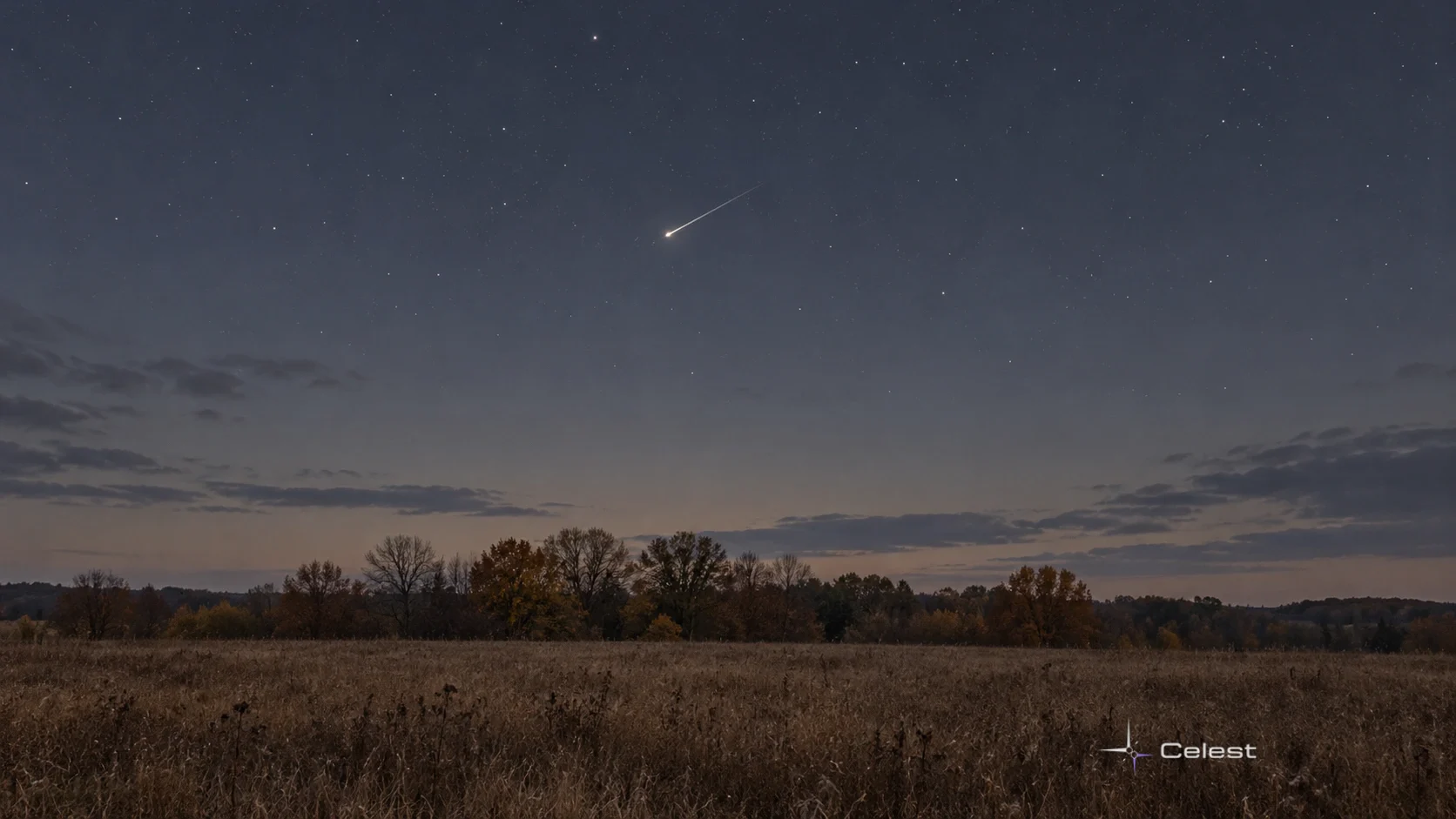
A fireball is an unusually bright meteor. Some Taurids reach that brightness even when only a few shower members appear in an hour. A low rate and an impressive individual flash describe different features, so they are not contradictory.
Their reference speeds are comparatively slow for meteors, around 27 kilometres per second for the Southern branch and 29 for the Northern. These particles are still moving extremely quickly by everyday standards. Apparent movement across the sky also depends on the track’s direction and your viewing angle.
Not every Taurid produces a large flare. Nor does a bright flash automatically establish which stream it belongs to, whether it fragmented or whether anything reached the ground. Keep the observed brightness separate from those further questions.
Why the Two Hourly Rates Stay Separate
ZHR, the zenithal hourly rate, describes standardised activity under very dark skies with the radiant overhead. The 2026 IMO list uses 7 for the Southern Taurids and 5 for the Northern Taurids. Some summaries use a lower Southern reference of about 5.
These are comparison benchmarks, rather than fixed numbers for your own hour outside. Moonlight, radiant height and the faintest streak you can distinguish affect the observed count.
You should also avoid adding the two reference maxima into one promised peak. Their activity changes across the season, and the strongest dates are different. A useful observing record identifies each branch when possible and keeps sporadic meteors outside either total.
Encke Is Part of a More Complicated Family
Comet 2P/Encke completes an orbit in approximately 3.3 years. Earth’s annual Taurid encounters involve material distributed along related paths, without requiring the present nucleus to return every autumn.
The parent labels are more complicated than one name suggests. JPL’s stream table associates the Southern Taurids with Encke and lists asteroid 2004 TG10 for the Northern branch. Researchers investigate those bodies within a wider complex; a catalog association alone does not reconstruct every fragmentation step.
A 2022 modelling study tested more than a hundred possible histories. One particular Encke history reproduced much of the observed shower structure, while many others failed to match its timing or duration. That supports investigating a common origin without making one model the definitive record of an ancient breakup.
How to Watch Without Chasing One Date
Check the sky calendar for the selected year, then compare the Moon’s timing across the available nights. The long observing season can offer alternatives to one inconvenient evening, although activity is not constant throughout it.
Use a broad unaided-eye view, with the Taurus region helping you judge directions. You do not need to stare at the radiant itself. A comfortable seat makes a sustained session easier than repeated brief checks.
If a bright meteor appears, note its time, direction, approximate duration and brightness. Compare the path with the current radiant positions before assigning it. Leave uncertain events unclassified; a memorable flash need not become a confidently identified Taurid.
Different Instruments See Different Debris
A 2022 comparison of visual, optical and radar observations found a fireball-enhancing concentration in optical records without the same signature in radar data. Particle size helps explain the difference: the instruments sample different parts of the population.
A separate telescope survey reported in 2025 also showed why careful classification matters. Seven of eight initially plausible Taurid objects were excluded, while one remained uncertain. They were not eight confirmed relatives of the comet.
The quiet intervals and bright flashes therefore belong to a larger investigation. Researchers combine atmospheric light, particle sizes and orbital paths to understand the family’s history. One spectacular meteor is part of that evidence, rather than a complete picture of everything travelling with the stream.
Leave a comment
Comments appear after moderation.