Quadrantids Meteor Shower: January Meteors With a Brief Peak
One of January’s strongest meteor streams has a short opportunity for its best display. Its name survives a discarded constellation, while its likely parent may be a comet that no longer looks active.

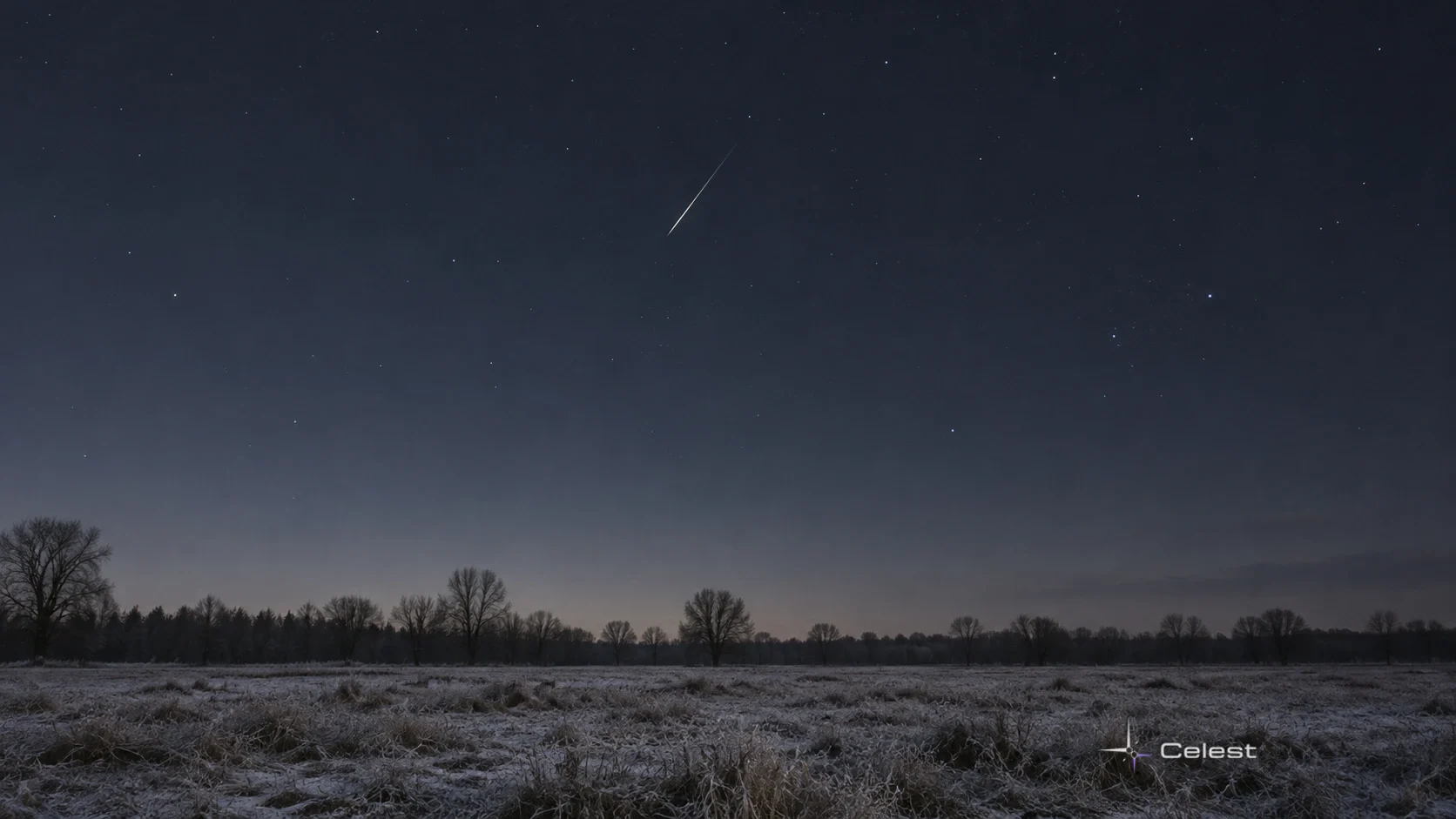
In the Celest calendar: Quadrantids Meteor Shower →
The Quadrantids meteor shower reaches its strongest activity for only a few hours in early January. A potentially rich display can therefore be easy to miss even during its wider active season. Compare its timing with other annual events in the meteor shower guide.
Check the sky calendar for the peak in your chosen year, then match it to local darkness. With this shower, picking the right part of the night can matter much more than simply choosing a date somewhere in January.
The Quadrantids at a Glance
Separate the shower’s reference properties from a forecast of your own observing session.
- Strongest season: early January.
- Main peak: a few hours, commonly described as about six.
- Ideal reference rate: ZHR 80 in the 2026 IMO calendar.
- Associated body: asteroid 2003 EH1, possibly a former comet.
- Encounter speed: about 40.4 kilometres, or 25 miles, per second.
- Apparent origin: the northern Boötes region, near Draco and the Big Dipper’s handle.
A Narrow Stream Makes a Brief Opportunity
NASA explains the short maximum as Earth crossing a thin particle stream nearly at a right angle. The concentrated encounter ends quickly, unlike a strong interval extending across several nights. Some activity continues outside that maximum, but the longer season does not preserve the same rate.
The distinction is between being active and being at full strength.
When particles enter the atmosphere, they create the light called a meteor. A broad photograph assembled from many flashes can make the event look continuously busy. An observer instead sees individual streaks and quiet intervals, with the timing of the strongest encounter affecting the count.
An occasional fireball, an exceptionally bright meteor, can make a sparse session memorable. It is a possibility rather than something a particular January night promises.
Why the Ideal Rate Can Mislead
ZHR, the zenithal hourly rate, describes a standardised view under very dark conditions with the radiant directly overhead. The 80 in the IMO reference table is an ideal comparison number. Moonlight, city glow and a less favourable radiant position reduce what you can actually see.
Practical estimates are not identical either. A dark-sky average is often put at around 25 per hour; NASA’s 2027 observing table instead lists fewer than 10. Its general prose separately describes 60–200 under perfect conditions. Those are differently presented benchmarks, rather than a single guaranteed result.
For planning, the useful question is whether the short maximum overlaps a dark observing window for you. A large reference rate cannot compensate for arriving after the concentrated part of the stream has passed.
An Asteroid With a Possible Cometary Past
The associated object, 2003 EH1, was discovered on 6 March 2003 by the LONEOS survey. It takes roughly 5.5 years to circle the Sun. The shower happens annually because Earth meets dispersed material along a stream, not because the parent repeats its own journey every January.
Its asteroid label describes how the body is classified, while a possible inactive-comet origin describes its history. Those statements can coexist. The evidence does not require a conspicuous active comet to accompany each display.
A physical study published in 2015 found no ongoing mass loss in its observations. The low permitted amount could not continuously supply the stream’s estimated mass over its inferred history. The authors considered either earlier episodes of shedding or a different parent.
An identity with a historical comet is also not established. Improved orbit measurements in a 2008 study excluded the proposed direct link with C/1490 Y1 and C/1385 U1. A familiar historical story should not replace that uncertainty.
Locate the Radiant, Then Look Beyond It
The radiant is the apparent direction from which the meteor paths spread across the sky. Nearly parallel particle paths create that convergence through perspective; the stars in that direction do not produce the meteor shower.
The Quadrantid region lies near Boötes and Draco, close to the end of the Big Dipper’s handle. Northern observers generally have the better view of this high-northern region. Check the live sky map for your position and time, then watch a wider patch instead of staring only at the radiant.
Night and predawn hours can be useful, but a short peak occurring during local daylight is a different situation from a convenient nighttime peak. Use the actual year’s timing before committing to a long session.
Try a reclining chair with a blanket or sleeping bag for winter watching. Keep your view broad and allow roughly half an hour in darkness for your eyes to adjust. That helps with faint flashes without establishing a deadline for the first meteor.
The Old Name and the Quiet Parent
Quadrans Muralis was a constellation introduced in 1795, named for a quadrant used to measure star positions. The shower was recorded in 1825, before that constellation was omitted from the IAU’s recognised list in 1922. The stars remained; the official way of dividing their sky region changed.
The shower therefore preserves a name that modern star charts no longer need. Its stream may also preserve a more active phase of a body that looked quiet in the physical observations. Following those brief atmospheric flashes can reveal both a history of sky mapping and a less certain history of material released into space.
Leave a comment
Comments appear after moderation.