Leonids Meteor Shower: Fast Meteors and Rare Storms
A familiar November shower has produced extraordinary meteor storms, but an ordinary observing night can be much quieter. The comet’s debris and the conditions of each encounter explain the difference.

In the Celest calendar: Leonids Meteor Shower →
The Leonids meteor shower brings fast cometary particles into Earth’s atmosphere each November, with its main activity around the middle of the month. The debris comes from comet 55P/Tempel-Tuttle. Leo gives the shower its name, but the constellation’s stars are not falling toward Earth.
Use the meteor-shower guide to compare its place in the year. A historic Leonid storm and an ordinary November night can look very different.
Check the current calendar for the dates of the observing season.
Leonids at a Glance
Keep the parent, apparent direction and rate distinct when planning an observation.
- Season: November, with the usual main peak in mid-November.
- Parent comet: 55P/Tempel-Tuttle.
- Apparent radiant: Leo.
- Speed: approximately 70 kilometres per second.
- Reference rate: about 15 ZHR in the IMO’s 2026 calendar, not a personal count.
- Best general observing period: around local midnight into the predawn hours.
A Comet Leaves More Than One Kind of Clock
Tempel-Tuttle travels around the Sun in roughly 33 years. Its nucleus is about 3.6 kilometres across. Ernst Tempel and Horace Tuttle independently discovered it in 1865 and 1866, which explains the two names attached to it.
Earth does not have to meet the comet itself every November. Material released from a comet gradually spreads along its path. Our planet encounters that dispersed debris annually, while the much larger parent follows its longer orbit.
A meteoroid is a small object in space. A meteor is the luminous phenomenon produced during its passage through the atmosphere. Material that survives to the ground is a meteorite. The familiar phrase shooting star refers to the flash, rather than a star arriving from Leo.
Why Leonids Cross the Sky So Quickly
Their encounter speed is around 70 kilometres per second. NASA’s different presentations round it to 69.7 or 71, and the IMO lists 71. Those are useful descriptions of the fast stream, rather than a stopwatch measurement of every streak you see.
The radiant is the direction from which the paths appear to spread. Perspective creates that pattern, much as parallel paths can seem to converge in the distance. Leo is the sky landmark for recognising the shower’s direction; it is not a nearby cloud of stars ejecting particles at us.
You do not need to watch only Leo. Meteors can appear across a broad area of sky. A trail viewed farther from the radiant can look longer, while a path close to it looks shortened by perspective. A wide, comfortable view is more useful than staring into one small patch.
An Ordinary Shower and a Historic Storm
A meteor storm reaches at least 1,000 meteors per hour. In 1966, an exceptional Leonid display briefly delivered thousands per minute during roughly fifteen minutes. That event explains the shower’s reputation, but it is not its normal annual rate.
The IMO’s 2026 calendar lists a reference ZHR around 15. ZHR means zenithal hourly rate: a standardised estimate under ideal reference conditions, including a high radiant and dark sky. Your actual count can be lower because the viewing geometry and sky differ from that reference.
NASA’s current Leonid guide also describes dark-sky observed rates below or around three per hour. A reference of fifteen and an observed count of only a few must remain separate. Neither is a promise that a particular observer will see a fixed number in the next hour.
The comet’s 33-year orbit does not settle the question either. Storms can occur near that cycle, but an encounter with denser debris is still needed. A new year needs its own evidence about the debris encounter, rather than a storm prediction copied from a famous historical photograph.
How to Watch Without Overcomplicating It
Check the dates, Moon and observing conditions before choosing a session. NASA’s general advice is to begin around local midnight and continue into the predawn period. The exact timing of a yearly maximum and your useful local window need not be identical.
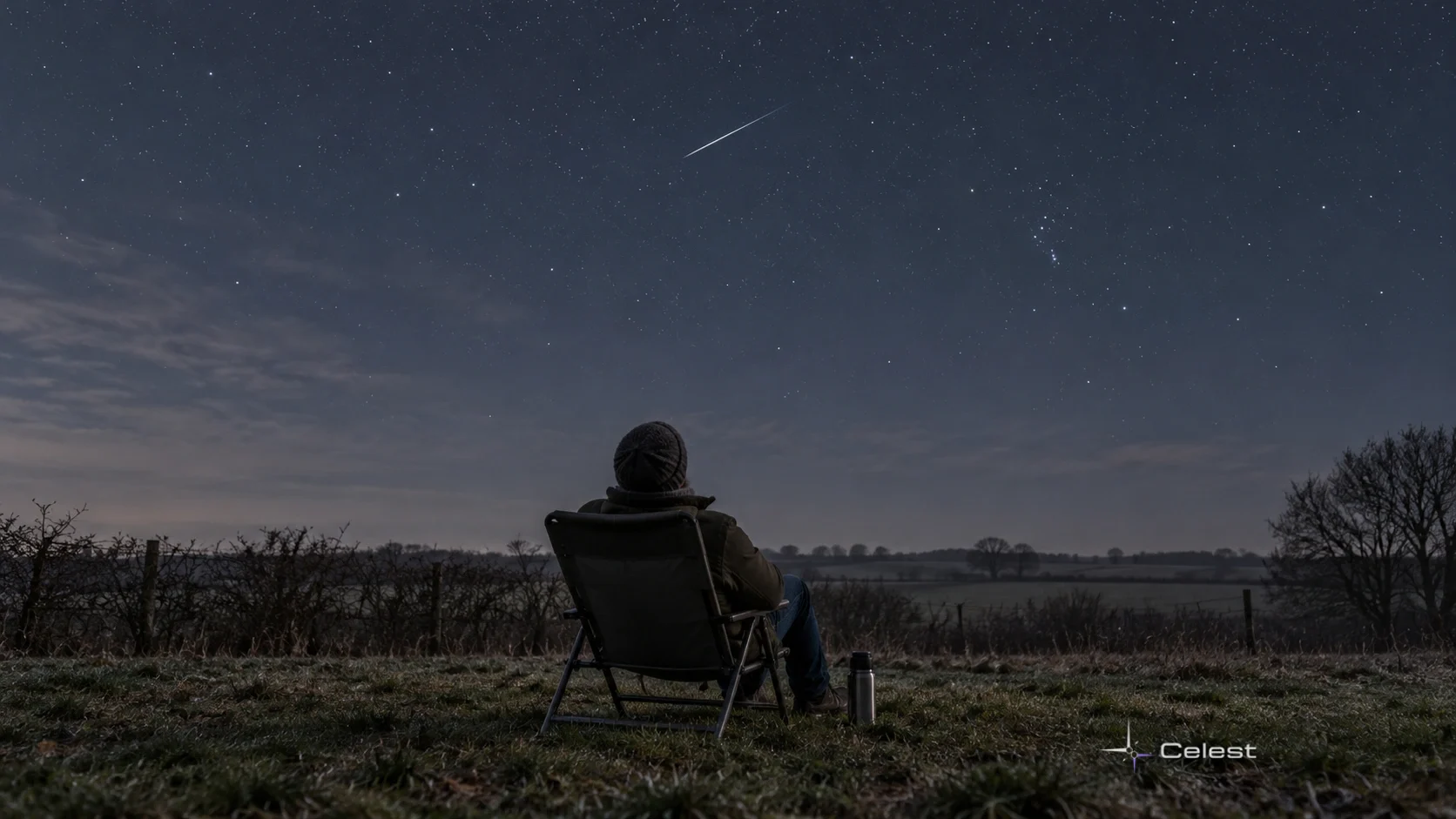
Find a place away from direct streetlights and take in a broad part of the sky. Bring warm layers and a blanket or reclining chair for a late-autumn night. You are watching atmospheric streaks over a wide field, so a telescope is not the main tool for counting them.
Give your eyes time in the dark. Around thirty minutes is useful adaptation guidance, not a deadline by which a meteor must appear. Avoid repeatedly brightening your view with a phone screen; use the chart to orient yourself, then let the sky occupy your attention.
Bright Flashes Do Not All Become Meteorites
Some Leonids produce especially bright fireballs. Larger cometary particles can generate those stronger flashes, while near-horizon Earth-grazers may leave long apparent paths. Brightness alone does not tell you that a piece survived to the ground.
That distinction also improves expectations. A single fast flash can be an interesting observation without a storm or a recoverable rock. You are seeing the end of a small fragment’s journey through space, and a brief encounter between a comet’s dispersed material and our atmosphere.
Leave a comment
Comments appear after moderation.