Neptune: A Pale Planet With Fierce Winds
The most distant of the eight planets is a cold, pale blue-green world with an active atmosphere. Its quiet-looking colour hides fast winds and changing storms.

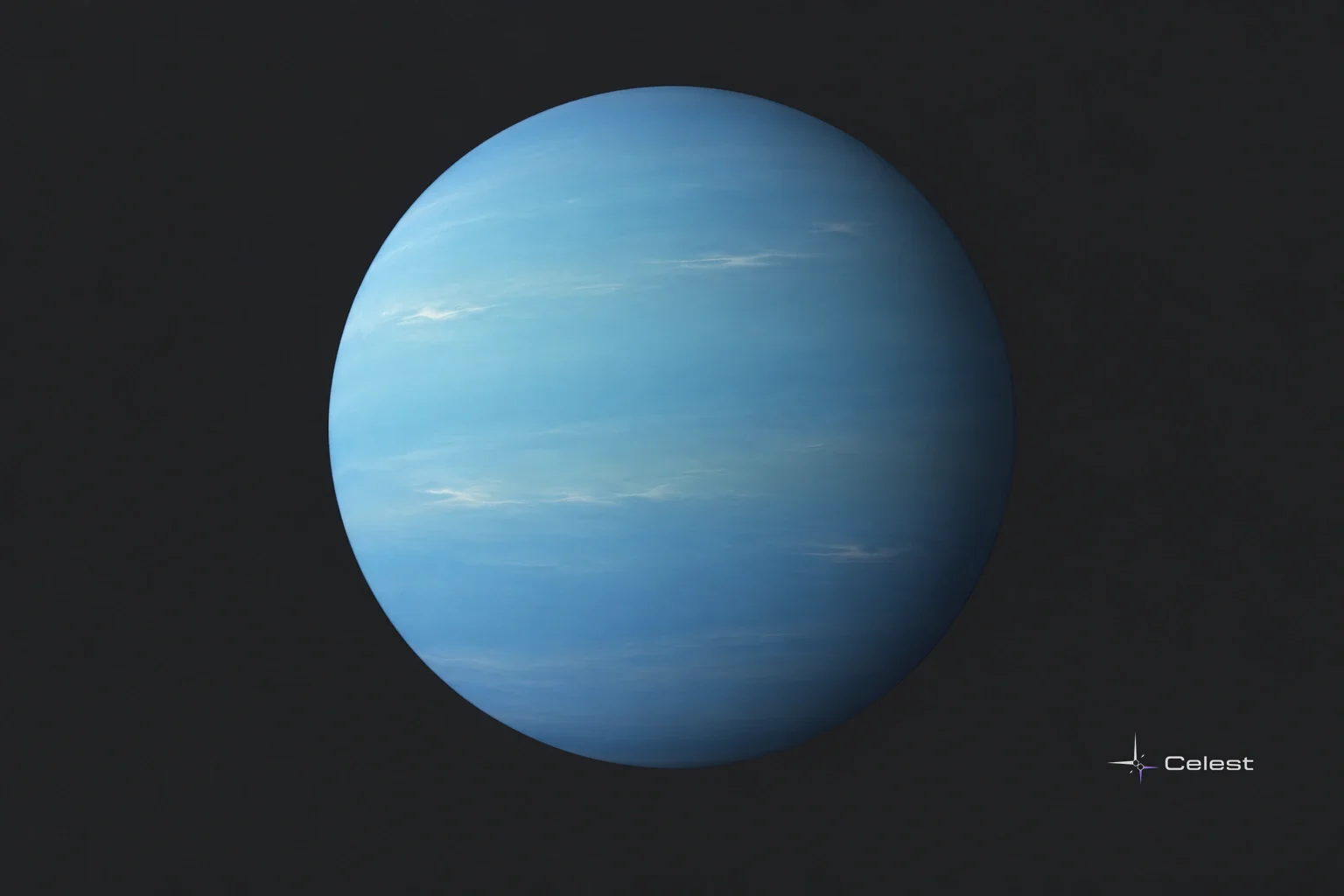
Neptune is the eighth planet from the Sun, a distant ice giant with a pale blue-green atmosphere and winds that can reach around 2,000 km/h. It is the outermost of the eight recognised planets. Its smooth-looking colour gives little hint of how active its weather can be.
You need binoculars with substantial power or a telescope to look for it. Start with the planet guide for its current position, then compare the surrounding stars in the live sky map. A striking blue globe in a book is not what you should expect to recognise immediately outdoors.
Neptune at a glance
The basic figures describe a large planet at a considerable distance:
- Type: ice giant, without an accessible solid surface.
- Position: eighth planet outward from the Sun.
- Diameter: about 49,528 km at the equator, roughly four Earth diameters.
- Solar distance: on average about 4.5 billion km, or 30 astronomical units.
- Day: about 16 hours for one rotation.
- Year: about 165 Earth years for one orbit.
An astronomical unit, usually written AU, is the average distance between Earth and the Sun. Neptune's average solar distance is different from its distance from Earth, which changes as both planets move. Sunlight itself takes about four hours to reach Neptune.
Why familiar pictures look so blue
Methane in Neptune's atmosphere absorbs some red sunlight, leaving a blue-green appearance in the light that returns. Hydrogen and helium make up most of the atmosphere. Methane's effect on colour does not mean the entire planet is made from that gas.
The deep blue in many familiar pictures was strengthened during image processing. A 2024 study rebalanced the observations using measured spectra, which show the amount of light at different wavelengths. Neptune and Uranus came out much closer in colour: pale greenish blue, with Neptune slightly bluer.
Enhanced pictures still have a purpose. Increasing contrast can make a faint cloud or atmospheric band easier to study. The important question is whether you are looking at natural-colour light or a presentation designed to reveal a feature.
Strong winds in a changing atmosphere
The roughly 2,000 km/h figure describes winds in the atmosphere, not the speed at which the entire planet rotates. Neptune has no solid ground at the visible cloud tops, so it is not a forecast for someone standing on a rocky surface.
Voyager 2 saw the Great Dark Spot in 1989. Later Hubble observations showed that the original feature had disappeared, while other dark storms developed. A labelled picture from the flyby therefore describes a particular observation, not a permanent marking that must still be there.
That change makes Neptune a weather system to keep studying. A single close encounter is a valuable snapshot, but it cannot show every storm the planet will produce afterward.
A moon travelling the other way
Neptune's largest moon, Triton, follows an orbit opposite to the planet's rotation. This is called a retrograde orbit. The unusual direction supports the idea that Neptune captured the moon rather than forming it in the same way as its regular satellites.
The capture is an inferred history. Voyager also observed active geyser-like plumes on Triton, giving astronomers a very different subject from Neptune's windy atmosphere. Keep the moon and the planet separate when a caption describes an icy surface or a plume.
Neptune also has faint rings, including brighter concentrated arcs. Rings are therefore not a property unique to Saturn. These delicate structures belong to professional observations rather than the first view you should expect through a small instrument.
How to see it
Use a chart for the date you intend to observe, then compare it with the observing conditions. Neptune is too faint for an unaided-eye identification. The chart and the surrounding stars do much more of the work than its famous colour.
Opposition is a useful observing period: Earth lies between the outer planet and the Sun. Its date changes from year to year, so an old September article or alignment picture is not a current finder guide. Treat a successful identification of the faint planet as the first goal; detailed storms and rings are much harder targets.
A predicted planet, one close visit
Neptune's recognised discovery in 1846 followed calculations based on irregularities in Uranus's motion. Astronomers could use the effect of an unseen body to predict where to look, then confirm the planet through observation.
Voyager 2 passed Neptune on 25 August 1989 and remains its only spacecraft visitor. The contrast between that short encounter and decades of telescope observations leaves an ongoing task: distinguish the planet's lasting properties from the weather that keeps changing.
Leave a comment
Comments appear after moderation.