Pluto: A Small Icy World With an Active Surface
Pluto is smaller than our Moon, but its landscape is far from featureless. Water-ice mountains, nitrogen plains and a thin atmosphere make this distant dwarf planet a useful lesson in how different kinds of ice can behave.

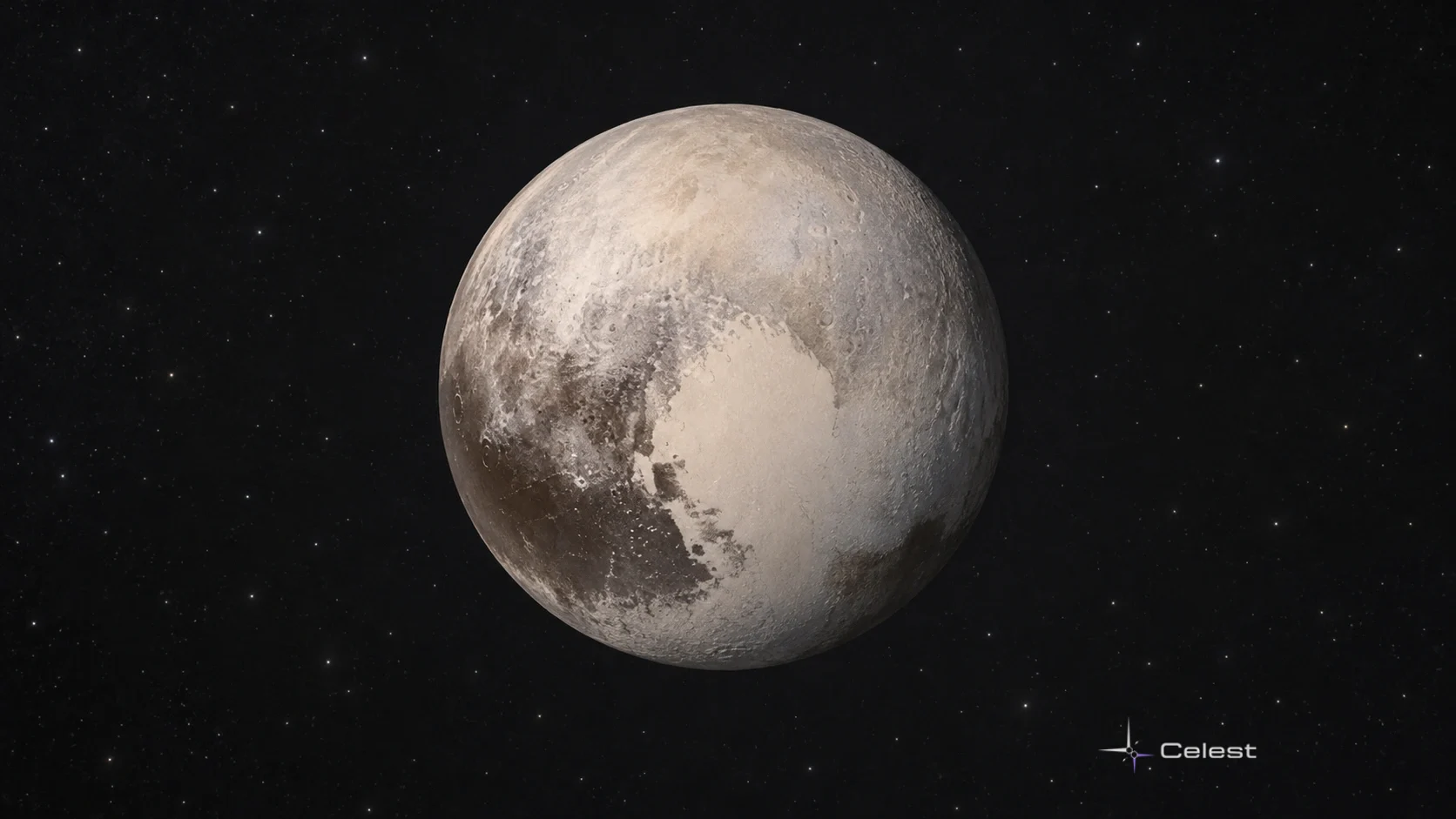
Pluto is a dwarf planet in the Kuiper Belt, a distant region of icy and rocky bodies. It is smaller than Earth’s Moon, yet has mountains, glaciers, five known moons and a thin atmosphere. To compare it with more familiar observing targets, start with the planet guide.
The important surprise is not simply how cold Pluto is. Different frozen substances behave differently there. Water ice can support rugged mountains, while nitrogen ice can deform and slowly circulate across a broad plain.
Pluto at a Glance
- Classification: dwarf planet, under the IAU’s adopted 2006 definition.
- Equatorial diameter: approximately 2,377 kilometres.
- Year: about 248 Earth years for one solar orbit.
- Rotation: roughly 153 hours, or 6.4 Earth days.
- Moons: five known, with Charon the largest.
- Close spacecraft encounter: New Horizons on July 14, 2015.
Its diameter is approximately two-thirds that of our Moon. Its much greater distance explains why a similarly detailed view requires very different observing methods. On average, it lies about 39 times Earth’s distance from the Sun, and sunlight needs roughly 5.5 hours to reach it.
What Makes Pluto a Dwarf Planet?
The 2006 classification considers both a body’s shape and its orbital setting. Pluto has enough gravity to be nearly round and travels around the Sun. It does not dominate its orbital region dynamically in the way the eight recognised planets do; many other Kuiper Belt bodies share that wider region.
Dwarf planet describes that classification, not the absence of mountains, an atmosphere or interesting geology. The designation also distinguishes these bodies from moons. Pluto itself orbits the Sun, while Charon belongs to Pluto’s satellite system.
Its name has a younger connection than the debate suggests. In 1930,11-year-old Venetia Burney proposed Pluto, the Roman underworld god, as a name for the newly discovered object. Clyde Tombaugh had found it at Lowell Observatory by examining photographic plates for movement against background stars.
An Icy Landscape With Different Materials
On July 14, 2015, the New Horizons flyby revealed a varied landscape, including rugged water-ice terrain and much smoother plains rich in frozen nitrogen. It was a close flyby, rather than a spacecraft settling into orbit or landing on the surface.
The bright heart-shaped region includes Sputnik Planitia, a broad nitrogen-ice plain. The heart is a description of its appearance in images. It contains surface patterns that researchers use to investigate how the ice moves and why that part of the landscape looks relatively fresh.
At Pluto’s temperatures, water ice can act like rigid rock. Nitrogen ice is softer and more easily deformed. Calling both materials ice does not make them mechanically identical, just as a mountain’s material and the glacier beside it can respond differently to the same surroundings.
How Can a Frozen Plain Keep Changing?
A 2016 study combined the spacecraft’s surface measurements with computer models. Modest heat from within Pluto can warm the lower part of a sufficiently thick nitrogen-ice layer. Warmer material rises, cooler material sinks, and the slow circulation renews the surface: a process called convection.
The model interpretation gives motions of a few centimetres per year and surface renewal on roughly 500,000-year timescales. Those figures describe this particular ice process. They are not Pluto’s age, the age of every mountain or the result of following one moving patch continuously for half a million years.
A further analysis reported in 2026 interpreted some northern Sputnik Planitia markings as possible temporary wetting by liquid nitrogen from beneath the glacier. That is a proposed explanation for surface patterns in 2015 images. It does not establish a global ocean, liquid-water lakes or rainfall resembling Earth’s.
Mountains, Moons and a Thin Atmosphere
Some bright mountain caps contain methane frost. A 2020 climate-model study explained them through the distribution of methane gas and its deposition on high terrain. Their resemblance to snowy terrestrial peaks does not mean the same cloud-and-snow process operates on both worlds.
Pluto also has a tenuous atmosphere dominated by nitrogen. New Horizons saw layers of blue haze, but colour alone should not suggest a breathable Earth-like sky. Charon, roughly half Pluto’s diameter, accompanies four much smaller moons: Nix, Hydra, Kerberos and Styx.
What Could You See From Earth?
Pluto is a faint telescopic target, rather than a bright naked-eye planet. An observing attempt involves identifying a small point among background stars using a current position chart. Do not expect the spacecraft’s mountains or heart-shaped terrain to appear in an amateur eyepiece.
Learn the surrounding sky with the constellation guide, and use an up-to-date dedicated chart if attempting identification. No fixed telescope size works under every combination of sky brightness, equipment and experience. The detailed images tell you what the world is like, not what an unaided observer will see.
Cold Does Not Mean Geologically Motionless
Pluto’s lesson is the behaviour of its materials. A rigid water-ice mountain and a slowly circulating nitrogen plain can coexist on a small distant world. Internal energy and the properties of the ice matter alongside the faint sunlight reaching the surface.
The 2015 flyby turned a difficult little point of light into a landscape with its own moving parts. Studying Pluto gives us a clearer idea of how varied the other small icy worlds beyond Neptune may be.
Leave a comment
Comments appear after moderation.