How to Spot the ISS: A Bright Moving Point
A current pass listing turns a moving light into an identifiable orbiting laboratory. Follow five simple steps, then understand the shadow and free fall behind the view.

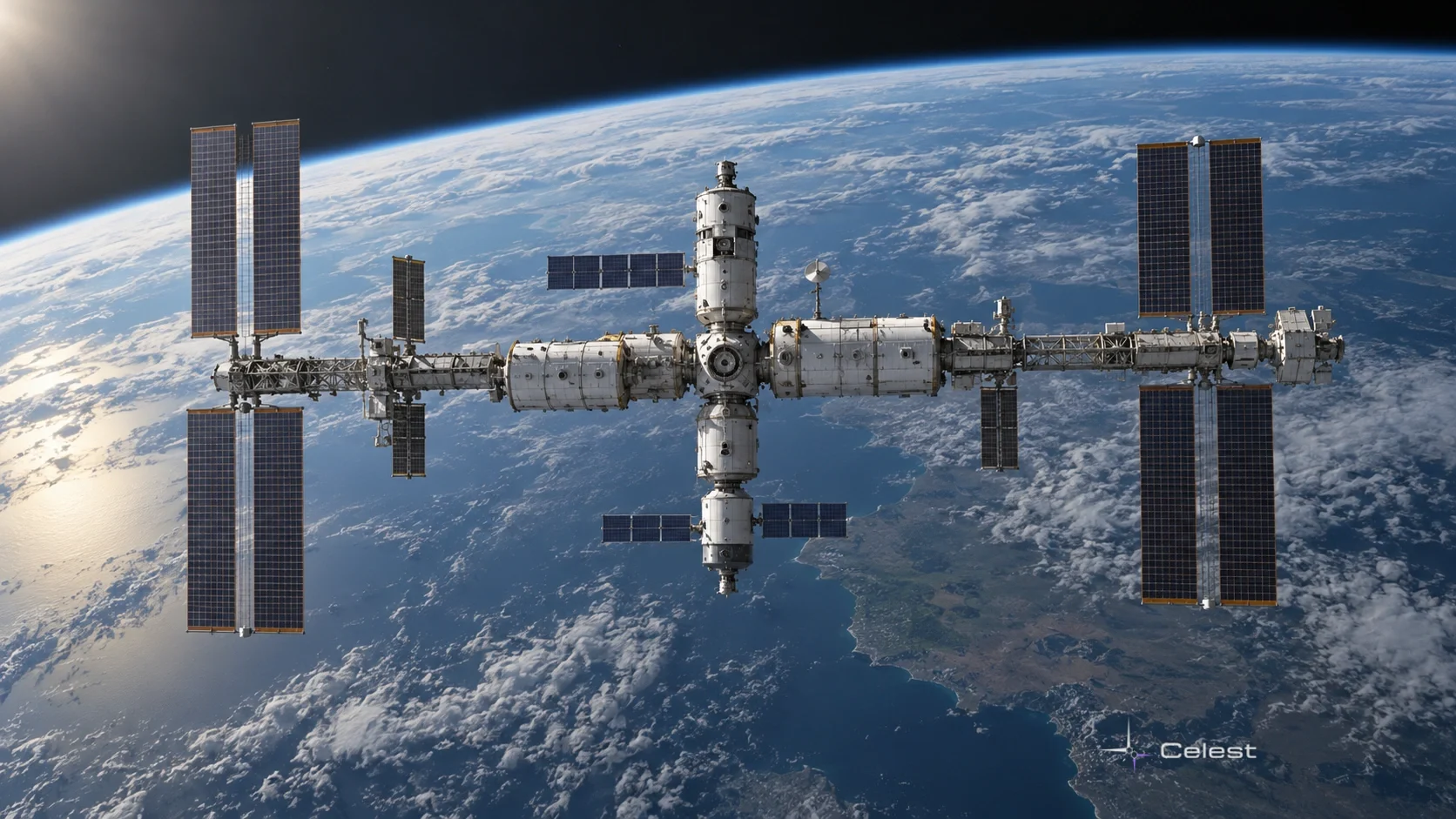
To spot the International Space Station, choose a current visible pass for your area and look for a bright point moving steadily along the predicted route. You can see it with unaided eyes. Recognising that moving point is the realistic first success; resolving its structure is a different task.
The point is an inhabited laboratory, usually shortened to ISS.
Start with the satellite-pass information on the live sky map, then check that the entry actually names the ISS. NASA’s Spot the Station app is another source of location-specific visible passes. Use a current prediction instead of waiting for any bright moving light to appear.
Before You Choose a Pass
A useful entry gives the local date and time, how long the station is expected to remain visible, its greatest height above the horizon, and the directions where the visible section starts and ends.
Confirm the selected area before saving those details.
Here, height above the horizon is an angle: zero degrees is at the horizon and ninety is overhead.
It is not the station’s distance above Earth. A higher route may be easier to follow above nearby buildings, but use the actual predicted path.
Check the observing conditions for the planned interval. You mainly need a usable view toward that route; buying a telescope is unnecessary for the first attempt. Choose an observing spot where buildings or trees will not hide the useful section.
Have the starting direction ready before you put the phone down.
Watch the ISS in Five Steps
- Choose the named pass. Select an ISS viewing opportunity for your area and check its date and local time. A current list may have no useful entry for the period you want.
- Note the route. Record the appearing direction, maximum height, disappearing direction and visibility duration. These describe the visible segment rather than a line permanently fixed in the sky.
- Face the starting direction. Be outside shortly before the predicted start and find that part of the horizon. Keep the broad route in view with your eyes.
- Follow the moving point. Look for a bright, steady light travelling smoothly through the predicted part of the sky. You do not need to chase it through a narrow telescope view.
- Compare the whole pass. Check that time, direction and movement fit the prediction. If it fades before reaching the horizon, note where; that can be part of the expected illuminated segment.
How to Check That You Found It
The strongest beginner check is a combination of cues: the correct time, the expected direction, smooth motion and a route that agrees with the pass listing.
A steady light by itself is less useful, because the sky contains other satellites as well.
Nearby stationary stars provide a background against which the motion becomes obvious. If you need help separating those background points from planets, the night sky guide can help you orient yourself before the pass begins.
The station goes around Earth in about ninety minutes. That does not mean it becomes visible from your garden every ninety minutes. Its route and the lighting must both suit your position, so use a predicted visible opportunity rather than the orbital period as a timetable.
If the Pass Does Not Match
- Nothing appears at the expected start: recheck the selected city, date and local time, then whether the starting direction is hidden. An old screenshot can describe a completely different opportunity.
- You see a flashing light: compare it with the predicted route and timing instead of identifying it from brightness alone. The ordinary ISS appearance is a steady moving point.
- The point fades high in the sky: it may have entered Earth’s shadow. Compare its disappearance with the listed visible segment before assuming the prediction failed.
- The beginning and ending directions look similar: a short illuminated section and rounded compass labels can produce that entry. The station can still be moving across the sky.
Why It Shines, Then Can Disappear
The station shines by reflecting sunlight, much as the Moon does. You can be in the dim evening while the spacecraft above you still receives direct sunlight. That arrangement often gives useful opportunities around dusk or dawn.
Once the station enters Earth’s shadow, its reflected light can fade from view even though it remains above your horizon. Its disappearance is therefore another clue about the Sun, Earth and orbiting spacecraft lining up in space.
Why the People Inside Can Float
The ISS has hosted people continuously since November 2000, and its crew can work on experiments, replace samples and maintain equipment.
The near-weightless laboratory environment is called microgravity. It is not produced by switching gravity off.
The station, people and loose objects are falling together around Earth. Their fast forward motion carries them around the planet as gravity curves their paths. Because the objects share that fall, they appear to float relative to the cabin.
The movement you watched from the ground is part of the same orbital motion that makes this laboratory possible.
A passing light becomes more interesting when you connect its steady journey to the people working inside it.
Leave a comment
Comments appear after moderation.