Meteor Shower Times: A Beginner's Field Guide
A meteor shower rewards patience more than gear. Here's the exact route — direction, timing, and posture — that turns a dark night into a handful of real streaks.

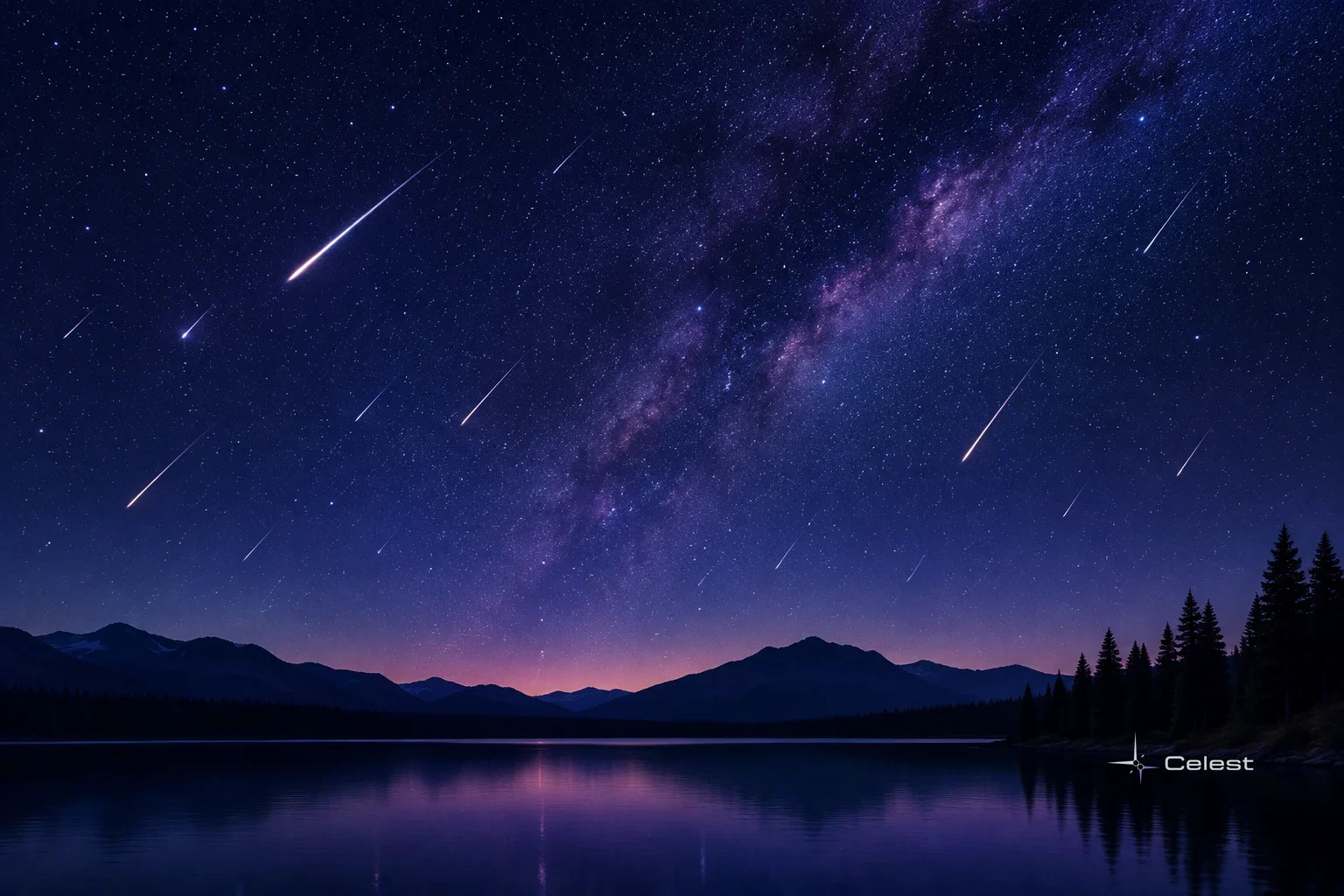
For many meteor showers, the best viewing is near the peak, between midnight and dawn, when the radiant is higher and your sky is dark. The exact window depends on the shower, your location and the Moon; the Draconids are an important evening exception. No telescope, no camera, nothing electronic required — your eyes are the only tool this needs.
A meteor shower happens when Earth crosses a trail of debris left by a comet or, in some cases, an asteroid. Those grains hit the upper atmosphere at high speed and burn up as brief streaks of light. Check the astronomy calendar for the shower's peak date before planning the night, since patience matters more than gear.
Before you go
A few checks before you leave the house make the difference between seeing nothing and seeing a dozen streaks.
- Pick the shower and its peak night — showers stay active for weeks but peak on one or two nights; the meteor shower guide lists the current one.
- Check the Moon — even a Moon a few days from full washes out faint meteors, since most meteors are faint to begin with; look up the phase in the Moon guide.
- Find genuine darkness — city glow buries weak streaks before they reach your eyes; the light-pollution map helps locate a darker spot nearby.
- Confirm clear skies — clouds block everything else on this list; check the observing conditions page before driving anywhere.
- Check the radiant's height — this is the point meteors seem to fan out from. Its position changes through the night and with your location, so use a current sky map rather than a fixed compass direction.
- Pack for comfort — a reclining chair or blanket, warm layers, snacks, water, and a red-light flashlight so you don't wreck your night vision.
Find it in five steps
Once you're at a dark site, the actual route to meteors takes only a few minutes to set up.
- Confirm the local viewing window. Check that the shower is active and its radiant is above your horizon during darkness. Peak times reported in another time zone need converting before you plan your night.
- Choose an open patch of sky. Face away from nearby lamps and, when possible, the Moon. Trees or buildings should not block most of your view.
- Find the zenith — the point directly overhead — to help judge where the darkest, clearest part of your sky lies.
- Watch a broad area, rather than staring at the radiant. Meteors can cross the sky well away from their apparent starting point.
- Lie back or recline so you can watch comfortably. Give yourself time: several quiet minutes do not mean the shower has stopped.
Meteors can appear anywhere in the sky, not only near the radiant, so scanning a broad patch works better than fixing on one point. For most showers, any time from midnight to dawn favors more meteors, because that's when your location has spun into the half of Earth facing forward along its orbit.
The Draconids favor the evening from northern observing locations. Geminids can become visible earlier in the evening too, but their radiant generally climbs higher toward the early morning. Check the specific shower instead of applying one clock time to all of them.
How to know you've found it
Give your eyes about twenty minutes away from bright lights before judging the conditions. At northern latitudes, the fainter stars of the Little Dipper can help you notice how much darkness and eye adaptation improve the view; seeing every star is not a requirement for watching meteors.
Most meteors last a fraction of a second and look like a quick scratch of light. Some flare brighter, and colors range from silvery-white to electric green, icy blue, or hot orange. A few are fireballs — exceptionally bright meteors, sometimes bright enough to cast shadows. Brightness defines a fireball; it does not have to move slowly.
Expect a stop-start rhythm: a burst of two or three streaks, then several quiet minutes with nothing at all. That lull is normal, not a sign you're doing something wrong.
If you can't see it
A few common problems have straightforward fixes, and none of them mean the shower failed to show up.
- Nothing for several minutes: That's a normal lull. Meteor rates come in bursts; give it another ten minutes before moving.
- Far fewer meteors than expected: Moonlight or light pollution may be hiding the faintest streaks. Check the Moon guide and consider a darker site.
- Neck or back strain: Standing or craning upward tires you fast. Lie flat on a blanket or recline a chair instead.
- Everything looks blurry through binoculars: Binoculars have too narrow a field for fast-moving meteors; put them down and use your eyes.
- The sky still looks washed out: Shield your eyes from nearby lights, dim your screen and give dark adaptation more time. If city glow dominates the whole sky, choose a darker site for a future session.
What binoculars add
Binoculars won't help catch the meteors themselves — their narrower field of view makes a fast streak harder to catch than with the naked eye. What they're good for is everything else happening between meteors.
A lingering meteor trail, a bright star cluster, or a stretch of the Milky Way all look better through a pair of 10x50 binoculars, the classic beginner size for astronomy. Bring them along as something to do during the lulls, not as the main tool.
If clouds win tonight, check the shower's activity window before trying again; the next clear night may still be useful even if the peak has passed. Check the night sky guide for what else is worth a look while the sky clears up.
Leave a comment
Comments appear after moderation.