How to Find the North Star, Polaris
Use the Big Dipper's pointer stars to find Polaris in northern skies. The route works when those stars are above your horizon and clear of obstacles.

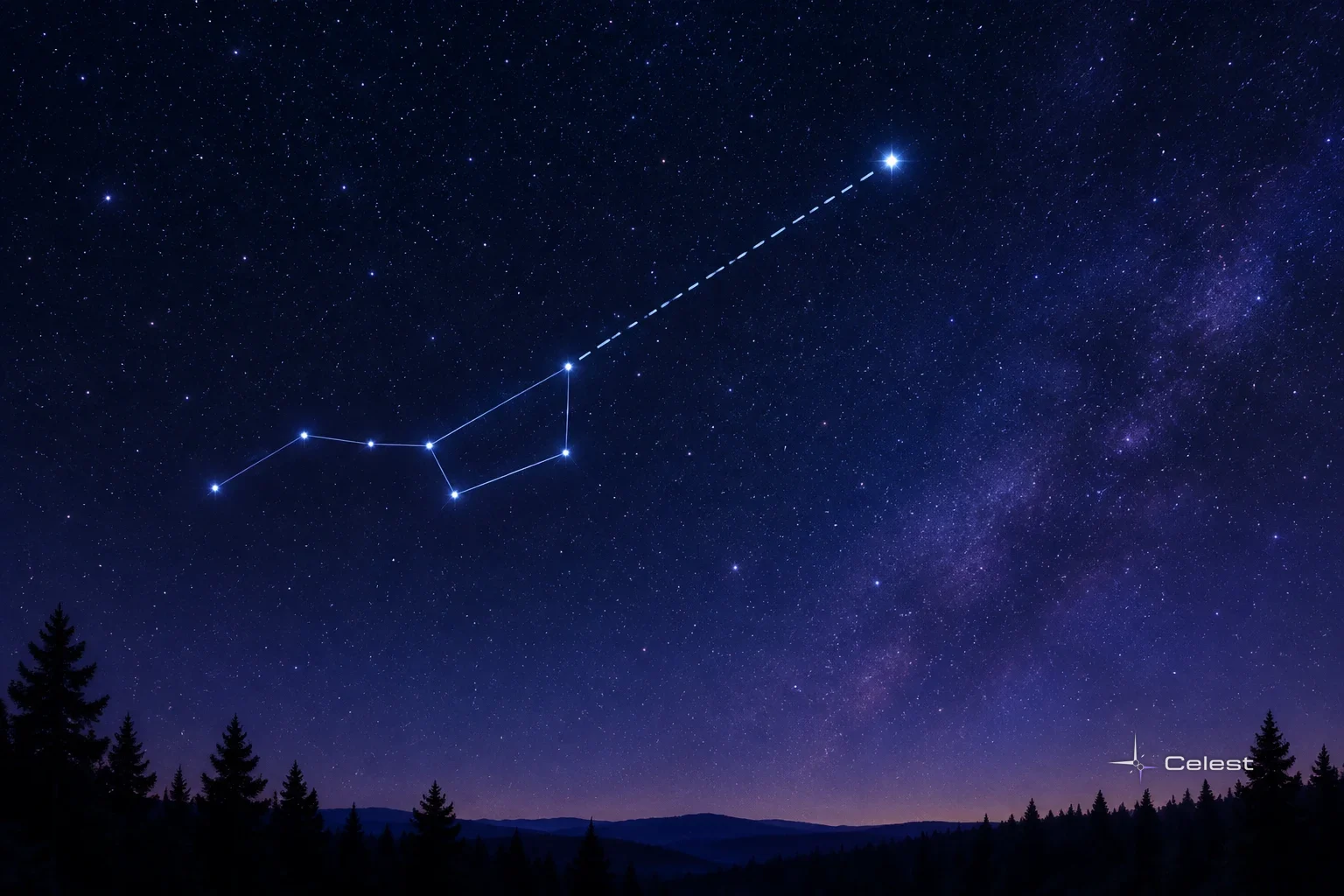
Look toward due north on a clear night and one moderately bright star holds almost still while everything else seems to drift slowly around it. That star is Polaris, the North Star, and finding it takes nothing but your eyes and a few minutes outside. Check the night sky guide first to see what else is up before you start.
No telescope or app is required for this route. It only works from the Northern Hemisphere — south of the equator, Polaris sits below the horizon and observers there use the Southern Cross to find true south instead.
Before you go
A few quick checks make the difference between five minutes outside and a frustrating half hour of squinting.
- Season: Polaris stays close to the north celestial pole. From most northern observing locations it is above the horizon all year, but it sits very low near the equator; the Big Dipper's height changes with latitude, season and hour.
- Moon and sky glow: check observing conditions and the Moon's phase — nearby glare and haze can make even a moderately bright star hard to pick out, while moonlight washes out the fainter stars used to confirm the pattern.
- Weather: you need a clear patch of sky facing north; even thin haze near the horizon can hide the Big Dipper when it's low.
- Direction: face roughly north. If you already know which way that is, you're set; if not, the Big Dipper method below will get you there anyway.
- Equipment: none needed. A red-light torch and a simple star chart help if you want to keep your night vision while checking your progress, but they're optional.
Find it in four steps
This route starts from a shape most people can already recognize once it's pointed out.
- Find the Big Dipper. Look for seven stars forming a shape like a saucepan or ladle — four stars in a bowl, three trailing off as a handle. It's an easily recognizable pattern within the larger constellation Ursa Major, though how much of it stays above the horizon depends on your latitude. Its orientation changes through the night and the seasons.
- Spot the two pointer stars. At the end of the bowl farthest from the handle are two stars named Dubhe and Merak. These are your pointers — everything from here follows the line between them.
- Extend the line. Draw an imaginary line through Merak and Dubhe, starting at Merak and passing through Dubhe, then keep going in that same direction for about five times the distance between the two stars.
- Land on Polaris. That line should bring you to a solitary, moderately bright star with no other bright stars close by. It's the final star in the handle of the Little Dipper, a much fainter pattern than the Big Dipper.
The Big Dipper swings around Polaris throughout the night and the year, sometimes appearing on its side or nearly upside down. Its shape relative to Polaris always stays the same, so the pointer-line trick works regardless of the season.
If the Plough is hidden
British readers may know the Big Dipper as the Plough, and it isn't always the easiest thing to see — trees, buildings or a low horizon can block it in some seasons.
When that happens, Cassiopeia offers a backup. It sits on the opposite side of Polaris from the Big Dipper, so when one is low, the other tends to be higher in the sky. Cassiopeia looks like a wide, stretched-out letter W or M.
Use the W to orient your chart, then locate Polaris between Cassiopeia and the Big Dipper, close to the north celestial pole. If the pointer stars are hidden and the remaining pattern is unfamiliar, consult the live sky map rather than relying on an uncalibrated hand-width shortcut.
How to know you've found it
A few things confirm you've got the right star rather than a random point of light.
Polaris doesn't move noticeably over the course of an hour, while nearby stars visibly shift position as Earth rotates. It's the brightest star in the faint Little Dipper, sitting at the very end of its handle — but it is not the brightest star in the whole sky.
At magnitude 2, Polaris actually ranks only around 48th in overall brightness; Sirius appears brighter when it is visible, and planets like Venus and Jupiter often outshine Polaris too.
One more check ties it to where you're standing: Polaris's height above your northern horizon roughly equals your latitude. An outstretched fist held at arm's length spans close to 10 degrees for most people, so a few stacked fists between the horizon and Polaris gives a rough latitude estimate.
If you can't see it
A few common snags, and what to do about each one.
- The Big Dipper is low or blocked: switch to the Cassiopeia method described above instead of waiting it out.
- The Little Dipper looks invisible: that's normal — its stars are dim. Trust the pointer-star line from the Big Dipper rather than trying to trace the whole shape first.
- You keep looking for the brightest star in the sky: Polaris won't stand out that way. Look for the star the pointer line actually lands on, not the flashiest point of light nearby.
- Moonlight or city glow is drowning out fainter stars: check the light pollution map for a darker spot, or wait for a night with less moon in the sky.
- You're south of the equator: Polaris isn't visible from the Southern Hemisphere at all. Southern observers use the Southern Cross to find celestial south instead.
What binoculars add
Naked eyes are enough to confirm Polaris, but binoculars reveal a little more around it. Through binoculars, Polaris sits as the standout point in a loose pattern nicknamed the Engagement Ring, acting as the ring's diamond among a scattering of fainter stars.
Polaris itself isn't a single star. William Herschel discovered a faint companion, Polaris B, in 1780, sitting a small distance from the main star. Hubble images taken in 2005 directly resolved the much closer companion Polaris Ab for the first time. Ordinary binoculars will not split that close pair.
Once you can pick out Polaris on sight, it becomes a fixed reference point for the rest of the sky — a still hub while the Big Dipper, Cassiopeia and everything else wheel slowly around it night after night.
Leave a comment
Comments appear after moderation.