How to Watch a Solar Eclipse Safely
No telescope required — just the right filter or a simple projection trick, and a clear sense of what never belongs anywhere near your eyes.

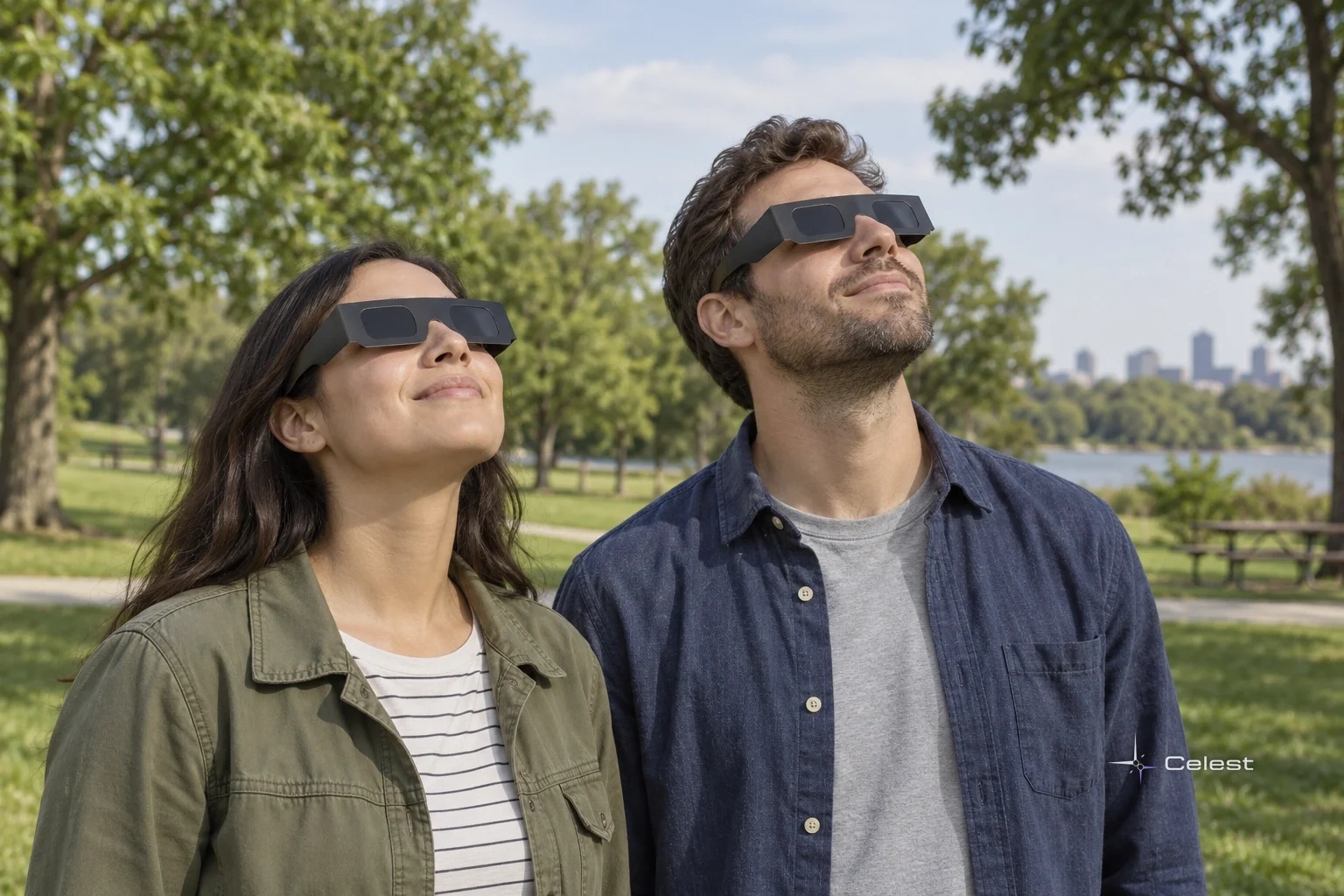
To watch the partial phases of a solar eclipse safely, use special-purpose solar viewers that meet ISO 12312-2, or turn your back to the Sun and watch a projected image instead. Nothing fancy is required for either method — a filter, or household items you likely already own.
Check the eclipse guide for the next event's date, path and local timing, since those details vary by location and aren't covered here. The astronomy calendar is the place to confirm when the next eclipse — partial, total or otherwise — reaches your area.
Before you go
Run through this checklist before the Sun and Moon line up.
- Filter check: Choose a reputable supplier of ISO 12312-2-compliant eclipse glasses or handheld viewers. Check the maker's instructions and discard any viewer with scratches, tears or other damage; an ISO claim printed on its own is not a safety guarantee.
- No filter, no problem: If you don't have certified eyewear, gather materials for a projection method instead — a pasta colander, a straw hat or any object riddled with small holes works.
- Leave the sunglasses behind: Regular sunglasses, however dark, do not protect your eyes and should not be used as a substitute.
- Sky conditions: Clear skies matter for an eclipse just as they do for any sky-watching plan — check observing conditions beforehand.
- Optics rule: If you plan to use binoculars, a camera or a telescope, know that eclipse glasses and handheld filters are not enough for those — more on that below.
Watch safely in four steps
Decide on your viewing method before the eclipse starts. Children need adult supervision throughout.
- Inspect your filter first. Follow the manufacturer's inspection instructions. Discard damaged viewers, and do not use a home light test as proof that an unknown product is safe.
- If the filter passes inspection, put it on before you look up, not after. Turn away from the Sun before removing it.
- If you have no filter, turn your back to the Sun. Hold the colander, straw hat or perforated card so sunlight passes through the small holes and lands on a flat surface — a sheet of paper, a wall, even the ground.
- Look for a leafy tree nearby. Sunlight filtering through overlapping leaves projects the same effect naturally onto the ground beneath it.
The projected image is small and easy to miss the first time. Move the projecting object closer to or farther from the surface until the shape sharpens.
How to know you've found it
During a partial phase, a projector or the gaps between leaves can show small images of the Sun with a bite missing. Never look through the hole itself; watch the image formed on the surface.
The missing portion grows or shrinks as the Moon moves across the Sun. You are watching the Sun's changing outline, not an image of a crescent Moon. Under a tree, the effect can look like dozens of tiny moons scattered across the grass.
An eclipse viewer shows the same changing outline. Keep using protection throughout a partial or annular eclipse. Only during a total eclipse's brief totality, within its path, is unfiltered naked-eye viewing safe. Use the locally verified start and end of totality; if unsure, keep the viewer on.
If you can't see it
A few common snags, and what to do about each one.
- No filter on hand: Switch to the projection method — a colander or perforated card works as well as anything purpose-built.
- Only sunglasses available: Stop. They don't block enough solar radiation and offer no real protection.
- Viewer is damaged or its safety is uncertain: Use projection instead. A blanket three-year expiry rule does not apply to all modern ISO-compliant viewers; follow the manufacturer's instructions.
- Using binoculars, a camera or a telescope with eclipse glasses held in front: Stop immediately — handheld filters don't survive the concentrated light those instruments gather.
- Eye pain, blurred vision or dark spots after viewing: Seek medical attention promptly. Solar damage to the retina doesn't always show symptoms right away, and can develop over hours or days.
What binoculars and cameras need instead
Binoculars, cameras and telescopes gather and concentrate sunlight far more than the naked eye does, which is exactly why handheld eclipse glasses fail with them — the Sun can burn straight through.
Use a solar filter designed for your instrument and secured over its front lens or objective, following the supplier's instructions. Binoculars need protection over both front lenses. If you don't have one designed for your equipment, skip direct viewing through optics and use the projection method instead.
For a first eclipse, an astronomy club's supervised solar telescope is a better place to learn than improvising filters on your own equipment. Check the Moon guide to understand why the eclipse happens at all — it's the Moon passing directly between Earth and the Sun.
Leave a comment
Comments appear after moderation.