What Is a Lunar Eclipse? The Shadow Explained
Earth's shadow has two zones, and which one the full Moon crosses decides everything you see — from a faint dimming to a rust-red Moon.

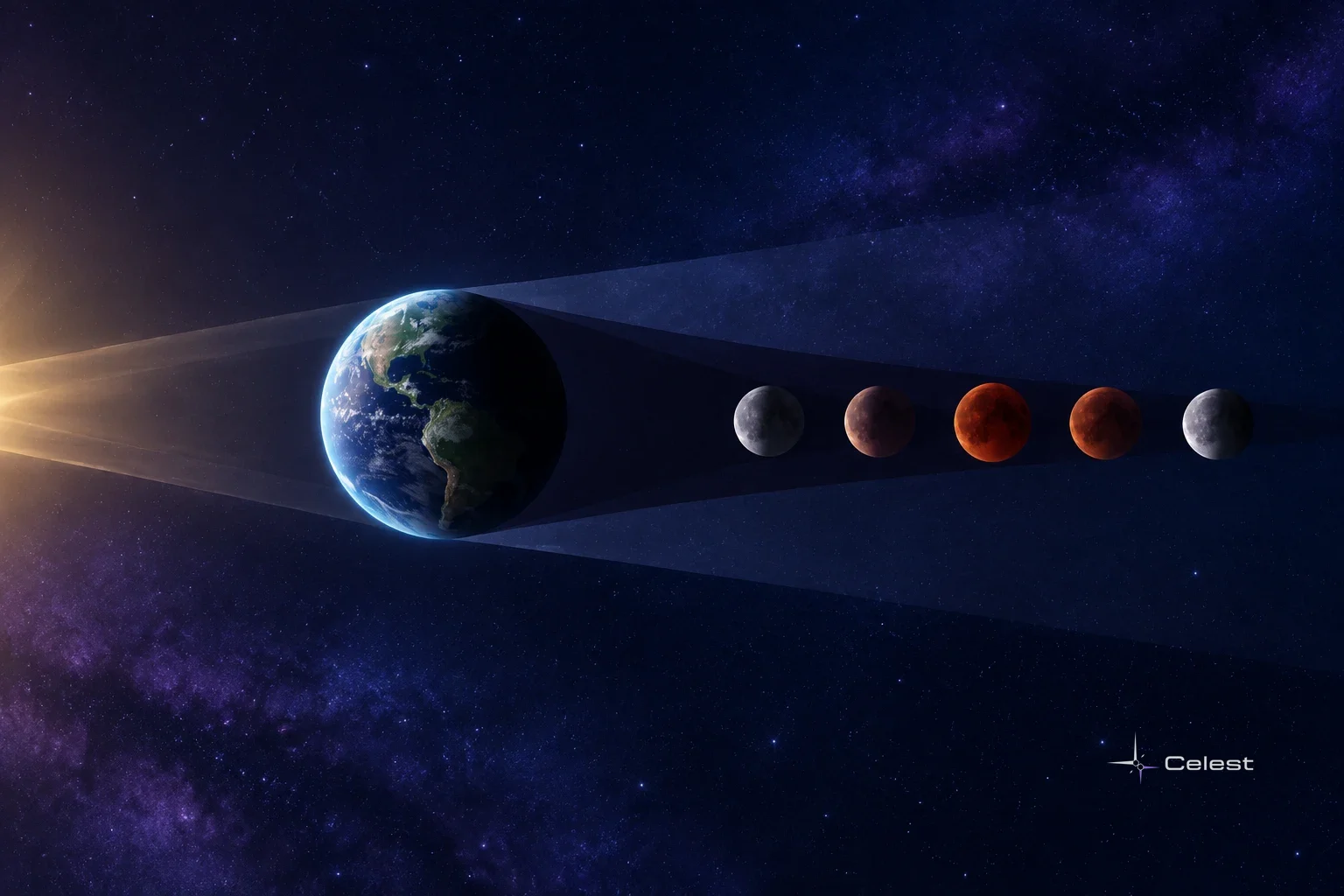
A lunar eclipse happens when Earth slides directly between the Sun and the Moon, so the full Moon passes through Earth's shadow.
Earth's shadow has two zones — a faint outer penumbra and a dark inner umbra — and which one the Moon crosses decides exactly what you'll see. During totality, sunlight bent through Earth's atmosphere often leaves the Moon glowing red or orange. Partial and penumbral eclipses do not redden the whole disc. The eclipse guide breaks down how the different types compare.
How it works
The chain starts with alignment. Sun, Earth and Moon must line up almost exactly, with Earth in the middle, and that geometry is only possible at full Moon, the night the Moon sits opposite the Sun as seen from Earth. The Moon guide shows how the phase lines up with this moment.
- Alignment — Earth moves directly between the Sun and the Moon; this can only happen at full Moon, never at any other phase of the month.
- Penumbra entry — the Moon slips into Earth's faint outer shadow first, dimming only slightly and easy to miss without close attention.
- Umbral contact (U1) — the Moon's leading edge touches the dark inner shadow, and a visible dark bite begins to appear.
- Totality (U2 to U3) — if the whole Moon slides into the umbra, it usually turns a deep red rather than vanishing outright.
- Exit — the Moon pulls back out through the umbra (U4) and then the penumbra (P4), returning to its normal full brightness.
The whole event is one full Moon walking through a two-zone shadow over a few hours. A total eclipse can run close to five hours from first penumbral contact to last, though totality itself usually lasts somewhere between thirty minutes and just over an hour, with a maximum near 100 minutes when the Moon crosses the umbra's centre.
The early penumbral dimming can be subtle. Watch from the first umbral contact if you want to follow the curved shadow moving across familiar lunar features.
Why the Moon turns red
Even fully inside Earth's shadow, the Moon doesn't disappear. Earth's atmosphere bends a sliver of sunlight around the planet's edge and onto the Moon's surface, much the way a straw looks bent in a glass of water. That refracted light is what keeps the Moon visible during totality.
Colour comes from which wavelengths survive the trip. Earth's air scatters blue light out of the beam and lets red light pass through, so the light reaching the Moon is heavily filtered toward the red end of the spectrum.
How dark or bright that red looks depends on how much dust sits in Earth's atmosphere at the time. Astronomers grade the result on the Danjon scale, running from L0, a nearly invisible grey eclipse, up to L4, a bright copper-orange Moon with a faint bluish rim.
Major volcanic eruptions load the stratosphere with aerosols and tend to produce the darkest eclipses on record.
Why doesn't a lunar eclipse happen every month
A full Moon happens every 29.5 days, but eclipses don't. The Moon's orbit is tilted about 5° relative to Earth's path around the Sun, so most full Moons pass above or below Earth's shadow entirely, missing it by a wide margin.
An eclipse only happens when a full Moon lines up near a node, one of the two points where the Moon's tilted orbit crosses the plane of Earth's orbit.
Only some of these alignments carry the whole Moon into the umbra. Others produce a partial eclipse or a subtle penumbral dimming.
Three types of lunar eclipse
The three types differ only in how much of the Moon dips into the umbra, and that difference decides whether you notice anything at all.
- Penumbral — the Moon crosses only the faint outer shadow, dimming just slightly; many people watching don't notice it happening at all.
- Partial — part of the Moon enters the dark umbra while the rest stays in the paler penumbra, producing a clearly visible dark bite.
- Total — the entire Moon slides into the umbra and usually turns red, the version most people mean when they say lunar eclipse.
All three are safe to watch directly, with no filters and no risk to your eyes, unlike a solar eclipse where looking at the Sun without a certified filter is dangerous.
A lunar eclipse is also visible from the whole night side of Earth at once, not from a narrow track a few hundred kilometers wide the way a total solar eclipse is. The night sky guide is worth a look while you wait for one.
See it for yourself
Start before any eclipse is even scheduled. On any ordinary full Moon night, step outside when the Moon is high and look at how evenly bright its disk is — that's the baseline you're comparing against later.
- Pick an open view — you'll want to track the Moon's path across a few hours, so avoid trees or buildings that block one side of the sky.
- Bring binoculars if you have them — no equipment is required, but binoculars make the umbra's edge and the eventual red colour easier to follow.
- Note the colour and date — compare what you see against the Danjon scale, since dust in the atmosphere changes the shade from one eclipse to the next.
Check observing conditions before heading out, since a lunar eclipse unfolds slowly enough that a thin patch of cloud can drift through and clear again before totality ends.
Leave a comment
Comments appear after moderation.