What Is an Eclipse? The Simple Explanation
Two sentences explain the whole idea, but the details — shadows, tilt, and why the Sun and Moon look the same size — make it stick.

- Published
- ◷
- 5 min read
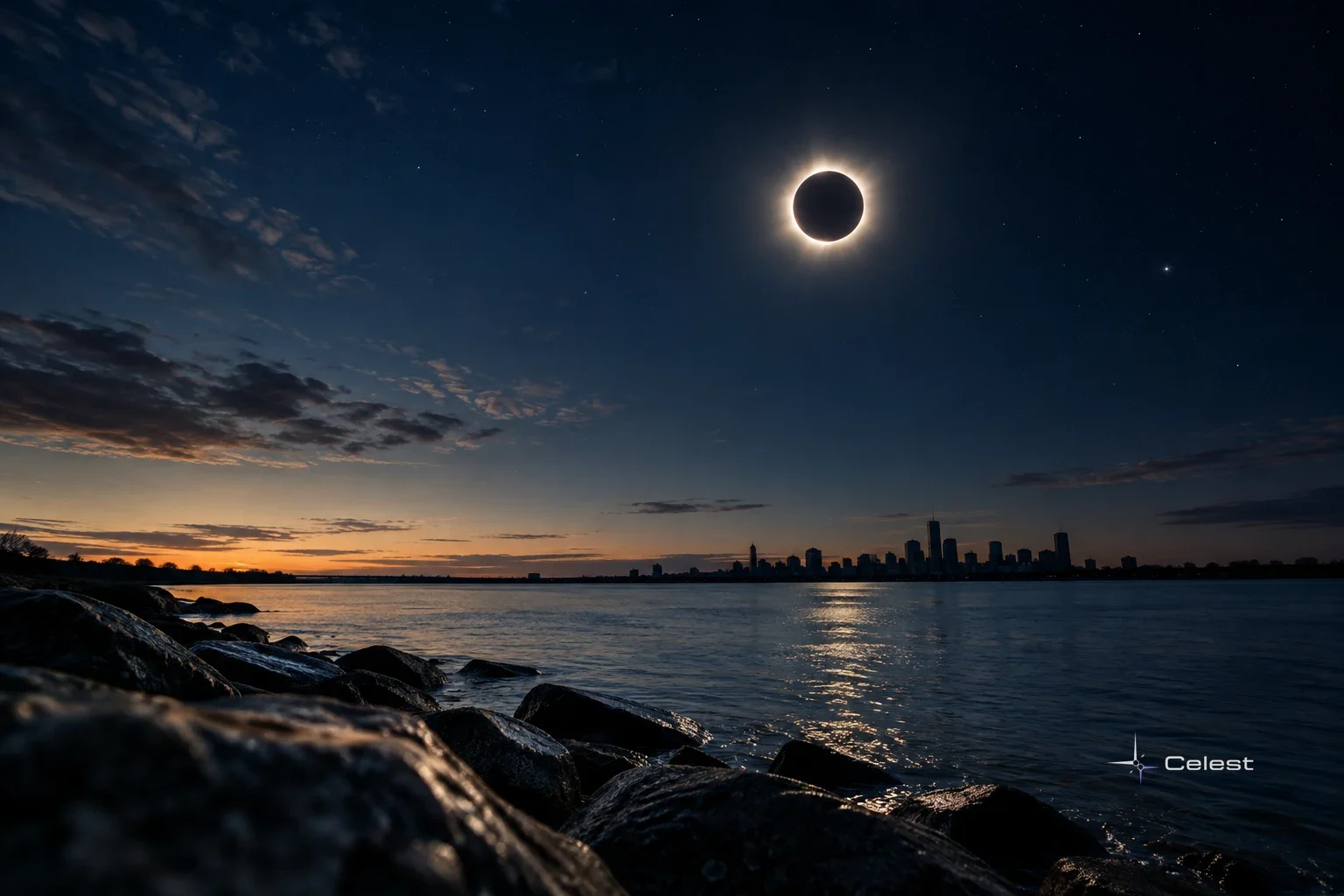
An eclipse happens when one celestial body slips into another's shadow or passes directly in front of it, blocking the light an observer would otherwise see.
From Earth, that geometry produces two events worth telling apart: a solar eclipse, when the Moon passes between the Sun and Earth and blocks sunlight, and a lunar eclipse, when Earth slides between the Sun and the Moon and its own shadow falls across the Moon's face.
Astronomers call that three-body lineup a syzygy (pronounced siz-uh-jee) — Sun, Moon and Earth arranged in a straight line. It doesn't happen every month, so the eclipse guide is worth checking rather than guessing when the next one falls.
The astronomy calendar tracks exactly when Earth's geometry lines up again.
How it works
Three things have to happen in order for an eclipse to occur, and each stage decides what the sky will actually show.
- Alignment — the Sun, Earth and Moon line up closely enough for one body's shadow, or silhouette, to fall across another.
- Shadow forms — the body in the middle casts two shadows: the umbra, a small dark inner cone, and the penumbra, a wider, paler outer zone.
- Position decides the view — an observer standing inside the umbra sees the full event; one inside only the penumbra sees a partial version.
- Distance shapes the shadow — how far the Moon sits from Earth at that moment changes whether the umbra even reaches the ground.
That fourth stage explains why solar eclipses come in more than one flavor, and why a lunar eclipse looks nothing like a solar one.
At a lunar eclipse, Earth's shadow falls on the Moon, and the Moon usually turns red rather than vanishing, because sunlight bent through Earth's atmosphere still reaches it after the atmosphere filters out most of the blue light.
A related but separate term, occultation, describes one body simply passing in front of another without necessarily casting a matching shadow — the Moon covering a star, for instance.
Why not every month
New Moon happens every month, yet a solar eclipse doesn't. The Moon's orbit is tilted about 5 degrees relative to Earth's orbit around the Sun, so most months the Moon's shadow passes above or below Earth entirely, missing it by a wide margin.
An eclipse needs the Moon to be new — or full, for a lunar eclipse — at the same moment it crosses close to the plane Earth and the Sun share. Those two conditions rarely line up together, which is exactly why an eclipse feels like an occasion rather than a routine.
The types, side by side
Not every solar eclipse looks the same, and the difference comes down to how completely the Moon covers the Sun from where you happen to be standing.
- Partial — only part of the Sun is covered, and only the penumbra sweeps across Earth.
- Annular — the Moon sits farther from Earth, its disk looks smaller than the Sun's, and a bright ring — a "ring of fire" — stays visible around the edge.
- Total — the Moon fully blocks the Sun for viewers standing inside the umbra, and the sky darkens as if it were night.
- Hybrid — the rarest type, which shifts from annular to total along different parts of the same path.
Total eclipses only look total because of a coincidence: the Sun's diameter is roughly 400 times the Moon's, and the Sun sits roughly 400 times farther away, so the two disks appear almost the same size in Earth's sky.
According to NSO, that balance is temporary — in about a million years the Moon will have drifted far enough that it can no longer fully cover the Sun.
Seeing one safely
Solar and lunar eclipses ask for opposite precautions, and mixing them up is the most common safety mistake.
A solar eclipse cannot be viewed safely with the naked eye, and ordinary sunglasses, binoculars or a telescope without a proper solar filter don't help — they can make the damage worse, not less. A simple pinhole projector, held with your back to the Sun so the image falls on a card in front of you, works without any special equipment.
A lunar eclipse carries none of that risk. There's nothing to filter, because you're only watching Earth's shadow cross the Moon, which is why it's safe to watch directly for as long as you like.
Either way, totality is only part of the show — a total solar eclipse opens and closes with a partial phase, so the whole event runs longer than the minutes of full coverage alone.
See it for yourself
Look at the Sun and Moon on any ordinary day and notice something odd: both disks look almost exactly the same size, even though one is hundreds of times bigger than the other. That's the coincidence that makes a total solar eclipse possible at all.
Check the Moon guide to see its current phase, and use the night sky guide to get oriented before the next real alignment sends that shadow your way. Nothing has to be in eclipse for the geometry to be worth noticing — the Sun and Moon quietly demonstrate it every single day.
Sources
The facts in this article are based on the sources below. How we work: editorial policy.
- Eclipse Science - NSO - National Solar Observatory — nso.edu
- Eclipse Basics — National Radio Astronomy Observatory
- What it feels like to experience a total solar eclipse — sciencemediacentre.es
Leave a comment
Comments appear after moderation.