What Is a Solar Eclipse? The Moon's Shadow Explained
The Moon's shadow can hide the Sun completely, ring it with light, or nibble a bite from its edge — the difference comes down to simple geometry.

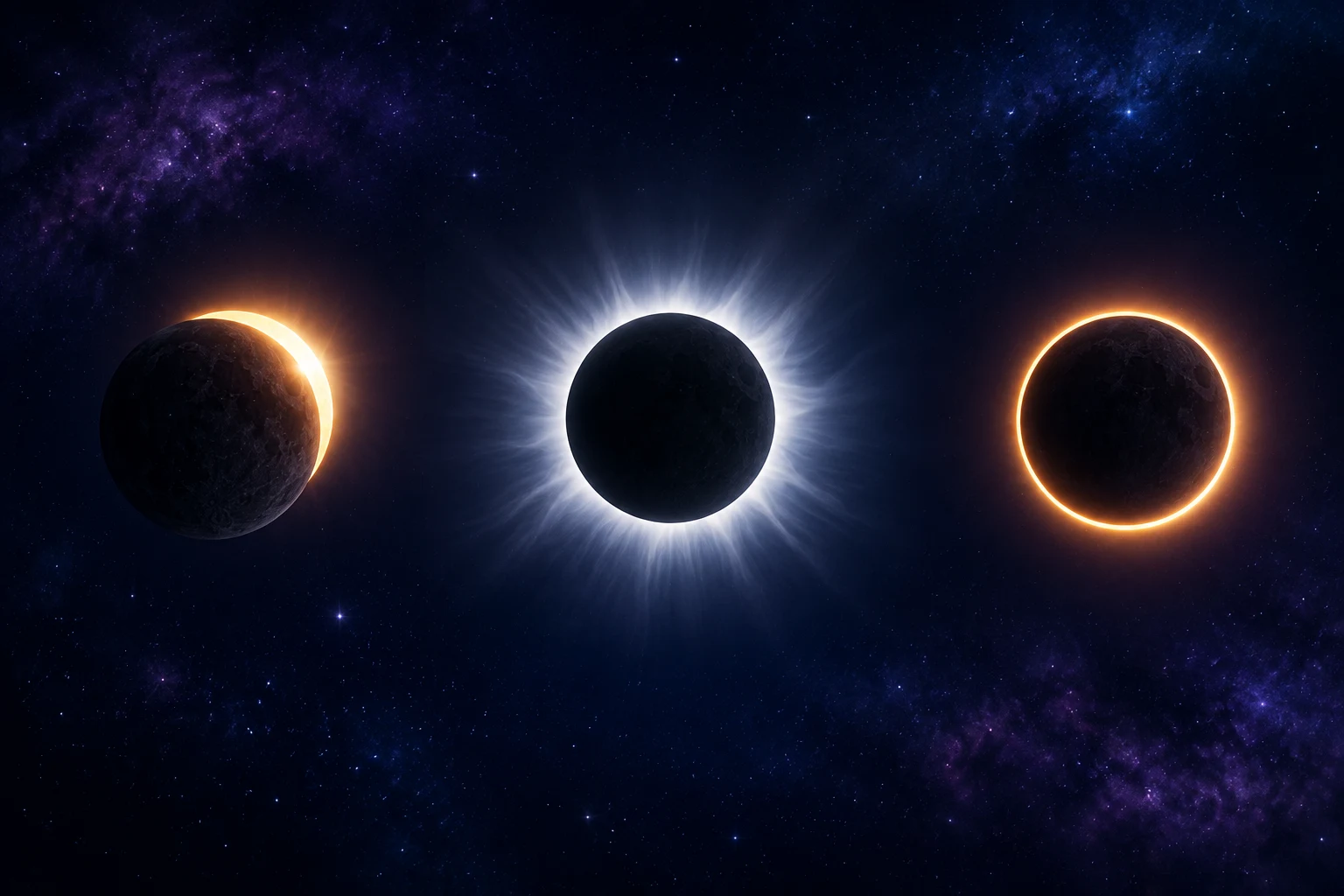
A solar eclipse happens when the Moon moves between the Sun and Earth and blocks some or all of the Sun's light from reaching you. The Moon blocks your view of the Sun — the Sun itself doesn't change.
This lineup can only happen near a new moon, and how much of the Sun disappears depends on which of four eclipse types you're watching.
How it works
The chain that produces an eclipse starts long before the day itself, with the Moon quietly circling Earth once every month.
- The Moon orbits Earth, moving through its monthly cycle of phases.
- Near a new moon, the Moon passes onto the same side of Earth as the Sun.
- The Moon blocks sunlight from reaching a strip of Earth's surface, casting its shadow onto the ground.
- The alignment sets the type — partial, annular, total, or hybrid — depending on how much of the Sun the Moon covers.
- Earth's rotation and the Moon's motion sweep the shadow along, so totality at any single spot lasts only a few minutes.
Put together, a solar eclipse is really a geometry problem: the result depends on how large the Moon looks against the Sun and exactly where its shadow falls that day. Check the astronomy calendar whenever a new eclipse is announced, since each one follows its own path across Earth.
Common misconception
A solar eclipse doesn't mean the Sun is failing or that something dangerous is happening in the sky. It's the Moon standing in front of it, nothing more.
That hasn't stopped old fears from lingering. In many countries, claims still circulate that eclipses are dangerous for pregnant women, and during some past eclipses people were told that all women should stay indoors. Nothing in the mechanism supports that; the Moon is simply casting a shadow.
What eclipses do change is human behavior, and that part is documented.
A psychologist at Johns Hopkins University studied social media posts during the total eclipse that crossed the United States on 21 August 2017 and found a jump in words tied to surprise, gratitude, and affection, with collective language outpacing individual language, especially among people inside the path of totality. That shift faded within about a day.
There's a less charming side, too. A University of Toronto study linked a total eclipse to a rise in traffic accidents near the path of totality, alongside the more predictable traffic jams and strained local services eclipse crowds bring.
Variations among solar eclipses
The four solar eclipse types differ in how much of the Sun the Moon covers and how the Moon's apparent size compares with the Sun's.
- Partial eclipse: the Moon covers only part of the Sun, leaving a bright crescent visible. It's the most common type.
- Annular eclipse: the Moon looks smaller than the Sun, so a glowing ring — popularly called the "ring of fire" — stays visible around it. It's the second most common type.
- Total eclipse: the Moon fully covers the Sun for a few minutes, the sky darkens, and the Sun's faint outer atmosphere, the corona, becomes visible.
- Hybrid eclipse: the rarest type, shifting between total and annular along its path — some places see a total eclipse, others an annular one, during the same event.
An annular eclipse still appears as a partial eclipse across a much wider stretch of Earth, sometimes thousands of kilometers across, even though only a narrow track sees the full ring. Details on the next confirmed dates for these events are worth checking on Celest's eclipse guide rather than guessing ahead.
See it for yourself
Keep solar viewers meeting ISO 12312-2 over your eyes whenever any part of the Sun's bright face is visible. Ordinary sunglasses are unsafe, including during the diamond-ring effect and Baily's beads just before totality.
Only inside the path of a total solar eclipse, while the Sun's bright face is completely covered, can you remove viewers for the brief total phase. Put them back on before any bright sunlight returns. Partial and annular eclipses require protection throughout.
Binoculars, cameras and telescopes need suitable solar filters securely fitted over their front apertures; eclipse glasses alone do not make looking through optics safe. You can also watch a projected pinhole image, with your back to the Sun.
Once totality begins, the sky dims like dusk, and the Sun's corona spreads out in pale streamers around the blacked-out disk. Check observing conditions and confirm the local path and contact times before choosing a viewing site.
The eclipse most people will ever witness is partial, seen from somewhere well outside the narrow path of totality. Even that thin sliver of missing sunlight is worth stepping outside for.
Leave a comment
Comments appear after moderation.