Mercury's Greatest Evening Elongation: Oct 12, 2026
Archived October 2026 event: why Mercury’s wide evening separation favored southern latitudes, what a telescope could show and how to plan a safe search.

In the Celest calendar: Mercury at Greatest Evening Elongation →
Mercury reached greatest evening elongation on October 12, 2026, standing about 25.2° from the Sun and shining at roughly magnitude −0.1. It was an evening apparition: the planet lay east of the Sun in the sky and set after it.
That event date has passed. For a current observing session, check Celest’s calendar and night sky guide for your own location rather than treating this date as a new opportunity.
The October apparition favored southern latitudes. In the Northern Hemisphere, the shallow angle of the evening ecliptic kept Mercury low despite its wide separation from the Sun. Latitude, twilight and a clear horizon mattered more than the elongation angle alone.
The quick plan
The useful details for the October 2026 apparition were:
- Date: October 12, 2026.
- Reference instant: 10:06 UTC in Celest’s calculation of greatest separation. This was a geometric reference time, not a local observing hour.
- Separation: about 25.2° from the Sun; this was not Mercury’s height above the horizon.
- Brightness: approximately magnitude −0.1, before allowing for the dimming caused by a low, hazy horizon.
- Moon: new Moon occurred on October 10; by October 12 it was a thin waxing crescent.
- Direction: toward the sunset side of the western sky. The exact bearing and usable interval depended on location.
- Equipment: begin with your eyes; use binoculars or a telescope only after the Sun has fully set.
The time of greatest separation is the same physical event worldwide. It does not tell every reader to go outside at that clock time, nor does it identify one best local evening for every city.
What you could expect to see
Mercury’s greatest elongations range from roughly 18° to 28°. The October separation was relatively wide, but a wide angle from the Sun does not guarantee a high planet in a dark sky.
To the unaided eye, the target was a bright point low in twilight. Near the horizon it could shimmer through unsteady air. Binoculars helped identify the point; they were not a way to see craters or the detailed landscape of the planet.
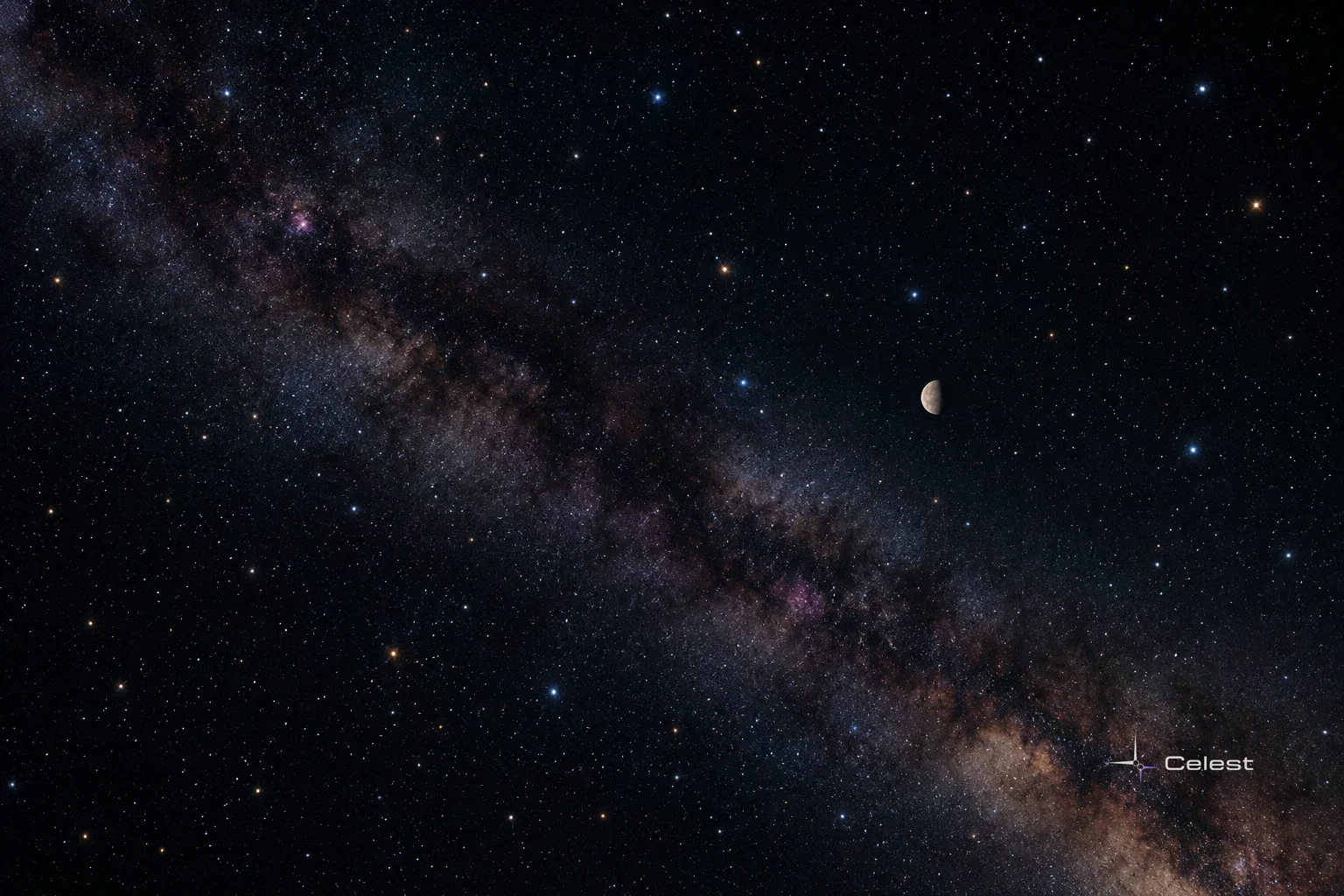
A telescope could reveal its small, partly illuminated disk if the air was steady enough. Celest’s calculation at the reference instant gives about 61% illumination, a little more than half lit. The illustration above is conceptual artwork, not a record of the event or a realistic naked-eye view.
How to watch safely
These precautions apply when planning another favorable evening apparition:
- Check the local view first. Confirm that Mercury will still be above your western horizon after sunset. A geometric elongation date alone does not establish visibility from your site.
- Choose an open horizon. Look for a safe place with a clear view toward the sunset direction. Arrive early enough to check the ground and skyline, while leaving binoculars and telescopes capped.
- Wait for complete sunset. Begin an optical search only after the Sun has fully set for your location, not merely disappeared behind a tree or building. If you cannot confirm that, leave the optics capped and skip the search.
- Use the map’s bearing. After sunset, compare the western skyline with Mercury’s position on a current chart. Look for a point of light rather than the enlarged disk in an illustration.
- Keep the search safe. Never sweep near the Sun with unfiltered optics while it is above the horizon. Accidental solar viewing can cause permanent eye damage.
- Stop when the view is lost. If haze, cloud or the horizon hides the planet, do not try to recover it by searching earlier while the Sun is still up.
If the sky does not cooperate
Check observing conditions before a future session. Cloud and haze near the horizon can hide Mercury even when the rest of the sky looks clear.
A missed evening does not automatically make the following night equally favorable. Mercury’s position, brightness and setting time change; check a fresh chart before trying again. The October 12 date belongs to this archived apparition, not a standing instruction for the rest of October.
Why Mercury never wanders far
An elongation is the angle between the Sun and an inner planet, Mercury or Venus, as seen from Earth. At greatest eastern elongation the planet is an evening object; at greatest western elongation it is a morning object.
The ecliptic is the Sun’s apparent yearly path across the sky, close to which the planets move. Its angle to the evening horizon changes with latitude and season. Northern autumn evenings generally give a shallower angle, while the corresponding southern spring offers a steeper one.
That geometry explains why an elongation can be favorable from one latitude and difficult from another. Celest’s visible planets guide provides the current local view: how high Mercury gets matters just as much as how far it is from the Sun.
Leave a comment
Comments appear after moderation.