Uranus: The Planet That Spins on Its Side
A pale blue-green planet has one of the strangest orientations in the Solar System. Its tilted axis changes how sunlight reaches its poles for decades at a time.

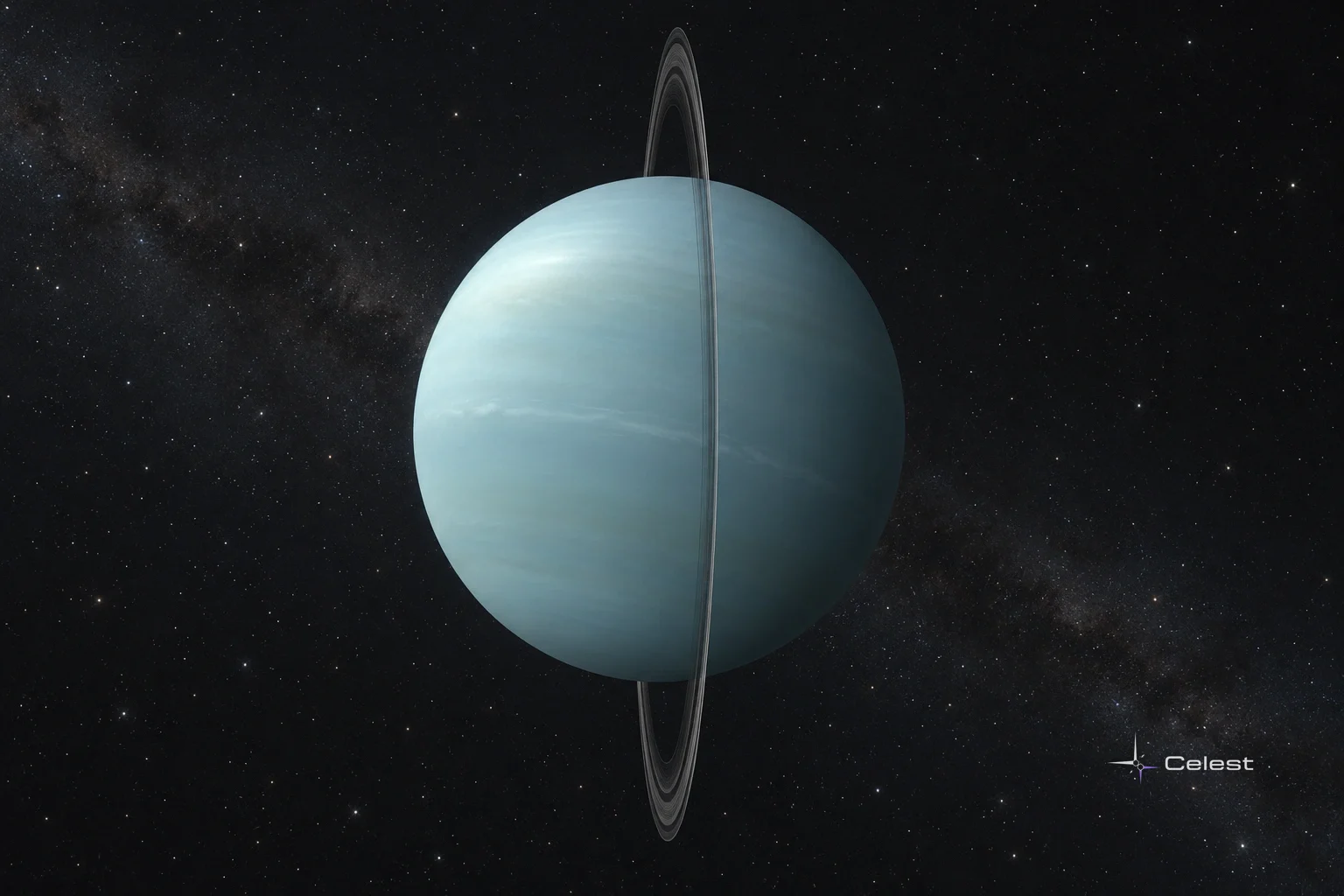
Uranus is a pale blue-green ice giant, seventh in order outward from the Sun. Its rotation axis is tipped so far over that it appears to spin on its side, giving its poles long stretches of sunlight and darkness. A year there lasts about 84 years on Earth.
You can look for it with binoculars or a small telescope, although finding the right point of light takes a current chart. Start with the planet guide for its position, then match the surrounding stars in the live sky map. The challenge is identifying the planet, rather than recognising a large, detailed globe.
Uranus at a glance
These figures describe the planet itself, rather than a particular night's view:
- Type: ice giant, with a deep fluid interior rather than a rocky surface.
- Position: seventh planet outward from the Sun.
- Diameter: about 51,118 km across the equator, roughly four Earth diameters.
- Year: about 84 Earth years for one circuit of the Sun.
- Day: about 17 hours for one rotation.
- Distance: on average about 2.9 billion km from the Sun.
Why its seasons last so long
The planet's axis, the imaginary line through its rotation poles, is tilted by 97.77 degrees relative to the upright direction of its orbit. Uranus still turns around that axis. The difference is where the axis points as the planet travels around the Sun.
For part of that long orbit, one pole faces the Sun while the other points away. The winter pole can remain in darkness for about 21 Earth years. Seasons therefore involve a much larger change in polar sunlight than the familiar yearly cycle on Earth.
An ancient collision with an Earth-sized object may explain the tilt. It is a proposed history, rather than an event anyone has witnessed. Keep that distinction when you see an illustration of a young planet being knocked onto its side.
What makes the planet look blue-green
Methane in the atmosphere absorbs some of the red light arriving from the Sun. More blue and green light returns toward the observer. Hydrogen and helium make up most of the atmosphere; methane does not have to be its largest ingredient to affect the colour.
The term ice giant can be misleading. It refers to a composition rich in substances such as water, ammonia and methane, which astronomers group as planetary ices. It does not mean Uranus is a solid frozen ball you could stand on. Deep inside, the pressures and temperatures are extreme.
A 2024 reanalysis found that Uranus and Neptune are closer in visible colour than many familiar pictures suggest. Both are pale greenish blue, with Neptune slightly bluer. Some older Neptune pictures had their colour and contrast increased to make atmospheric features easier to study.
Rings revealed by missing starlight
In 1977, astronomers watched Uranus pass in front of a distant star. The star's light dipped before and after the planet covered it. Those extra interruptions revealed a system of rings. The method is called a stellar occultation: a nearer object temporarily hides a background star.
Webb later showed the faint rings in infrared light, wavelengths human eyes cannot see. The colours assigned to those infrared filters help display the data. They should not be read as a prediction of what binoculars will show you.
How to see it
Choose a night using the observing conditions, then use the map for that date and your location. A finder chart from an old planetary alignment can place you in the wrong patch of sky. Uranus moves against the background stars as it follows its orbit.
Binoculars or a small telescope make the faint planet easier to detect. In exceptionally dark conditions it can be just within unaided-eye reach, but do not make that your first test. Identify it with optics and the nearby stars before trying without them. The rings and detailed cloud patterns in professional images are a different observing challenge.
What remains hidden inside?
Voyager 2 passed Uranus on 24 January 1986, and remains its only spacecraft visitor. Much of the close-up evidence came from that brief encounter; telescopes continue to add measurements from afar.
The smooth-looking globe still leaves questions about its deep interior and unusual tilt. A quiet appearance in visible light need not mean a simple planet. Changing the wavelength already reveals structures that the first close-up pictures could barely show.
Leave a comment
Comments appear after moderation.