Mercury: The Small Planet With Ice Near the Sun
The innermost planet combines a heavily cratered exterior with an active metallic interior. Its polar shadows show why distance from the Sun alone cannot describe the conditions across a whole world.

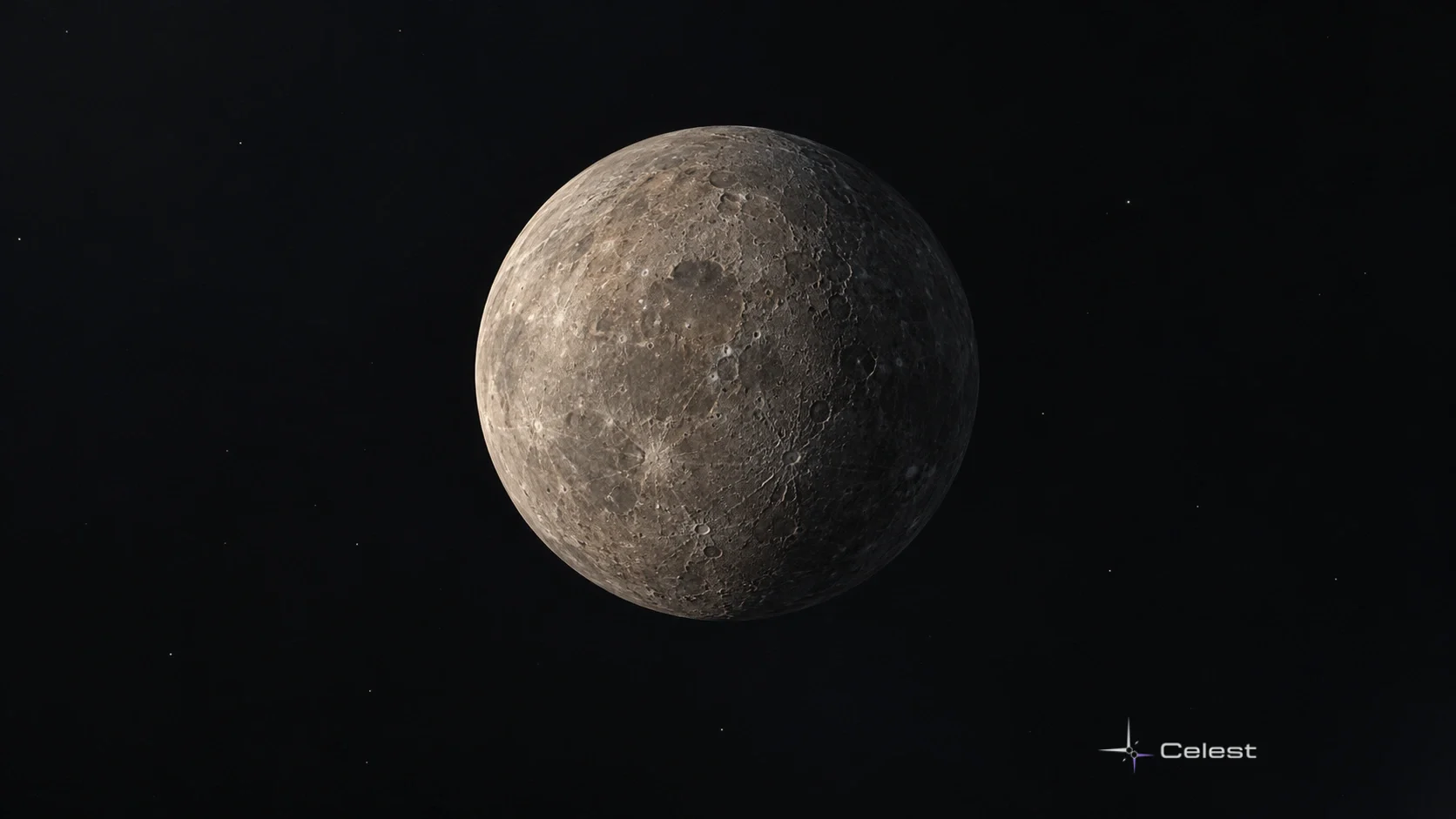
Mercury is the Solar System’s smallest planet and the closest to the Sun, yet it preserves water ice in some permanently shaded polar craters. Its sunlit ground and sheltered shadows experience very different conditions. Compare its place among the rocky worlds in the planet guide.
Mercury is also a practical observing challenge: from Earth, it stays near the Sun’s direction. Use the live sky map to check its position for your evening or morning, rather than treating any old twilight photograph as a current finder chart.
Mercury at a Glance
These rounded figures describe the planet and its orbit, not its changing distance from Earth.
- Type: a small rocky planet with a metallic interior.
- Size: about 4,880 kilometres (3,032 miles) across.
- Average Sun distance: about 58 million kilometres (36 million miles), or 0.4 astronomical units.
- Year: approximately 88 Earth days.
- Solar day: a full daylight-and-night cycle lasts about 176 Earth days.
- Companions: no natural moons and no rings.
Ice Survives Where Sunlight Never Reaches
In 2012, MESSENGER measurements supported water ice as the main ingredient of Mercury’s north-polar deposits. The coldest deposits expose ice at the surface. In somewhat warmer deposits, dark material covers ice preserved below it.
The shelter comes from deep craters near the poles. Mercury’s small axial tilt allows some crater interiors to remain in shadow throughout the year. A polar depression can therefore escape the heating experienced by the nearby sunlit terrain.
This is a collection of cold traps, not a broad ice cap resembling Earth’s. Finding frozen water there also does not demonstrate a liquid ocean or living organisms. The important result is that local illumination can make one part of a planet very different from another.
Mercury has no thick insulating atmosphere. Its sparse exosphere is made of atoms released from the surface, including material struck by the solar wind, a flow of particles from the Sun. That thin population of atoms cannot act like a dense atmospheric blanket.
Sunlit surface temperatures can reach 430°C (800°F), while nighttime ground can fall to −180°C (−290°F). Those are extremes, not a single temperature for the entire planet. Venus remains hotter overall because its dense atmosphere changes how heat is retained.
A Full Solar Day Lasts Two Mercury Years
Mercury turns once on its axis in about 59 Earth days. A complete solar day takes roughly three times that long: about 176 Earth days, or two Mercury years. A rotation and a sunrise cycle answer different questions.
While the planet turns, it also moves around the Sun. The direction toward the Sun changes during that orbit, so returning to the same orientation in space does not yet restore the same solar position above the surface.
Keep this distinction when comparing planetary days. The 59-day figure describes Mercury’s rotation relative to the stars. The 176-day figure describes its complete daylight-and-night cycle. Neither means that its year has changed from approximately 88 Earth days.
Craters Cover a World With an Active Interior
Mercury’s exterior resembles the Moon’s in its many impact craters. Large basins such as Caloris record especially substantial collisions, while smoother terrain interrupts the cratered landscape. A rocky crust surrounds the mantle, the layer between that crust and the metallic core.
Bright streaks around some craters are rays of material thrown outward by impacts. Fine fragments reflect more light than larger pieces. Their brightness fades as dust impacts and solar-wind particles alter the exposed material, so the surface preserves more than crater outlines alone.
The core occupies a large share of Mercury’s interior. Liquid metal in its outer region is associated with the planet’s weak magnetic field. A 2019 analysis of MESSENGER’s measurements also supported a solid inner core.
Researchers inferred that structure by comparing Mercury’s rotation and the spacecraft’s changing motion under gravity with models of the interior. No camera looked through the crust. The evidence comes from how mass affects measurable motion.
MESSENGER studied Mercury from orbit for about four years after arriving in 2011. Its mission ended with an impact in April 2015, but the stored measurements remain available for investigations that combine surface images with gravity and magnetic information.
How to Find Mercury in Twilight
Mercury’s orbit lies inside Earth’s. As a result, it appears near the Sun in the morning or evening sky, rather than opposite the Sun throughout a long night. Its apparent separation from the Sun is called elongation.
A greatest elongation gives the widest apparent separation during that viewing period. It does not mean Mercury is physically farthest from the Sun. Choose a current opportunity on the map, then check the observing conditions for the date and the relevant eastern or western view.
Start by identifying the point with unaided eyes in twilight. An evening opportunity puts Mercury toward the western horizon after sunset; a morning opportunity places it toward the eastern horizon before sunrise. The available window changes with the date and your location.
For a beginner, keep the Sun below the horizon and never sweep binoculars or a telescope near it. Concentrated sunlight can cause immediate eye injury. Mercury’s phases, the changing fraction of its illuminated face, are an optical observing task; recognising its point of light is a useful first success.
Small Depressions Leave a Larger Question
MESSENGER found bright, shallow hollows that do not fit the familiar pattern of impact craters. Their irregular shapes suggest material has disappeared from the surface. One explanation proposes that previously buried material becomes unstable when exposed to solar heating and the space environment.
The exact formation process remains unresolved. These features leave a specific question about Mercury’s evolution: which materials are escaping, and how do they keep changing an apparently old, crater-covered surface?
Leave a comment
Comments appear after moderation.